Clinical Research (Neurosciences), KEMRI-Wellcome Trust Research Programme, Centre for Geographic Medicine Research (Coast), Box, Kilifi, PO Box 230-80108, Kenya.
Health Economics Research Unit, KEMRI-Wellcome Trust Research Programme, Centre for Geographic Medicine Research (Coast), Kilifi, Kenya.
BMC Public Health. 2020 Apr 16;20(1):504. doi: 10.1186/s12889-020-8435-0.
Eighty per cent of perinatally HIV infected (PHI) adolescents live in sub-Saharan Africa (sSA), a setting also characterized by huge economic disparities. Caregiving is crucial to the management of chronic illness such as HIV/AIDS, but the economic costs and mental disorders borne by caregivers of PHI adolescents often go unnoticed. In this study, we evaluated economic costs, coping strategies and association between economic cost and mental health functioning of caregivers of perinatally HIV infected adolescents in Kilifi, Kenya.
We used a cost of illness descriptive analysis approach to determine the economic burden and Patient Health Questionnaire (PHQ-9) to assess the caregivers' mental health. Cross-sectional data were collected from 121 primary caregivers of PHI adolescents in Kilifi using a structured cost questionnaire. Economic costs (direct and indirect costs) were measured from primary caregivers' perspective. We used descriptive statistics in reporting the results of this study.
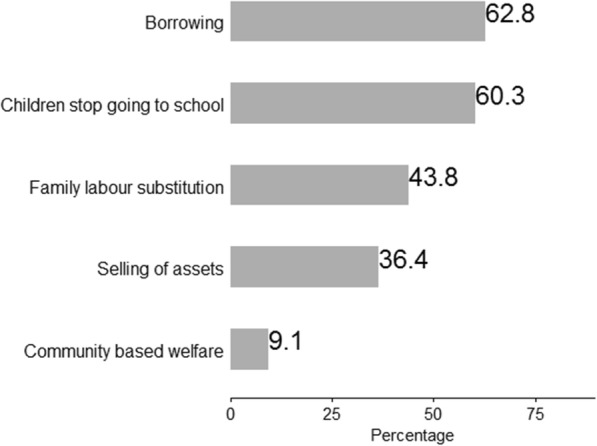
Average monthly direct and indirect costs per primary caregiver was Ksh 2784.51 (USD 27.85). Key drivers of direct costs were transportation (66.5%) and medications (13.8%). Total monthly costs represented 28.8% of the reported caregiver monthly earnings. Majority of the caregivers borrowed resources to cope with high economic burden. About 10.7% of primary caregivers reported depressive symptoms. Caregivers with positive depression screen (PHQ-9 score ≥ 10) had high average monthly direct and indirect costs. However, this was not statistically different compared to costs incurred by caregivers who screened negative for depressive symptoms.
Our study indicates that HIV/AIDS is associated with a significant economic burden for caregivers of adolescents living with HIV. Results underscore the need for developing economic empowerment and social support programmes that reduce the economic burden of caring for perinatally infected adolescent. These efforts may improve the mental health and quality of life of caregivers of adolescents living with HIV.
80%的围产期感染艾滋病毒(PHI)的青少年生活在撒哈拉以南非洲(sSA),这一地区还存在巨大的经济差距。照顾者在管理慢性疾病(如艾滋病毒/艾滋病)方面至关重要,但 PHI 青少年照顾者的经济成本和精神障碍往往被忽视。在这项研究中,我们评估了肯尼亚基利菲 PHI 青少年照顾者的经济成本、应对策略以及经济成本与心理健康功能之间的关系。
我们使用疾病成本描述性分析方法来确定经济负担,并使用患者健康问卷(PHQ-9)评估照顾者的心理健康。我们使用结构化成本问卷从基利菲的 121 名 PHI 青少年的主要照顾者那里收集了横断面数据。从主要照顾者的角度衡量经济成本(直接成本和间接成本)。我们使用描述性统计来报告这项研究的结果。
每位主要照顾者的平均月直接和间接成本为 2784.51 肯尼亚先令(27.85 美元)。直接成本的主要驱动因素是交通(66.5%)和药物(13.8%)。每月总费用占报告的照顾者月收入的 28.8%。大多数照顾者为了应对高昂的经济负担而借贷资源。约 10.7%的主要照顾者报告有抑郁症状。有阳性抑郁筛查(PHQ-9 评分≥10)的照顾者的月直接和间接成本较高。然而,与抑郁症状筛查阴性的照顾者相比,这一成本没有统计学差异。
我们的研究表明,艾滋病毒/艾滋病给感染艾滋病毒的青少年的照顾者带来了巨大的经济负担。研究结果强调需要制定经济赋权和社会支持计划,以减轻照顾围产期感染青少年的经济负担。这些努力可能会改善感染艾滋病毒的青少年照顾者的心理健康和生活质量。