• 文献检索
  • 文档翻译
  • 深度研究
  • 学术资讯
  • Suppr Zotero 插件Zotero 插件
  • 邀请有礼
  • 套餐&价格
  • 历史记录
应用&插件
Suppr Zotero 插件Zotero 插件浏览器插件Mac 客户端Windows 客户端微信小程序
定价
高级版会员购买积分包购买API积分包
服务
文献检索文档翻译深度研究API 文档MCP 服务
关于我们
关于 Suppr公司介绍联系我们用户协议隐私条款
关注我们

Suppr 超能文献

核心技术专利:CN118964589B侵权必究
粤ICP备2023148730 号-1Suppr @ 2026

文献检索

告别复杂PubMed语法,用中文像聊天一样搜索,搜遍4000万医学文献。AI智能推荐,让科研检索更轻松。

立即免费搜索

文件翻译

保留排版,准确专业,支持PDF/Word/PPT等文件格式,支持 12+语言互译。

免费翻译文档

深度研究

AI帮你快速写综述,25分钟生成高质量综述,智能提取关键信息,辅助科研写作。

立即免费体验

生存与死亡皆为被统计之事:我们对全球青少年艾滋病毒流行情况的了解。

Living and dying to be counted: What we know about the epidemiology of the global adolescent HIV epidemic.

作者信息

Slogrove Amy L, Mahy Mary, Armstrong Alice, Davies Mary-Ann

机构信息

Centre for Infectious Disease Epidemiology and Research, School of Public Health and Family Medicine, Faculty of Health Sciences, University of Cape Town, Cape Town, South Africa.

Strategic Information and Monitoring Division, UNAIDS, Geneva, Switzerland.

出版信息

J Int AIDS Soc. 2017 May 16;20(Suppl 3):21520. doi: 10.7448/IAS.20.4.21520.

DOI:10.7448/IAS.20.4.21520
PMID:28530036
原文链接:https://pmc.ncbi.nlm.nih.gov/articles/PMC5719718/
Abstract

INTRODUCTION

With increasing survival of vertically HIV-infected children and ongoing new horizontal HIV infections, the population of adolescents (age 10-19 years) living with HIV is increasing. This review aims to describe the epidemiology of the adolescent HIV epidemic and the ability of national monitoring systems to measure outcomes in HIV-infected adolescents through the adolescent transition to adulthood.

METHODS

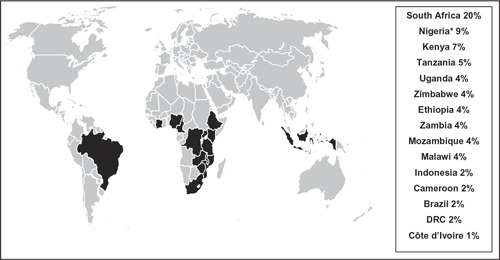
Differences in global trends between younger (age 10-14 years) and older (age 15-19 years) adolescents in key epidemic indicators are interrogated using 2016 UNAIDS estimates. National population-based survey data in the 15 highest adolescent HIV burden countries are evaluated and examples of national case-based surveillance systems described. Finally, we consider the potential impact of adolescent-specific recommendations in the 2016 WHO Consolidated Guidelines on the Use of Antiretroviral Drugs for Treating and Preventing HIV Infection.

DISCUSSION

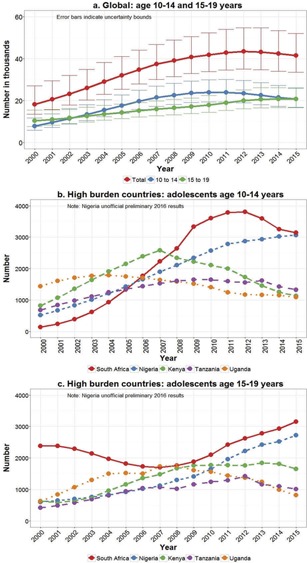
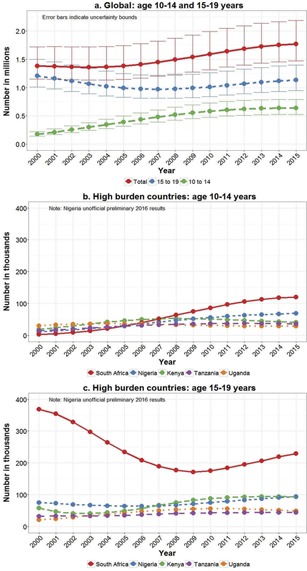
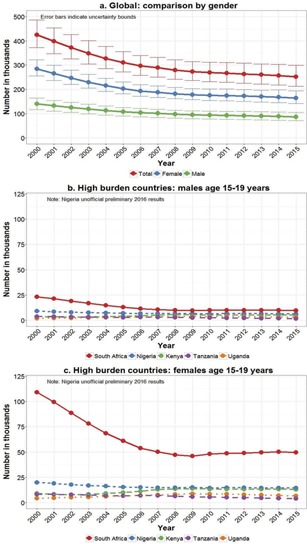
UNAIDS estimates indicate the population of adolescents living with HIV is increasing, new HIV infections in older adolescents are declining, and while AIDS-related deaths are beginning to decline in younger adolescents, they are still increasing in older adolescents. National population-based surveys provide valuable estimates of HIV prevalence in older adolescents and recent surveys include data on younger adolescents. Only a few countries have nationwide electronic case-based HIV surveillance, with the ability to provide population-level data on key HIV outcomes in the diagnosed population living with HIV. However, in the 15 highest adolescent HIV burden countries, there are no systems tracking adolescent transition to adulthood or healthcare transition. The strength of the 2016 WHO adolescent-specific recommendations on antiretroviral therapy and provision of HIV services to adolescents was hampered by the lack of evidence specific to this age group.

CONCLUSIONS

Progress is being made in national surveillance and global monitoring systems to specifically identify trends in adolescents living with HIV. However, HIV programmes responsive to the evolving HIV prevention and treatment needs of adolescents can be facilitated further by: data disaggregation to younger and older adolescents and mode of HIV infection where feasible; implementation of tools to achieve expanded national case-based surveillance; streamlining consent/assent procedures in younger adolescents and consensus on indicators of adolescent healthcare transition and transition to adulthood.

摘要

引言

随着垂直感染艾滋病毒儿童存活率的提高以及新的水平传播艾滋病毒感染的持续发生,感染艾滋病毒的青少年(10至19岁)人数正在增加。本综述旨在描述青少年艾滋病毒流行的流行病学情况,以及国家监测系统在衡量艾滋病毒感染青少年从青少年期过渡到成年期的结果方面的能力。

方法

利用2016年联合国艾滋病规划署的估计数据,对关键流行指标方面较年轻青少年(10至14岁)和较年长青少年(15至19岁)之间的全球趋势差异进行了研究。对15个青少年艾滋病毒负担最重国家基于全国人口的调查数据进行了评估,并介绍了国家个案监测系统的实例。最后,我们考虑了2016年世界卫生组织《关于使用抗逆转录病毒药物治疗和预防艾滋病毒感染的综合指南》中针对青少年的建议可能产生的影响。

讨论

联合国艾滋病规划署的估计表明,感染艾滋病毒的青少年人数正在增加,较年长青少年中的新艾滋病毒感染病例正在减少,虽然较年轻青少年中与艾滋病相关的死亡人数开始下降,但较年长青少年中的此类死亡人数仍在增加。基于全国人口的调查提供了较年长青少年艾滋病毒流行率的宝贵估计数据,最近的调查还包括了较年轻青少年的数据。只有少数国家拥有全国性的基于电子病例的艾滋病毒监测系统,能够提供感染艾滋病毒确诊人群关键艾滋病毒结果的人群水平数据。然而,在15个青少年艾滋病毒负担最重的国家,没有跟踪青少年向成年期过渡或医疗保健过渡的系统。2016年世界卫生组织关于抗逆转录病毒疗法和为青少年提供艾滋病毒服务的针对青少年的建议,因缺乏该年龄组的具体证据而受到阻碍。

结论

国家监测和全球监测系统在具体确定感染艾滋病毒青少年的趋势方面正在取得进展。然而,通过以下方式可进一步推动满足青少年不断变化的艾滋病毒预防和治疗需求的艾滋病毒项目:在可行的情况下按较年轻和较年长青少年以及艾滋病毒感染方式进行数据分类;实施工具以实现扩大的国家个案监测;简化较年轻青少年的同意/赞成程序,并就青少年医疗保健过渡和向成年期过渡的指标达成共识。
https://cdn.ncbi.nlm.nih.gov/pmc/blobs/b9fa/5719718/20359b3e6278/JIA2-20-21520-g004.jpg
https://cdn.ncbi.nlm.nih.gov/pmc/blobs/b9fa/5719718/919bd9722ef6/JIA2-20-21520-g001.jpg
https://cdn.ncbi.nlm.nih.gov/pmc/blobs/b9fa/5719718/2999a703c382/JIA2-20-21520-g002.jpg
https://cdn.ncbi.nlm.nih.gov/pmc/blobs/b9fa/5719718/fbef763c48b2/JIA2-20-21520-g003.jpg
https://cdn.ncbi.nlm.nih.gov/pmc/blobs/b9fa/5719718/20359b3e6278/JIA2-20-21520-g004.jpg
https://cdn.ncbi.nlm.nih.gov/pmc/blobs/b9fa/5719718/919bd9722ef6/JIA2-20-21520-g001.jpg
https://cdn.ncbi.nlm.nih.gov/pmc/blobs/b9fa/5719718/2999a703c382/JIA2-20-21520-g002.jpg
https://cdn.ncbi.nlm.nih.gov/pmc/blobs/b9fa/5719718/fbef763c48b2/JIA2-20-21520-g003.jpg
https://cdn.ncbi.nlm.nih.gov/pmc/blobs/b9fa/5719718/20359b3e6278/JIA2-20-21520-g004.jpg

相似文献

1
Living and dying to be counted: What we know about the epidemiology of the global adolescent HIV epidemic.生存与死亡皆为被统计之事:我们对全球青少年艾滋病毒流行情况的了解。
J Int AIDS Soc. 2017 May 16;20(Suppl 3):21520. doi: 10.7448/IAS.20.4.21520.
2
CDC National Health Report: leading causes of morbidity and mortality and associated behavioral risk and protective factors--United States, 2005-2013.美国疾病控制与预防中心国家健康报告:2005 - 2013年美国发病和死亡的主要原因以及相关行为风险和保护因素
MMWR Suppl. 2014 Oct 31;63(4):3-27.
3
Transition from paediatric to adult care of adolescents living with HIV in sub-Saharan Africa: challenges, youth-friendly models, and outcomes.撒哈拉以南非洲地区感染艾滋病毒青少年从儿科护理向成人护理的过渡:挑战、青少年友好型模式及成果
J Int AIDS Soc. 2017 May 16;20(Suppl 3):21528. doi: 10.7448/IAS.20.4.21528.
4
Adolescents with HIV and transition to adult care in the Caribbean, Central America and South America, Eastern Europe and Asia and Pacific regions.加勒比地区、中美洲和南美洲、东欧以及亚太地区的青少年艾滋病毒感染者及向成人护理的过渡情况。
J Int AIDS Soc. 2017 May 16;20(Suppl 3):21475. doi: 10.7448/IAS.20.4.21475.
5
The global epidemiology of adolescents living with HIV: time for more granular data to improve adolescent health outcomes.全球青少年艾滋病感染者流行病学:需要更详细的数据来改善青少年健康结局。
Curr Opin HIV AIDS. 2018 May;13(3):170-178. doi: 10.1097/COH.0000000000000449.
6
The changing epidemiology of the global paediatric HIV epidemic: keeping track of perinatally HIV-infected adolescents.全球儿科艾滋病流行的变化流行病学:追踪围产期感染艾滋病毒的青少年。
J Int AIDS Soc. 2013 Jun 18;16(1):18555. doi: 10.7448/IAS.16.1.18555.
7
Contemporary issues on the epidemiology and antiretroviral adherence of HIV-infected adolescents in sub-Saharan Africa: a narrative review.撒哈拉以南非洲地区感染艾滋病毒青少年的流行病学和抗逆转录病毒药物依从性的当代问题:一项叙述性综述。
J Int AIDS Soc. 2015 Sep 16;18(1):20049. doi: 10.7448/IAS.18.1.20049. eCollection 2015.
8
Updates to the spectrum model to estimate key HIV indicators for adults and children.用于估计成人和儿童关键艾滋病毒指标的频谱模型更新。
AIDS. 2014 Nov;28 Suppl 4(4):S427-34. doi: 10.1097/QAD.0000000000000483.
9
Demographic change and HIV epidemic projections to 2050 for adolescents and young people aged 15-24.人口变化和艾滋病毒疫情预测到 2050 年,针对的是 15-24 岁的青少年和年轻人。
Glob Health Action. 2019;12(1):1662685. doi: 10.1080/16549716.2019.1662685.
10
Epidemiology of HIV and AIDS among adolescents: current status, inequities, and data gaps.青少年中的艾滋病毒和艾滋病流行病学:现状、不平等和数据差距。
J Acquir Immune Defic Syndr. 2014 Jul 1;66 Suppl 2:S144-53. doi: 10.1097/QAI.0000000000000176.

引用本文的文献

1
Suicide assessment and feasible evidence-based treatments for adolescents living with HIV in Malawi: Protocol for a pilot randomized controlled trial.马拉维感染艾滋病毒青少年的自杀评估及可行的循证治疗:一项试点随机对照试验方案
PLoS One. 2025 Sep 3;20(9):e0330847. doi: 10.1371/journal.pone.0330847. eCollection 2025.
2
Prevalence and factors associated with mental health challenges among adolescents with HIV and viral non-suppression in rural northern Uganda.乌干达北部农村地区感染艾滋病毒且病毒未得到抑制的青少年心理健康问题的患病率及相关因素
Front Public Health. 2025 Jun 20;13:1568575. doi: 10.3389/fpubh.2025.1568575. eCollection 2025.
3

本文引用的文献

1
Improving estimates of children living with HIV from the Spectrum AIDS Impact Model.利用频谱艾滋病影响模型改进对感染艾滋病毒儿童数量的估计。
AIDS. 2017 Apr;31 Suppl 1(Suppl 1):S13-S22. doi: 10.1097/QAD.0000000000001306.
2
Higher rates of triple-class virological failure in perinatally HIV-infected teenagers compared with heterosexually infected young adults in Europe.与欧洲异性传播感染的年轻成年人相比,围产期感染艾滋病毒的青少年出现三重病毒学失败的比例更高。
HIV Med. 2017 Mar;18(3):171-180. doi: 10.1111/hiv.12411. Epub 2016 Sep 14.
3
Health outcomes and the transition experience of HIV-infected adolescents after transfer to adult care in Québec, Canada.
Age-specific all-cause mortality rates among adolescents and youth living with and without HIV: Evidence from a cohort study in South Africa.
感染与未感染艾滋病毒的青少年和青年的特定年龄全因死亡率:来自南非一项队列研究的证据。
J Int AIDS Soc. 2025 Jun;28(6):e26522. doi: 10.1002/jia2.26522.
4
Factor Structure, Reliability, and Validity of the 10-Item HIV Stigma Scale for Adolescents and Youth Living with HIV in Rural, Southwestern Uganda.乌干达西南部农村地区感染艾滋病毒的青少年和青年的10项艾滋病毒耻辱感量表的因子结构、信度和效度
AIDS Behav. 2025 Jun 3. doi: 10.1007/s10461-025-04781-0.
5
Treatment outcomes among young persons living with HIV who transitioned to adult care in southern Nigeria: A retrospective cohort study.尼日利亚南部从儿童期过渡到成人期接受治疗的艾滋病毒感染者的治疗结果:一项回顾性队列研究。
PLoS One. 2025 May 12;20(5):e0321962. doi: 10.1371/journal.pone.0321962. eCollection 2025.
6
Sustainability of an evidence-based intervention supporting transition to independent care for youth living with HIV in Kenya.肯尼亚一项支持感染艾滋病毒青年向独立护理过渡的循证干预措施的可持续性。
PLOS Glob Public Health. 2025 Jan 13;5(1):e0004111. doi: 10.1371/journal.pgph.0004111. eCollection 2025.
7
Prevalence of chronic kidney disease among young people living with HIV in Sub Saharan Africa: A systematic review and meta-analysis.撒哈拉以南非洲地区 HIV 感染者中慢性肾脏病的患病率:系统评价和荟萃分析。
PLoS One. 2024 Nov 4;19(11):e0301954. doi: 10.1371/journal.pone.0301954. eCollection 2024.
8
Barriers and facilitators of transition of adolescents living with HIV into adult care in under-resourced settings of Southern Ethiopia: a qualitative study.资源匮乏的埃塞俄比亚南部,青少年艾滋病患者转入成人关怀的阻碍因素和促进因素:一项定性研究。
BMC Public Health. 2024 Oct 14;24(1):2800. doi: 10.1186/s12889-024-20338-7.
9
Empowering adolescents living with perinatally-acquired HIV: tailored CD4+ count assessment for optimized care, the EDCTP READY-study.增强围产期感染艾滋病毒青少年的能力:为优化治疗量身定制的CD4+细胞计数评估,即EDCTP READY研究。
Front Med (Lausanne). 2024 Sep 20;11:1457501. doi: 10.3389/fmed.2024.1457501. eCollection 2024.
10
Mixed Methods Evaluation of a Youth-Friendly Clinic for Young People Living with HIV Transitioning from Pediatric Care.对一家为从儿科护理过渡过来的感染艾滋病毒青少年提供服务的青年友好型诊所的混合方法评估。
Trop Med Infect Dis. 2024 Aug 28;9(9):198. doi: 10.3390/tropicalmed9090198.
加拿大魁北克省感染艾滋病毒的青少年转至成人护理后的健康状况及过渡经历。
BMC Pediatr. 2016 Jul 26;16:109. doi: 10.1186/s12887-016-0644-4.
4
Interventions to improve treatment, retention and survival outcomes for adolescents with perinatal HIV-1 transitioning to adult care: moving on up.改善围产期感染HIV-1的青少年向成人护理过渡期间的治疗、留存率和生存结果的干预措施:向上迈进。
Curr Opin HIV AIDS. 2016 Sep;11(5):477-486. doi: 10.1097/COH.0000000000000302.
5
Our future: a Lancet commission on adolescent health and wellbeing.我们的未来:《柳叶刀》青少年健康与福祉委员会
Lancet. 2016 Jun 11;387(10036):2423-78. doi: 10.1016/S0140-6736(16)00579-1. Epub 2016 May 9.
6
High rates of virological failure and drug resistance in perinatally HIV-1-infected children and adolescents receiving lifelong antiretroviral therapy in routine clinics in Togo.在多哥的常规诊所中,接受终身抗逆转录病毒治疗的围产期感染HIV-1的儿童和青少年中,病毒学失败率和耐药率很高。
J Int AIDS Soc. 2016 Apr 27;19(1):20683. doi: 10.7448/IAS.19.1.20683. eCollection 2016.
7
Global and National Burden of Diseases and Injuries Among Children and Adolescents Between 1990 and 2013: Findings From the Global Burden of Disease 2013 Study.1990年至2013年间全球及各国儿童和青少年的疾病与伤害负担:全球疾病负担研究2013的结果
JAMA Pediatr. 2016 Mar;170(3):267-87. doi: 10.1001/jamapediatrics.2015.4276.
8
Linkage to and retention in care following healthcare transition from pediatric to adult HIV care.从儿科转至成人HIV护理后的护理联系与持续接受护理情况。
AIDS Care. 2016;28(5):561-5. doi: 10.1080/09540121.2015.1131967. Epub 2016 Jan 13.
9
Service delivery interventions to improve adolescents' linkage, retention and adherence to antiretroviral therapy and HIV care.旨在改善青少年与抗逆转录病毒疗法及艾滋病护理的联系、留存率和依从性的服务提供干预措施。
Trop Med Int Health. 2015 Aug;20(8):1015-32. doi: 10.1111/tmi.12517. Epub 2015 May 13.
10
Building our youth for the future.为未来培养我们的青年一代。
J Int AIDS Soc. 2015 Feb 26;18(2 Suppl 1):20027. doi: 10.7448/IAS.18.2.20027. eCollection 2015.