Laboratory of Immunopharmacology, Oswaldo Cruz Foundation, Av. Brasil, 4365, Manguinhos, Rio de Janeiro, 21040-900, Brazil.
Laboratory of Cardiovascular Investigation, Oswaldo Cruz Foundation, Rio de Janeiro, Brazil.
J Neuroinflammation. 2020 Apr 16;17(1):117. doi: 10.1186/s12974-020-01771-y.
Brain circulation disorders such as chronic cerebral hypoperfusion have been associated with a decline in cognitive function during the development of dementia. Astrocytes together with microglia participate in the immune response in the CNS and make them potential sentinels in the brain parenchyma. In addition, astrocytes coverage integrity has been related to brain homeostasis. Currently, physical exercise has been proposed as an effective intervention to promote brain function improvement. However, the neuroprotective effects of early physical exercise on the astrocyte communication with the microcirculation and the microglial activation in a chronic cerebral hypoperfusion model are still unclear. The aim of this study was to investigate the impact of early intervention with physical exercise on cognition, brain microcirculatory, and inflammatory parameters in an experimental model of chronic cerebral hypoperfusion induced by permanent bilateral occlusion of the common carotid arteries (2VO).
Wistar rats aged 12 weeks were randomly divided into four groups: Sham-sedentary group (Sham-Sed), Sham-exercised group (Sham-Ex), 2VO-sedentary group (2VO-Sed), and 2VO-exercised group (2VO-Ex). The early intervention with physical exercise started 3 days after 2VO or Sham surgery during 12 weeks. Then, the brain functional capillary density and endothelial-leukocyte interactions were evaluated by intravital microscopy; cognitive function was evaluated by open-field test; hippocampus postsynaptic density protein 95 and synaptophysin were evaluated by western blotting; astrocytic coverage of the capillaries, microglial activation, and structural capillary density were evaluated by immunohistochemistry.
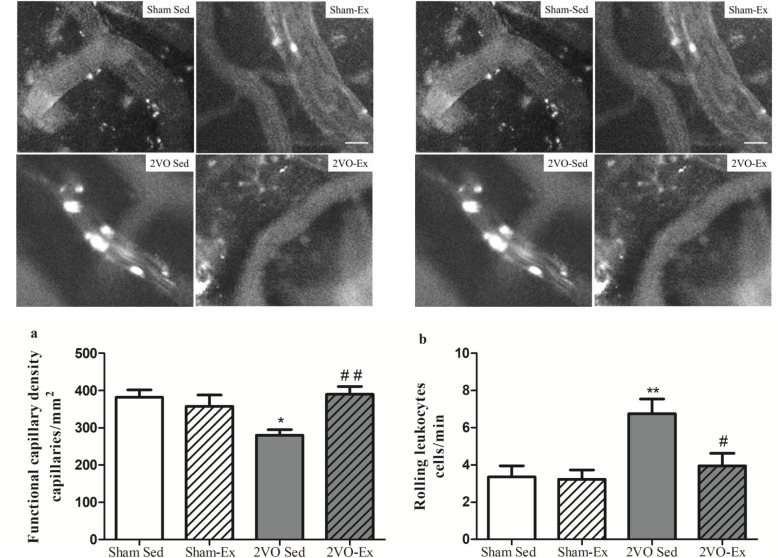
Early moderate physical exercise was able to normalize functional capillary density and reduce leukocyte rolling in the brain of animals with chronic cerebral hypoperfusion. These effects were accompanied by restore synaptic protein and the improvement of cognitive function. In addition, early moderate exercise improves astrocytes coverage in blood vessels of the cerebral cortex and hippocampus, decreases microglial activation in the hippocampus, and improves structural capillaries in the hippocampus.
Microcirculatory and inflammatory changes in the brain appear to be involved in triggering a cognitive decline in animals with chronic cerebral ischemia. Therefore, early intervention with physical exercise may represent a preventive approach to neurodegeneration caused by chronic cerebral hypoperfusion.
慢性脑灌注不足等脑循环障碍与痴呆发展过程中认知功能下降有关。星形胶质细胞与小胶质细胞一起参与中枢神经系统的免疫反应,使它们成为脑实质中的潜在哨兵。此外,星形胶质细胞覆盖完整性与脑内稳态有关。目前,体育锻炼已被提议作为一种有效干预措施,以促进大脑功能的改善。然而,早期体育锻炼对慢性脑灌注不足模型中星形胶质细胞与微循环的通讯以及小胶质细胞激活的神经保护作用仍不清楚。本研究旨在探讨早期干预性体育锻炼对永久性双侧颈总动脉闭塞(2VO)诱导的慢性脑灌注不足模型大鼠认知、脑微循环和炎症参数的影响。
12 周龄 Wistar 大鼠随机分为四组:假手术安静组(Sham-Sed)、假手术运动组(Sham-Ex)、2VO 安静组(2VO-Sed)和 2VO 运动组(2VO-Ex)。2VO 或 Sham 手术后 3 天开始早期干预性体育锻炼,持续 12 周。然后,通过活体显微镜评估脑功能毛细血管密度和内皮白细胞相互作用;通过旷场试验评估认知功能;通过 Western blot 评估海马突触后密度蛋白 95 和突触小体蛋白;通过免疫组织化学评估星形胶质细胞对毛细血管的覆盖、小胶质细胞激活和结构毛细血管密度。
早期适度的体育锻炼能够使慢性脑灌注不足动物的功能毛细血管密度正常化,并减少脑中白细胞滚动。这些作用伴随着突触蛋白的恢复和认知功能的改善。此外,早期适度运动改善大脑皮质和海马血管中的星形胶质细胞覆盖,减少海马中的小胶质细胞激活,并改善海马中的结构毛细血管。
大脑中的微循环和炎症变化似乎参与了慢性脑缺血动物认知能力下降的触发。因此,早期干预性体育锻炼可能是预防慢性脑灌注不足引起的神经退行性变的一种方法。