Department of Human Anatomy, Histology and Embryology & K. K. Leung Brain Research Centre, Preclinical School of Medicine, The Fourth Military Medical University, Xi'an, 710032, China.
Student Brigade, Preclinical School of Medicine, The Fourth Military Medical University, Xi'an, 710032, China.
J Neuroinflammation. 2020 Apr 16;17(1):118. doi: 10.1186/s12974-020-01767-8.
Neuropathic pain is a debilitating status that is insusceptible to the existing analgesics. It is important to explore the underlying pathophysiological changes and search for new pharmacological approaches. Transient receptor potential canonical 6 (TRPC6) is a mechanosensitive channel that is expressed by dorsal root ganglia and glial cells. It has been demonstrated that this channel in dorsal root ganglia plays essential roles in the formation of mechanical hyperalgesia in neuropathic pain. Recent pharmacological screening suggests that larixyl acetate (LA), a main constituent of larch resin, is able to selectively inhibit TRPC6 function. But whether LA is effective in treating neuropathic pain remains unknown. We investigated the efficacy of LA in rat neuropathic pain model, examined its effects on central neuroinflammation, and explored the possible molecular mechanisms by targeting the spinal dorsal horn.
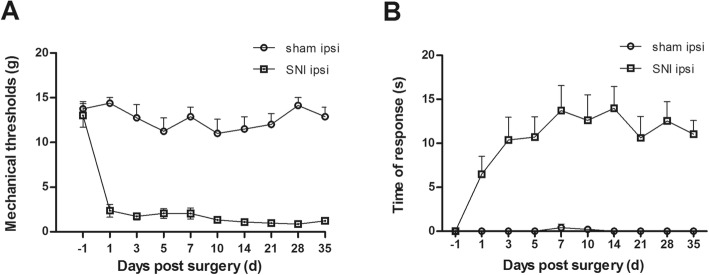
Spared nerve injury (SNI) was conducted in Sprague-Dawley rats. Mechanical hypersensitivity and cold allodynia before and after single and multiple i.t. applications of LA at the dose of 3, 10, and 30 μM were evaluated by von Frey filament and acetone tests, respectively. Western blot, immunohistochemical, and immunocytochemical stainings were employed to examine the level and expression feature of ionized calcium-binding adaptor molecule 1 (Iba-1), glial fibrillary acidic protein (GFAP), TRPC6, and phosphorylated p38 kinase. The changes of cytokine concentrations, including that of TNF-α, IL-1β, IL-6, and IL-10, were also assessed by multiplex analysis. TRPC6 antisense strategy was finally adopted to investigate the action mechanisms of LA.
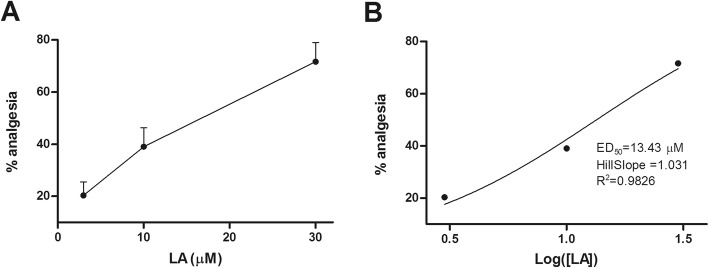
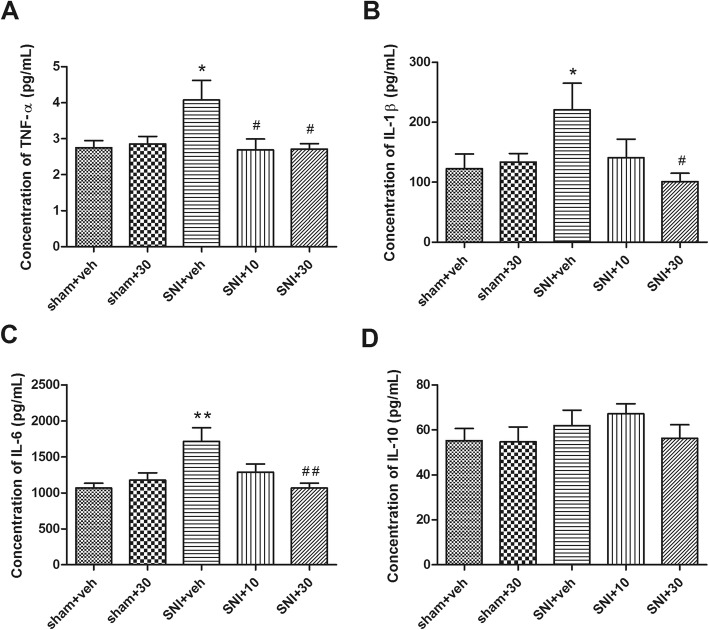
Single application of LA on day 5 post injury caused dose-dependent inhibition of mechanical allodynia with the ED value of 13.43 μM. Multiple applications of LA at 30 μM not only enhanced the analgesic efficacy but also elongated the effective duration without obvious influences on animal locomotor activities. Single and multiple administrations of LA at 30 μM played similar but weaker inhibitory effects on cold allodynia. In addition to behavioral improvements, multiple applications of LA for 6 days dose-dependently inhibited the upregulation of Iba-1, TNF-α, IL-1β, and IL-6, whereas had no obvious effects on the levels of GFAP and IL-10. Combined Western blot and immunostaining assays revealed that the expression of TRPC6 was significantly increased in both spinal dorsal horn after nerve injury and the cultured microglia challenged by LPS, which was however suppressed by the addition of LA at 30 μM or 10 μM, respectively. Further knockdown of TRPC6 with antisense oligodeoxynucleotide produced prominent analgesic effects in rats with SNI, accompanied by the reduced phosphorylation level of p38 in the microglia.
These data demonstrate that i.t. applied LA exhibits analgesic and anti-inflammatory action in neuropathic pain. The action of LA involves the suppression of TRPC6 and p38 signaling in the microglia. LA may be thus a promising pharmacological candidate for the treatment of intractable chronic pain.
神经病理性疼痛是一种使人虚弱的状态,现有的镇痛药对此无能为力。因此,探索潜在的病理生理学变化并寻找新的药理学方法非常重要。瞬时受体电位经典型 6 型(TRPC6)是一种机械敏感性通道,在背根神经节和神经胶质细胞中表达。已有研究表明,背根神经节中的这种通道在神经病理性疼痛的机械性痛觉过敏形成中起着重要作用。最近的药理学筛选表明,落叶松酯(LA),一种落叶松树脂的主要成分,能够选择性地抑制 TRPC6 功能。但 LA 治疗神经病理性疼痛是否有效仍不清楚。我们在大鼠神经病理性疼痛模型中研究了 LA 的疗效,研究了它对中枢神经炎症的影响,并通过靶向脊髓背角探索了可能的分子机制。
在 Sprague-Dawley 大鼠中进行 spared 神经损伤(SNI)。通过 von Frey 纤维和丙酮试验分别评估单次和多次鞘内应用 LA(剂量为 3、10 和 30 μM)后,机械性超敏反应和冷觉过敏的变化。采用 Western blot、免疫组织化学和免疫细胞化学染色检测离子钙结合衔接蛋白 1(Iba-1)、胶质纤维酸性蛋白(GFAP)、TRPC6 和磷酸化 p38 激酶的水平和表达特征。还通过多重分析评估细胞因子浓度(包括 TNF-α、IL-1β、IL-6 和 IL-10)的变化。最后采用 TRPC6 反义策略来研究 LA 的作用机制。
伤后第 5 天单次应用 LA 可剂量依赖性地抑制机械性痛觉过敏,ED 值为 13.43 μM。30 μM 的 LA 多次应用不仅增强了镇痛效果,而且延长了有效持续时间,对动物的运动活动没有明显影响。单次和多次给予 30 μM 的 LA 对冷觉过敏的抑制作用相似但较弱。除了行为改善外,LA 多次应用 6 天可剂量依赖性地下调 Iba-1、TNF-α、IL-1β 和 IL-6 的上调,而对 GFAP 和 IL-10 的水平没有明显影响。联合 Western blot 和免疫染色检测显示,神经损伤后脊髓背角和 LPS 刺激的培养小胶质细胞中 TRPC6 的表达均显著增加,但分别用 30 μM 或 10 μM 的 LA 处理后,TRPC6 的表达受到抑制。用反义寡核苷酸对 TRPC6 进行进一步敲低,可使 SNI 大鼠产生明显的镇痛作用,同时降低小胶质细胞中 p38 的磷酸化水平。
这些数据表明鞘内应用 LA 对神经病理性疼痛具有镇痛和抗炎作用。LA 的作用涉及抑制小胶质细胞中的 TRPC6 和 p38 信号。因此,LA 可能是治疗难治性慢性疼痛的一种有前途的药理学候选药物。