Chai Xiao-Ning, Ludwig Friedrich-Alexander, Müglitz Anne, Schaefer Michael, Yin Hai-Yan, Brust Peter, Regenthal Ralf, Krügel Ute
Rudolf Boehm Institute for Pharmacology and Toxicology, Leipzig University, 04107 Leipzig, Germany.
Acupuncture and Tuina School, Chengdu University of Traditional, Chinese Medicine, Chengdu 610075, China.
Pharmaceuticals (Basel). 2021 Mar 13;14(3):259. doi: 10.3390/ph14030259.
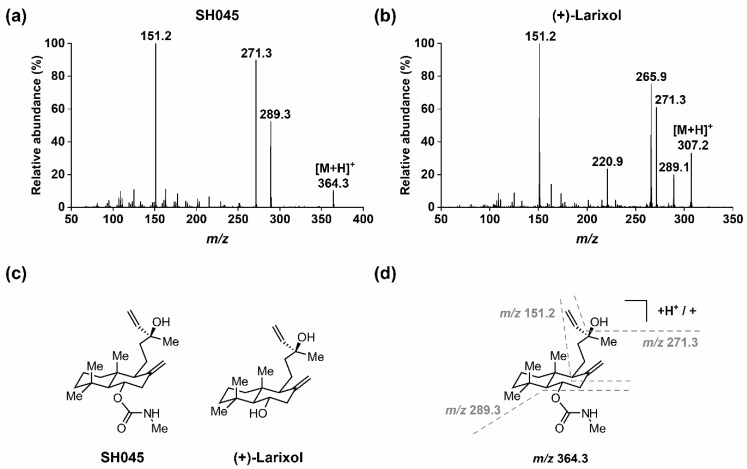
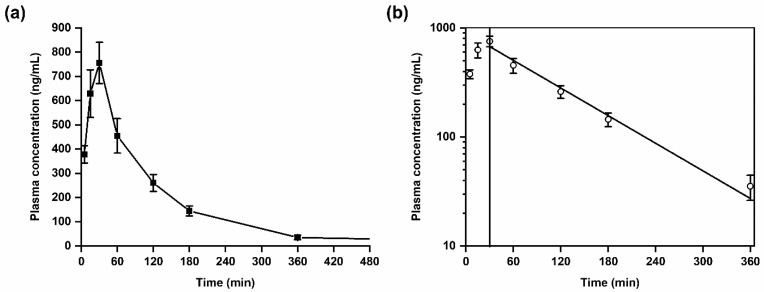
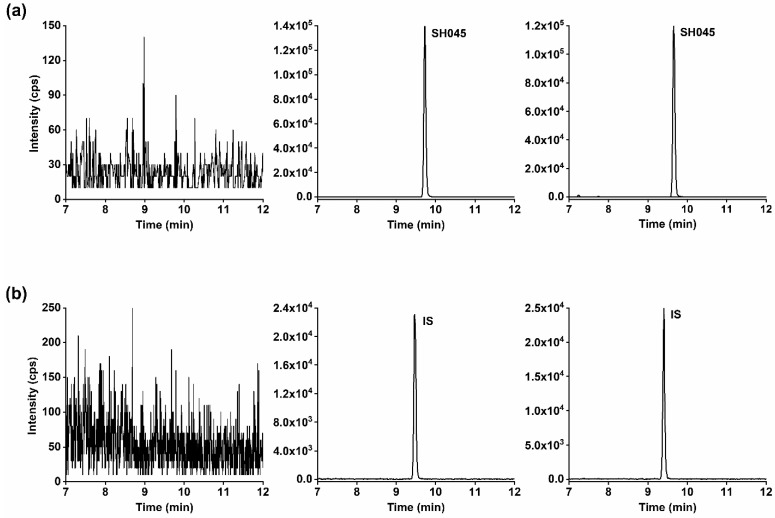
TRPC6 (transient receptor potential cation channels; canonical subfamily C, member 6) is widespread localized in mammalian tissues like kidney and lung and associated with progressive proteinuria and pathophysiological pulmonary alterations, e.g., reperfusion edema or lung fibrosis. However, the understanding of TRPC6 channelopathies is still at the beginning stages. Recently, by chemical diversification of (+)-larixol originating from resin traditionally used for inhalation, its methylcarbamate congener, named SH045, was obtained and identified in functional assays as a highly potent, subtype-selective inhibitor of TRPC6. To pave the way for use of SH045 in animal disease models, this study aimed at developing a capable bioanalytical method and to provide exploratory pharmacokinetic data for this promising derivative. According to international guidelines, a robust and selective LC-MS/MS method based on MRM detection in positive ion mode was established and validated for quantification of SH045 in mice plasma, whereby linearity and accuracy were demonstrated for the range of 2-1600 ng/mL. Applying this method, the plasma concentration time course of SH045 following single intraperitoneal administration (20 mg/kg body weight) revealed a short half-life of 1.3 h. However, the pharmacological profile of SH045 is promising, as five hours after administration, plasma levels still remained sufficiently higher than published low nanomolar IC values. Summarizing, the LC-MS/MS method and exploratory pharmacokinetic data provide essential prerequisites for experimental pharmacological TRPC6 modulation and translational treatment of TRPC6 channelopathies.
瞬时受体电位阳离子通道6(TRPC6;瞬时受体电位阳离子通道;典型亚家族C,成员6)广泛分布于哺乳动物组织,如肾脏和肺,与进行性蛋白尿和病理生理肺部改变相关,例如再灌注水肿或肺纤维化。然而,对TRPC6通道病的认识仍处于初始阶段。最近,通过对传统用于吸入的树脂中提取的(+)-落叶松脂进行化学衍生,得到了其氨基甲酸甲酯类似物,命名为SH045,并在功能试验中鉴定为TRPC6的高效、亚型选择性抑制剂。为了为SH045在动物疾病模型中的应用铺平道路,本研究旨在开发一种可行的生物分析方法,并为这种有前景的衍生物提供探索性药代动力学数据。根据国际指南,建立了一种基于正离子模式下MRM检测的稳健且选择性的LC-MS/MS方法,并对其在小鼠血浆中定量SH045进行了验证,在2-1600 ng/mL范围内证明了线性和准确性。应用该方法,单次腹腔注射(20 mg/kg体重)后SH045的血浆浓度-时间过程显示半衰期较短,为1.3小时。然而,SH045的药理学特征很有前景,因为给药后5小时,血浆水平仍远高于已发表的低纳摩尔IC值。总之,LC-MS/MS方法和探索性药代动力学数据为TRPC6的实验药理学调节和TRPC6通道病的转化治疗提供了必要的前提条件。