Ceballos Leonardo A, Vercellino Davide, D'Errico Valeria, Barzanti Paola, Decastelli Lucia, Nicolandi Luca, Negro Mauro, Ru Giuseppe
Experimental Zooprophylactic Institute of Piedmont, Liguria and Aosta Valley, Turin.
Hygiene Service for Livestock and Zootechnical Production, ASL AT, Asti.
Ital J Food Saf. 2020 Apr 1;9(1):8273. doi: 10.4081/ijfs.2020.8273. eCollection 2020 Mar 31.
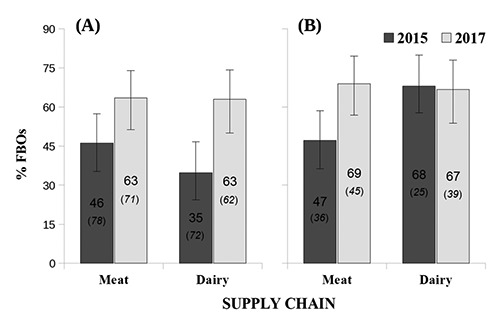
Small food businesses, because of their limited resources, are hard pressed to comply with the requirements of a conventional food safety management system (FSMS). To overcome it, the European legislation provides some flexibility in the application of FSMS. With this study, we evaluated the change in the perception and awareness of hazards in food production and in the attitudes of food business operators (FBOs) after a regional regulation was introduced to allow flexibility and a campaign of training activities on the FSMS simplification opportunities. Training activities targeting various stakeholders have been carried out in Piedmont region since 2014. A total of 283 FBOs from the dairy and the meat supply chains were recruited for a two-round survey. Overall, the majority of the FBOs believed that application of an FSMS helps to overcome official controls, to produce healthy foods, to better manage the production process, and for staff training; its usefulness for enhancing customer trust was judged of limited value. FBO knowledge on the possibility of simplifying the FSMS activities increased significantly between surveys, suggesting the success of the information campaigns. Over time, simplification increased in the meat but not in the dairy supply chain, where it involved nearly 70% of FBOs. The cost of FSMS (mainly due to microbiological analysis) and the time it takes were the main reasons for FBO resistance to its application. Simplification of FSMS procedures were welcomed by the vast majority (>90%) of FBOs. The perception of hazards was low and generic, suggesting the need for targeted training activities.
小型食品企业由于资源有限,很难遵守传统食品安全管理体系(FSMS)的要求。为克服这一问题,欧洲立法在FSMS的应用方面提供了一些灵活性。通过本研究,我们评估了在引入一项允许灵活性的区域法规以及开展一系列关于FSMS简化机会的培训活动之后,食品生产中危害认知和意识的变化以及食品企业经营者(FBOs)态度的变化。自2014年以来,针对皮埃蒙特地区的各类利益相关者开展了培训活动。总共招募了来自乳制品和肉类供应链的283家FBOs参与两轮调查。总体而言,大多数FBOs认为应用FSMS有助于通过官方检查、生产健康食品、更好地管理生产过程以及进行员工培训;而其在增强客户信任方面的作用被认为价值有限。在两轮调查之间,FBOs关于简化FSMS活动可能性的知识显著增加,表明信息宣传活动取得了成功。随着时间的推移,肉类供应链中的简化有所增加,而乳制品供应链中则没有,在乳制品供应链中,近70%的FBOs参与了简化。FSMS的成本(主要由于微生物分析)及其所需时间是FBOs抵制其应用的主要原因。FSMS程序的简化受到绝大多数(>90%)FBOs的欢迎。对危害的认知较低且较为笼统,这表明需要开展有针对性的培训活动。