Qi Si-Min, Cheng Gang, Cheng Xiang-Dong, Xu Zhiyuan, Xu Beihua, Zhang Wei-Dong, Qin Jiang-Jiang
College of Pharmaceutical Sciences, Zhejiang Chinese Medical University, Hangzhou, China.
Institute of Cancer and Basic Medicine, Chinese Academy of Sciences, Cancer Hospital of the University of Chinese Academy of Sciences, Zhejiang Cancer Hospital, Hangzhou, China.
Front Cell Dev Biol. 2020 Apr 2;8:233. doi: 10.3389/fcell.2020.00233. eCollection 2020.
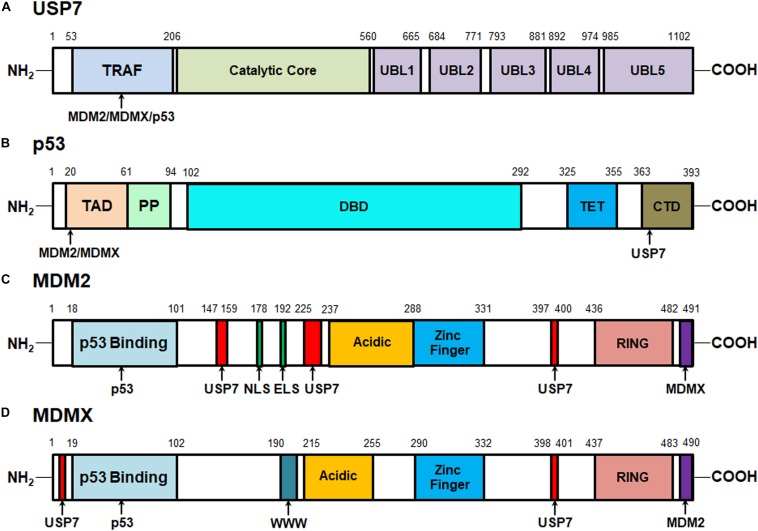
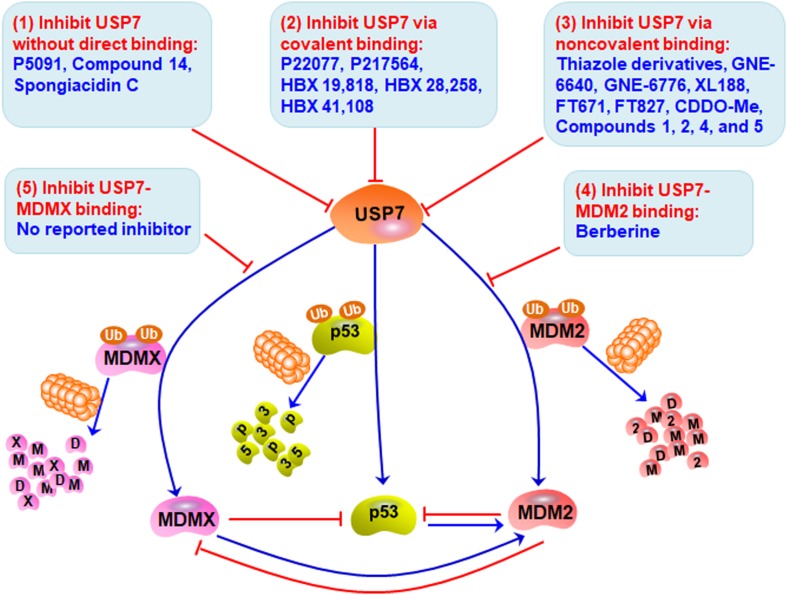
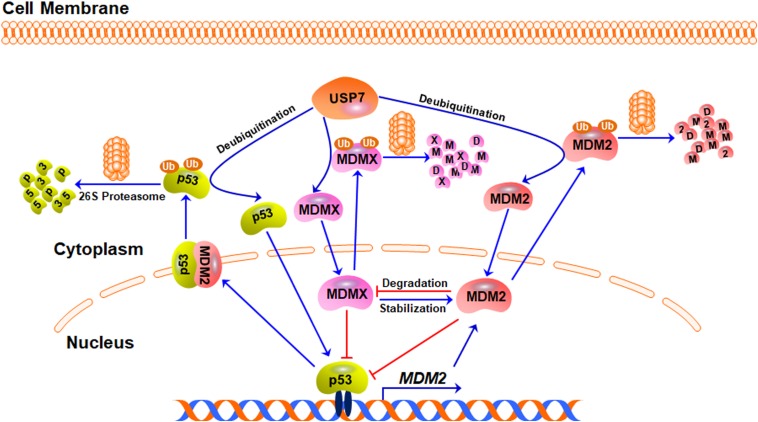
The p53 tumor suppressor protein and its major negative regulators MDM2 and MDMX oncoproteins form the MDM2/MDMX-p53 circuitry, which plays critical roles in regulating cancer cell growth, proliferation, cell cycle progression, apoptosis, senescence, angiogenesis, and immune response. Recent studies have shown that the stabilities of p53, MDM2, and MDMX are tightly controlled by the ubiquitin-proteasome system. Ubiquitin specific protease 7 (USP7), one of the most studied deubiquitinating enzymes plays a crucial role in protecting MDM2 and MDMX from ubiquitination-mediated proteasomal degradation. USP7 is overexpressed in human cancers and contributes to cancer initiation and progression. USP7 inhibition promotes the degradation of MDM2 and MDMX, activates the p53 signaling, and causes cell cycle arrest and apoptosis, making USP7 a potential target for cancer therapy. Several small-molecule inhibitors of USP7 have been developed and shown promising efficacy in preclinical settings. In the present review, we focus on recent advances in the understanding of the USP7-MDM2/MDMX-p53 network in human cancers as well as the discovery and development of USP7 inhibitors for cancer therapy.
p53肿瘤抑制蛋白及其主要负调控因子MDM2和MDMX癌蛋白形成MDM2/MDMX-p53信号通路,该通路在调节癌细胞生长、增殖、细胞周期进程、凋亡、衰老、血管生成和免疫反应中起关键作用。最近的研究表明,p53、MDM2和MDMX的稳定性受到泛素-蛋白酶体系统的严格控制。泛素特异性蛋白酶7(USP7)是研究最多的去泛素化酶之一,在保护MDM2和MDMX免受泛素化介导的蛋白酶体降解方面起关键作用。USP7在人类癌症中过度表达,并促进癌症的发生和发展。抑制USP7可促进MDM2和MDMX的降解,激活p53信号通路,并导致细胞周期停滞和凋亡,使USP7成为癌症治疗的潜在靶点。已经开发出几种USP7小分子抑制剂,并在临床前研究中显示出有前景的疗效。在本综述中,我们重点关注对人类癌症中USP7-MDM2/MDMX-p53网络的理解以及用于癌症治疗的USP7抑制剂的发现和开发方面的最新进展。