Nemeth Banne, Douillet Delphine, le Cessie Saskia, Penaloza Andrea, Moumneh Thomas, Roy Pierre-Marie, Cannegieter Suzanne
Department of Clinical Epidemiology, Leiden University Medical Center, The Netherlands.
Department of Orthopaedic Surgery, Leiden University Medical Center, The Netherlands.
EClinicalMedicine. 2020 Feb 4;20:100270. doi: 10.1016/j.eclinm.2020.100270. eCollection 2020 Mar.
Patients with lower-limb trauma requiring immobilization have an increased risk of venous thromboembolism (VTE). While thromboprophylaxis for all patients seems not effective, targeted thromboprophylaxis in high risk patients may be an appropriate alternative. Therefore, we aimed to develop and validate a risk assessment model for VTE risk: the TRiP(cast) score (Thrombosis Risk Prediction following cast immobilization).
In this prediction model study, for development, data were used from the MEGA study (case-control study into the etiology of VTE) and for validation, data from the POT-CAST trial (randomized trial on the effectiveness of thromboprophylaxis following cast immobilization) were used. Model discrimination was calculated by estimating the Area Under the Curve (AUC). For model calibration, observed and predicted risks were assessed.
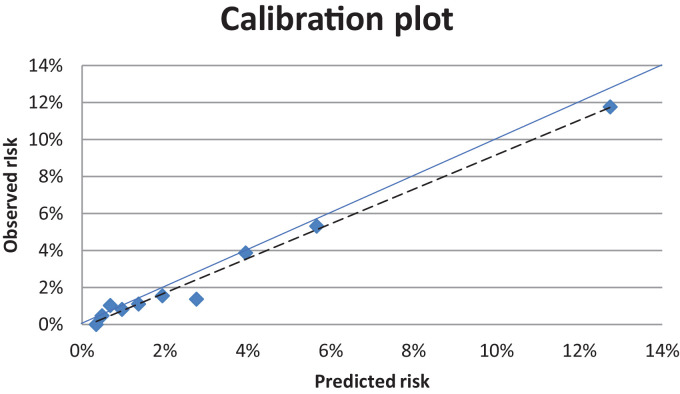
The TRiP(cast) score includes 14 items; one item for trauma severity (or type), one for type of immobilization and 12 items related to patients' characteristics. Validation analyses showed an AUC of 0.74 (95%CI 0.61-0.87) in the complete dataset ( = 1250) and 0.72 (95%CI 0.60-0.84) in the imputed data set ( = 1435). The calibration plot shows the degree of agreement between the observed and predicted risks (intercept 0.0016 and slope 0.933). Using a cut-off score of 7 points in the POT-CAST trial (incidence 1.6%), the sensitivity, specificity, positive and negative predictive values were 76.1%, 51.2%, 2.5%, and 99.2%, respectively.
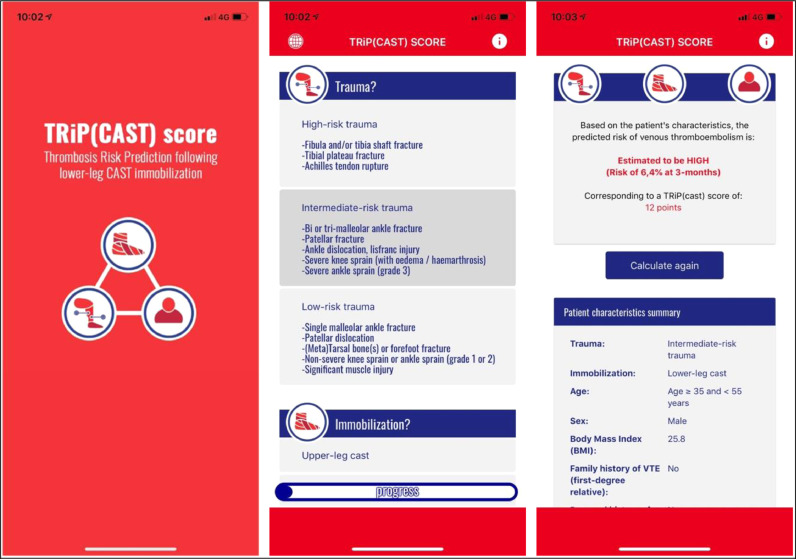
The TRiP(cast) score provides a helpful tool in daily clinical practice to accurately stratify patients in high versus low-risk categories in order to guide thromboprophylaxis prescribing. To accommodate implementation in clinical practice a mobile phone application has been developed.
ZonMW VIMP grant:17110200011.
需要固定的下肢创伤患者发生静脉血栓栓塞(VTE)的风险增加。虽然对所有患者进行血栓预防似乎并不有效,但对高危患者进行有针对性的血栓预防可能是一种合适的选择。因此,我们旨在开发并验证一种VTE风险评估模型:TRiP(石膏固定)评分(石膏固定后血栓形成风险预测)。
在这项预测模型研究中,开发阶段使用了MEGA研究(VTE病因的病例对照研究)的数据,验证阶段使用了POT-CAST试验(石膏固定后血栓预防有效性的随机试验)的数据。通过估计曲线下面积(AUC)来计算模型辨别力。对于模型校准,评估观察到的风险和预测的风险。
TRiP(石膏固定)评分包括14项;一项用于创伤严重程度(或类型),一项用于固定类型,12项与患者特征相关。验证分析显示,在完整数据集(n = 1250)中AUC为0.74(95%CI 0.61 - 0.87),在插补数据集(n = 1435)中AUC为0.72(95%CI 0.60 - 0.84)。校准图显示了观察到的风险和预测风险之间的一致程度(截距0.0016,斜率0.933)。在POT-CAST试验中使用7分的截断评分(发生率1.6%),敏感性、特异性、阳性预测值和阴性预测值分别为76.1%、51.2%、2.5%和99.2%。
TRiP(石膏固定)评分在日常临床实践中提供了一个有用的工具,可准确地将患者分为高风险和低风险类别,以指导血栓预防处方。为了便于在临床实践中实施,已开发了一个手机应用程序。
荷兰卫生与福利研究所VIMP资助:17110200011。