Department of Radiology, Kobe University Graduate School of Medicine, 7-5-2 Kusunoki-cho, Chuo-ku, Kobe, Hyogo, 650-0017, Japan.
GE Healthcare, Hino, Tokyo, Japan.
Eur Radiol. 2020 Sep;30(9):4995-5003. doi: 10.1007/s00330-020-06848-z. Epub 2020 Apr 16.
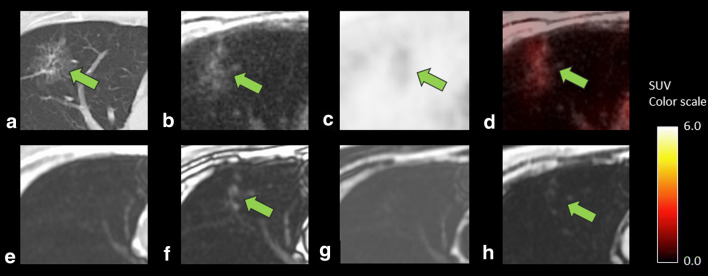
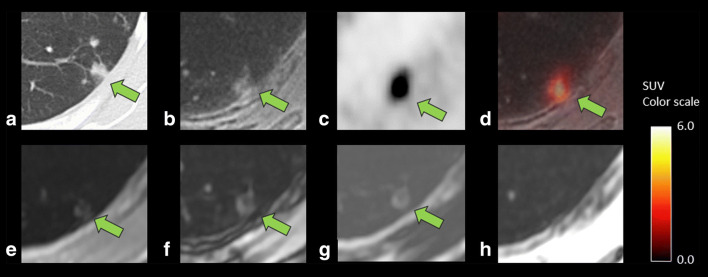
This study aimed to evaluate the diagnostic performance of the lung zero-echo time (ZTE) sequence in FDG PET/MRI for detection and differentiation of lung lesions in oncologic patients in comparison with conventional two-point Dixon-based MR imaging.
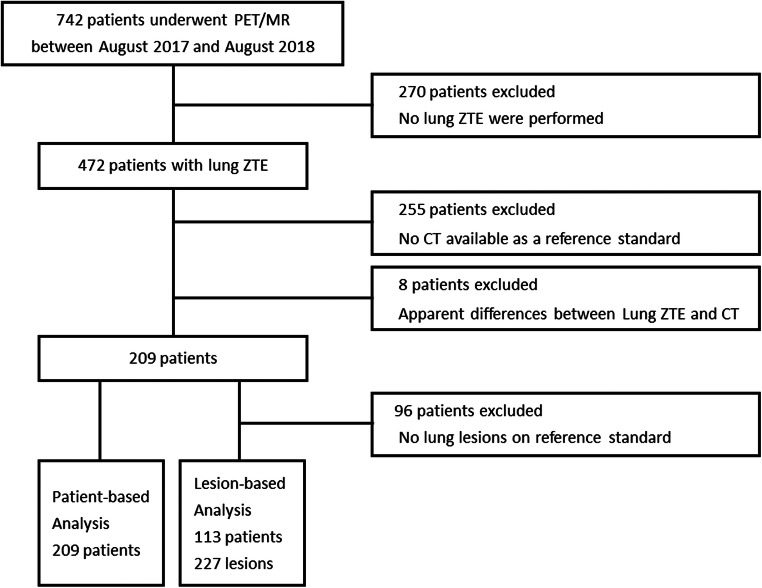
In this single-institution retrospective study approved by the institutional review board, 209 patients with malignancies (97 men and 112 women; age range, 17-89 years; mean age, 66.5 ± 12.9 years) underwent F-FDG PET/MRI between August 2017 and August 2018, with diagnostic Dixon and ZTE under respiratory gating acquired simultaneously with PET. Image analysis was performed for PET/Dixon and PET/ZTE fused images by two readers to assess the detectability and differentiation of lung lesions. The reference standard was pathological findings and/or the data from a chest CT. The detection and differentiation abilities were evaluated for all lesions and subgroups divided by lesion size and maximum standardized uptake value (SUVmax).
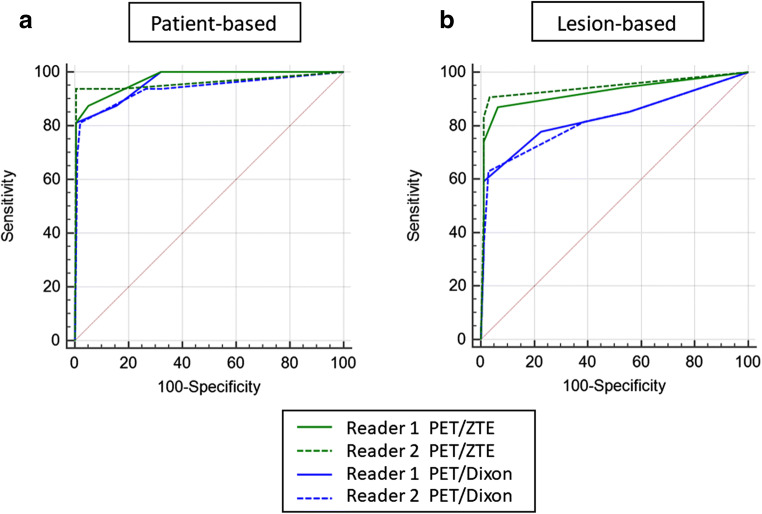
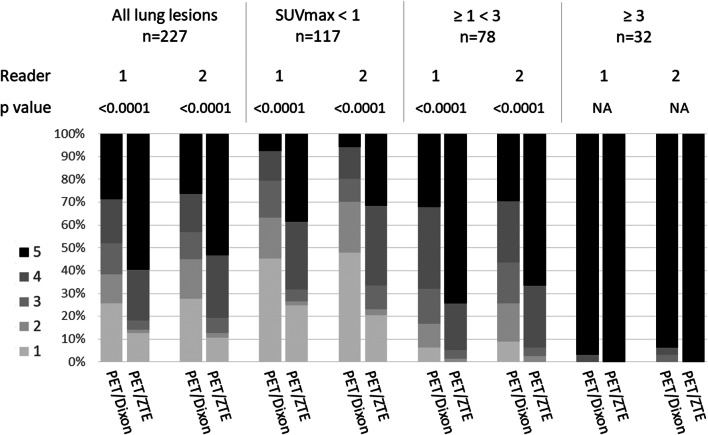
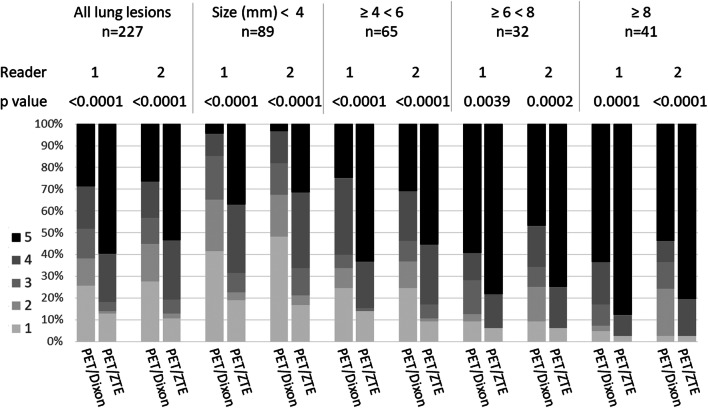
Based on the reference standard, 227 lung lesions were identified in 113 patients. The detectability of PET/ZTE was significantly better than that of PET/Dixon for overall lesions, lesions with a SUVmax less than 3.0 and lesions smaller than 4 mm (p < 0.01). The diagnostic performance of PET/ZTE was significantly better than that of PET/Dixon for overall lesions and lesions smaller than 4 mm (p < 0.01).
ZTE can improve diagnostic performance in the detection and differentiation of both FDG-avid and non-FDG-avid lung lesions smaller than 4 mm in size, yielding a promising tool to enhance the utility of FDG PET/MRI in oncology patients with lung lesions.
• The detection rate of PET/ZTE for lesions with a SUVmax of less than 1.0 was significantly better than that of PET/Dixon. • The performance for differentiation of PET/ZTE for lesions that were even smaller than 4 mm in size were significantly better than that of PET/Dixon. • Inter-rater agreement of PET/ZTE for the differentiation of lesions less than 4 mm in size was substantial and better than that of PET/Dixon.
本研究旨在评估肺部零回波时间(ZTE)序列在 FDG PET/MRI 中对肿瘤患者肺部病变的检测和鉴别诊断的性能,与常规两点 Dixon 基 MR 成像相比。
这是一项在机构审查委员会批准下进行的单中心回顾性研究,209 例恶性肿瘤患者(97 名男性和 112 名女性;年龄范围为 17-89 岁;平均年龄为 66.5±12.9 岁)在 2017 年 8 月至 2018 年 8 月期间进行了 F-FDG PET/MRI 检查,同时进行了呼吸门控的诊断性 Dixon 和 ZTE。由两位读者对 PET/Dixon 和 PET/ZTE 融合图像进行图像分析,以评估肺部病变的可检测性和鉴别能力。参考标准为病理发现和/或胸部 CT 数据。根据病变大小和最大标准化摄取值(SUVmax)将所有病变和亚组分为两组,评估检测和鉴别能力。
根据参考标准,在 113 名患者中发现了 227 个肺部病变。对于所有病变、SUVmax 小于 3.0 的病变和小于 4mm 的病变,PET/ZTE 的检测率明显优于 PET/Dixon(p<0.01)。对于所有病变和小于 4mm 的病变,PET/ZTE 的诊断性能明显优于 PET/Dixon(p<0.01)。
ZTE 可以提高对大小小于 4mm 的 FDG 阳性和非 FDG 阳性肺部病变的检测和鉴别诊断的性能,为增强 FDG PET/MRI 在有肺部病变的肿瘤患者中的应用提供了一种有前途的工具。
• PET/ZTE 对 SUVmax 小于 1.0 的病变的检测率明显优于 PET/Dixon。• PET/ZTE 在鉴别甚至小于 4mm 的病变方面的性能明显优于 PET/Dixon。• PET/ZTE 对小于 4mm 的病变的鉴别诊断的两位读者之间的一致性是实质性的,优于 PET/Dixon。