Department of Radiological Sciences, School of Health Sciences at Narita, International University of Health and Welfare.
Magn Reson Med Sci. 2022 Mar 1;21(1):71-82. doi: 10.2463/mrms.rev.2021-0011. Epub 2021 Apr 16.
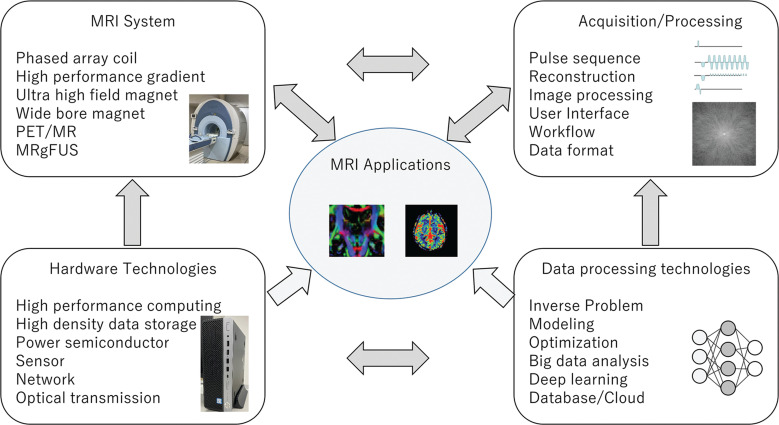
Clinical MRI systems have continually improved over the years since their introduction in the 1980s. In MRI technical development, the developments in each MRI system component, including data acquisition, image reconstruction, and hardware systems, have impacted the others. Progress in each component has induced new technology development opportunities in other components. New technologies outside of the MRI field, for example, computer science, data processing, and semiconductors, have been immediately incorporated into MRI development, which resulted in innovative applications. With high performance computing and MR technology innovations, MRI can now provide large volumes of functional and anatomical image datasets, which are important tools in various research fields. MRI systems are now combined with other modalities, such as positron emission tomography (PET) or therapeutic devices. These hybrid systems provide additional capabilities.In this review, MRI advances in the last two decades will be considered. We will discuss the progress of MRI systems, the enabling technology, established applications, current trends, and the future outlook.
自 20 世纪 80 年代问世以来,临床磁共振成像(MRI)系统不断得到改进。在 MRI 技术的发展过程中,MRI 系统各组成部分(包括数据采集、图像重建和硬件系统)的发展相互影响。每个组件的进步都在其他组件中引发了新技术发展的机会。MRI 领域以外的新技术,例如计算机科学、数据处理和半导体技术,已立即被纳入 MRI 开发中,从而产生了创新的应用。随着高性能计算和磁共振技术的创新,MRI 现在可以提供大量的功能和解剖图像数据集,这些数据集是各个研究领域的重要工具。MRI 系统现在与正电子发射断层扫描(PET)或治疗设备等其他模式结合使用。这些混合系统提供了额外的功能。本综述将考虑过去二十年中 MRI 的进展。我们将讨论 MRI 系统、使能技术、现有应用、当前趋势和未来展望的进展。