Department of Anesthesiology and Intensive Care, Faculty of Medicine, University of Warmia and Mazury, Ul. Żołnierska 18, 10-900, Olsztyn, Poland.
Department of Biopharmaceutics and Pharmacodynamics, Medical University of Gdańsk, Gdańsk, Poland.
Pharmacol Rep. 2020 Jun;72(3):719-729. doi: 10.1007/s43440-020-00104-3. Epub 2020 Apr 16.
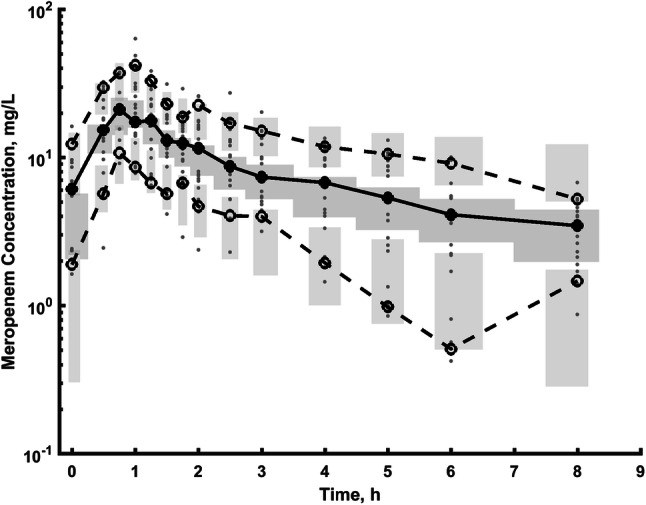
The primary objective of this study was to develop a population pharmacokinetic model of meropenem, based on the population of critically ill adult patients undergoing CRRT. The secondary one was to examine the relationship between patient characteristics (covariates) and individual PK parameters. Finally, we aimed to perform Monte Carlo simulations to assess the probability of target attainment (PTA) of %T > MIC considering the uncertainty of PK parameters.
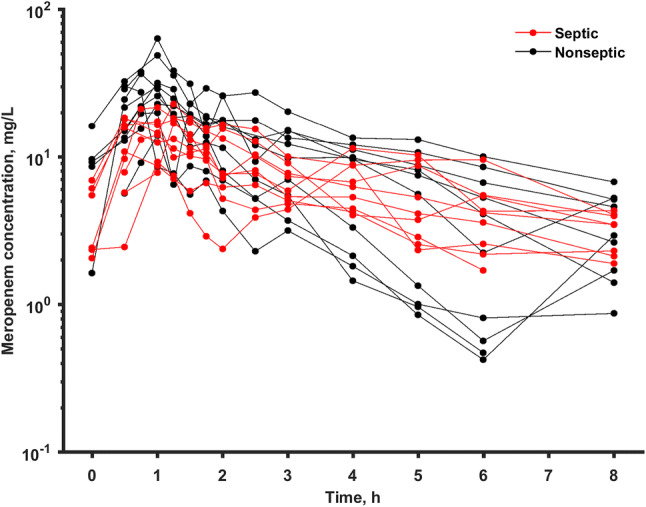
The study population included 19 adult critically ill patients on CRRT, receiving 1 g of meropenem in 1-h infusions every 8 h. Blood samples were collected prior to (time zero) and 15, 30, 45, 60, 75, 90, 120, 180, 240 and 480 min after the start of meropenem administration. Population nonlinear mixed-effects modeling was conducted using NONMEM software, Fortran, and Wings for NONMEM.
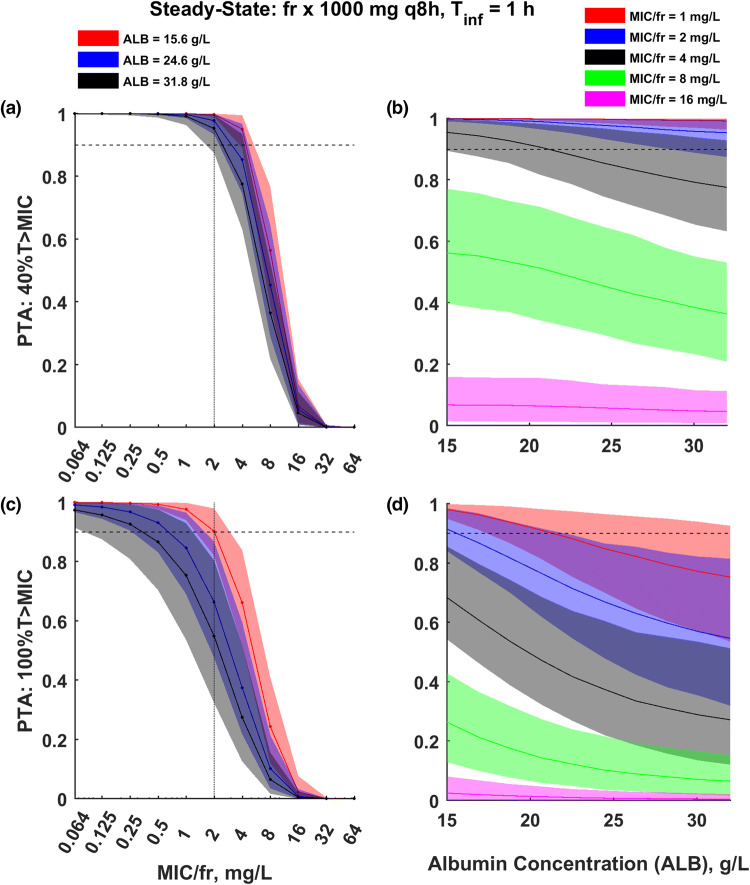
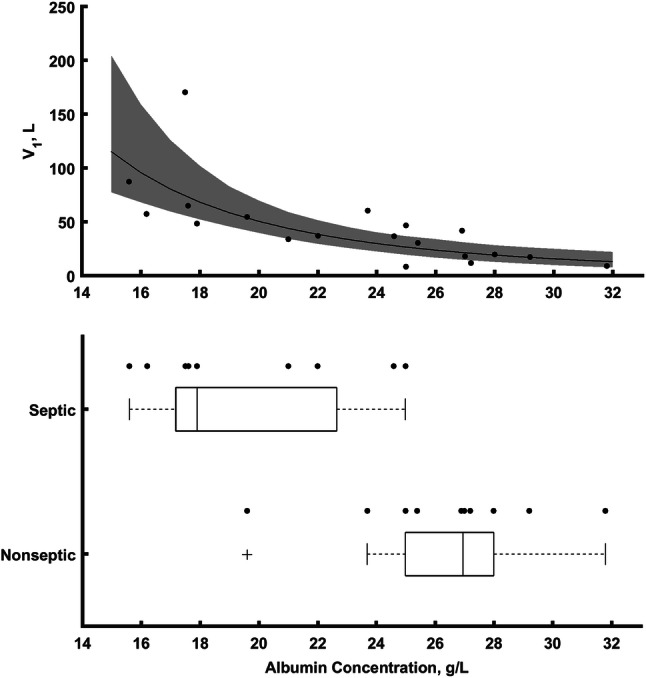
A two-compartment model was used to describe the available data. Typical values of the central and peripheral volume of distribution, and the CRRT and inter-compartmental clearance for a theoretical patient with 24.6 g/l albumin concertation were V = 27.9 l, V = 33.7 l, Cl = 15.1 l/h, and Q = 21.1 l/h. A significant covariate relationship between V and albumin concentration was observed in the data that was described by a power relationship with - 2.87 exponent. Subsequently performed Monte Carlo simulations of the model allowed us to assess the impact of albumin concentration on PTA. The 40%T > 2 mg/l target was reached in more than 90% of subjects after 1-h infusion of 1000 mg q8h and steady-state conditions. The more stringent 100%T > 2 mg/l target requires higher doses and/or longer infusion durations that depend on the albumin concentration.
The population PK model was successfully developed to describe the time course of meropenem concentrations. The hypoalbuminemia was found to be associated with higher PTA in the CRRT patients after multiple short-term infusions.
本研究的主要目的是建立一个基于接受连续肾脏替代治疗(CRRT)的成年危重症患者群体的美罗培南群体药代动力学模型。次要目的是检验患者特征(协变量)与个体药代动力学参数之间的关系。最后,我们旨在进行蒙特卡罗模拟,以评估考虑到药代动力学参数不确定性时,目标浓度时间百分比(%T > MIC)的达标概率(PTA)。
研究人群包括 19 名接受 CRRT 的成年危重症患者,每 8 小时接受 1 克美罗培南 1 小时输注。在美罗培南给药前(零时)和给药后 15、30、45、60、75、90、120、180、240 和 480 分钟采集血样。使用 NONMEM 软件、Fortran 和 Wings for NONMEM 进行群体非线性混合效应建模。
采用双室模型来描述可用数据。对于白蛋白浓度为 24.6 g/L 的理论患者,典型的中央和外周分布容积、CRRT 和两室间清除率值分别为 V = 27.9 L、V = 33.7 L、Cl = 15.1 L/h 和 Q = 21.1 L/h。在数据中观察到 V 与白蛋白浓度之间存在显著的协变量关系,该关系通过 -2.87 指数的幂函数关系来描述。随后对模型进行的蒙特卡罗模拟使我们能够评估白蛋白浓度对 PTA 的影响。在 1 小时输注 1000 mg q8h 和稳态条件下,超过 90%的患者在 1 小时输注后达到 40%T > 2 mg/L 的目标。更严格的 100%T > 2 mg/L 的目标需要更高的剂量和/或更长的输注时间,这取决于白蛋白浓度。
成功建立了描述美罗培南浓度时间过程的群体药代动力学模型。在多次短期输注后,我们发现低白蛋白血症与 CRRT 患者更高的 PTA 相关。