Institute of Silviculture, University of Natural Resources and Life Sciences (BOKU) Vienna, Vienna, Austria.
Ecosystem Dynamics and Forest Management Group, Technical University of Munich, Freising, Germany.
Glob Chang Biol. 2020 Jul;26(7):4013-4027. doi: 10.1111/gcb.15118. Epub 2020 May 8.
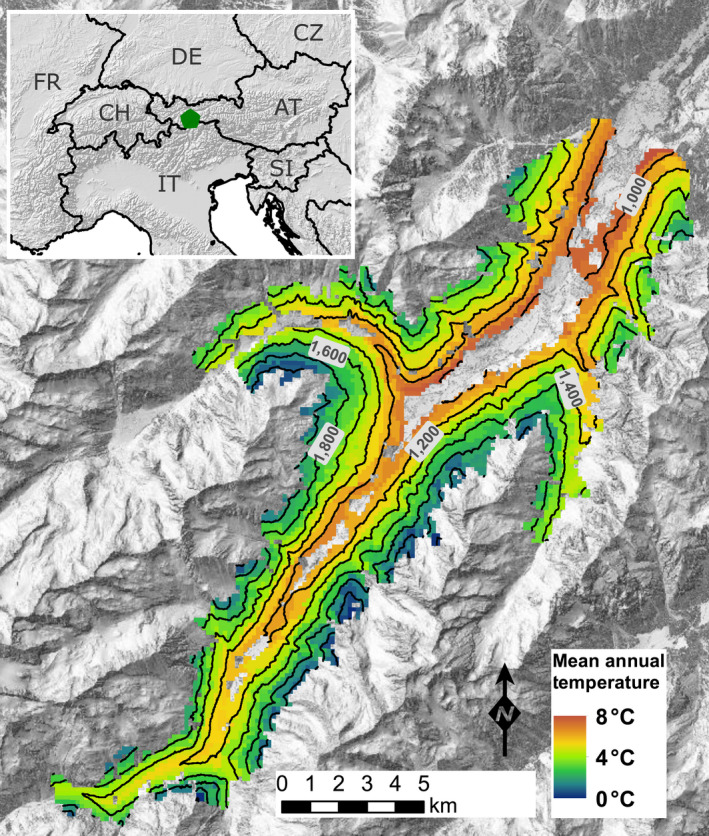
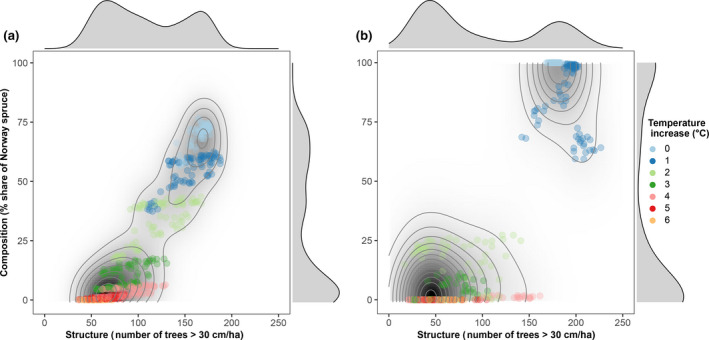
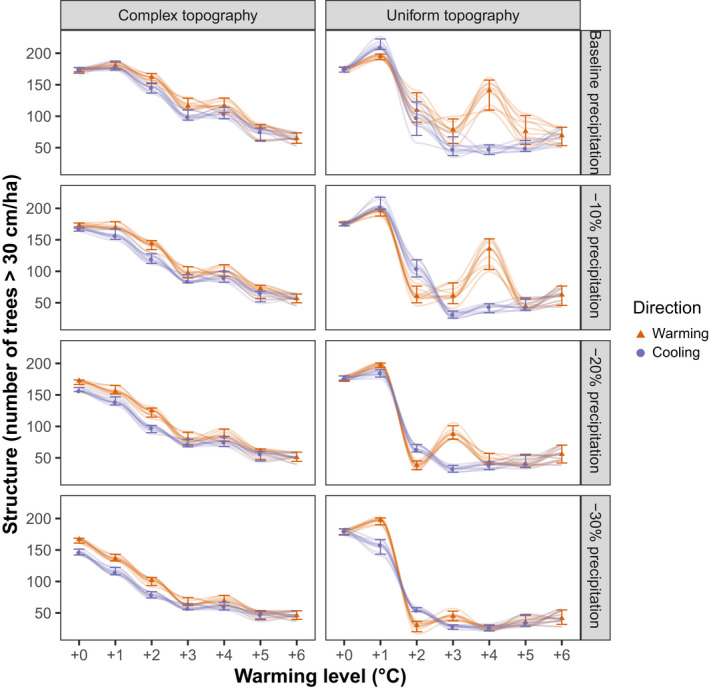
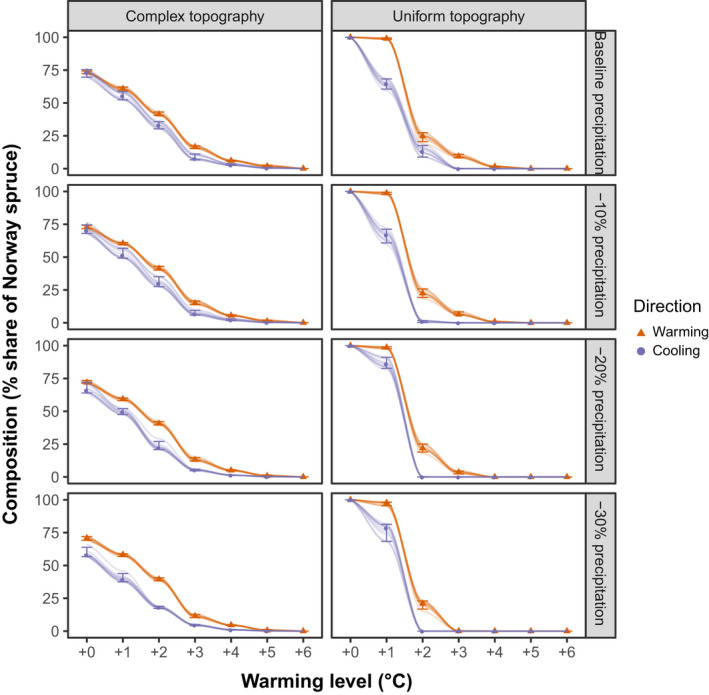
Mountain forests are at particular risk of climate change impacts due to their temperature limitation and high exposure to warming. At the same time, their complex topography may help to buffer the effects of climate change and create climate refugia. Whether climate change can lead to critical transitions of mountain forest ecosystems and whether such transitions are reversible remain incompletely understood. We investigated the resilience of forest composition and size structure to climate change, focusing on a mountain forest landscape in the Eastern Alps. Using the individual-based forest landscape model iLand, we simulated ecosystem responses to a wide range of climatic changes (up to a 6°C increase in mean annual temperature and a 30% reduction in mean annual precipitation), testing for tipping points in vegetation size structure and composition under different topography scenarios. We found that at warming levels above +2°C a threshold was crossed, with the system tipping into an alternative state. The system shifted from a conifer-dominated landscape characterized by large trees to a landscape dominated by smaller, predominantly broadleaved trees. Topographic complexity moderated climate change impacts, smoothing and delaying the transitions between alternative vegetation states. We subsequently reversed the simulated climate forcing to assess the ability of the landscape to recover from climate change impacts. The forest landscape showed hysteresis, particularly in scenarios with lower precipitation. At the same mean annual temperature, equilibrium vegetation size structure and species composition differed between warming and cooling trajectories. Here we show that even moderate warming corresponding to current policy targets could result in critical transitions of forest ecosystems and highlight the importance of topographic complexity as a buffering agent. Furthermore, our results show that overshooting ambitious climate mitigation targets could be dangerous, as ecological impacts can be irreversible at millennial time scales once a tipping point has been crossed.
山地森林由于其温度限制和对变暖的高度暴露,特别容易受到气候变化的影响。同时,它们复杂的地形可能有助于缓冲气候变化的影响,并创造气候避难所。气候变化是否会导致山地森林生态系统的关键转变,以及这些转变是否可以逆转,仍然不完全清楚。我们研究了森林组成和大小结构对气候变化的恢复力,重点关注东阿尔卑斯山的一个山地森林景观。使用基于个体的森林景观模型 iLand,我们模拟了生态系统对广泛的气候变化(最高可达平均年气温升高 6°C 和平均年降水量减少 30%)的响应,测试了不同地形情景下植被大小结构和组成的临界点。我们发现,在变暖水平超过+2°C 时,系统越过了一个阈值,进入了一个替代状态。系统从以针叶树为主导、树木较大的景观转变为以较小的、主要是阔叶树为主导的景观。地形复杂性缓和了气候变化的影响,使替代植被状态之间的过渡更加平滑和延迟。随后,我们反转了模拟的气候强迫,以评估景观从气候变化影响中恢复的能力。森林景观表现出滞后,特别是在降水较低的情况下。在相同的平均年温度下,变暖与冷却轨迹之间的平衡植被大小结构和物种组成存在差异。在这里,我们表明,即使是与当前政策目标相对应的适度变暖,也可能导致森林生态系统的关键转变,并强调地形复杂性作为缓冲剂的重要性。此外,我们的结果表明,过度追求雄心勃勃的气候缓解目标可能是危险的,因为一旦越过临界点,生态影响可能在千年时间尺度上是不可逆转的。