Le Souëf Peter N, Adachi Yuichi, Anastasiou Eleni, Ansotegui Ignacio J, Badellino Héctor A, Banzon Tina, Beltrán Cesar Pozo, D'Amato Gennaro, El-Sayed Zeinab A, Gómez Rene Maximiliano, Hossny Elham, Kalayci Ömer, Morais-Almeida Mário, Nieto-Garcia Antonio, Peden David B, Phipatanakul Wanda, Wang Jiu-Yao, Wan I-Jen, Wong Gary, Xepapadaki Paraskevi, Papadopoulos Nikolaos G
School of Medicine, University of Western Australia and Telethon Kids Institute, Perth, Australia.
Pediatric Allergy Center, Toyama Red Cross Hospital, Toyama, Japan.
World Allergy Organ J. 2024 Nov 8;17(11):100988. doi: 10.1016/j.waojou.2024.100988. eCollection 2024 Nov.
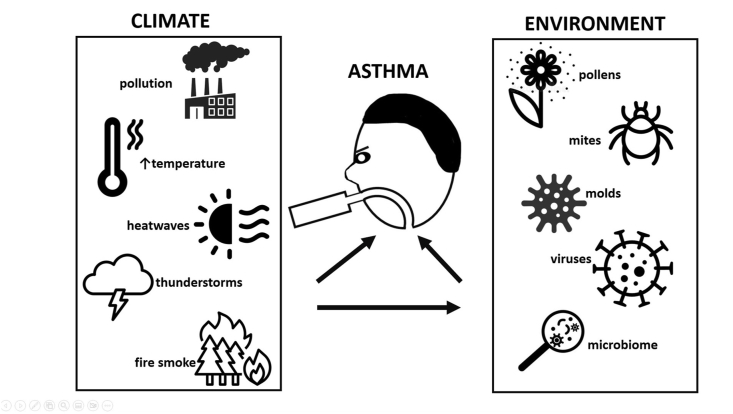
The twenty-first century has seen a fundamental shift in disease epidemiology with anthropogenic environmental change emerging as the likely dominant factor affecting the distribution and severity of current and future human disease. This is especially true of allergic diseases and asthma with their intimate relationship with the natural environment. Climate change-related variables including increased ambient temperature, heat waves, extreme weather events, air pollution, and rainfall distribution, all can affect asthma in children, but each of these variables also affects asthma via alterations in pollen production and release, outdoor allergen exposure or the microbiome. Air pollution, with its many and varied respiratory consequences, is likely to have the greatest effect, as it has increased globally due to rapid increases in fossil fuel combustion, global population, crowding, and megacities, as well as forest burning and trees succumbing to an increasingly hostile environment. Human activities have also caused substantial deterioration of the global microbiome with reductions in biodiversity for molds, bacteria, and viruses. Reduced microbiome diversity has, in turn, been associated with increases in Th2 allergic responses and allergic disease. The collective effect of these changes has already shifted allergy and asthma disease patterns. Given that changes in climate have been relatively small to date, the unavoidable, much greater shifts in climate in the future are concerning. Determining the relative scale of the direct versus indirect effects of climate change variables is needed if effective avoidance and adaptive measures are to be implemented. This would also require much more basic, epidemiological, and clinical research to understand the causal mechanisms, the most relevant climate factors involved, the regions most affected and, most importantly, effective and actionable adaptation measures. We suggest that allergy and respiratory health workers should follow current guidance to reduce present risks related to climate change and watch for new recommendations to reduce future risks. Since the respiratory system is the one most affected by climate change, they also need to call for more research in this area and show strong leadership in advocating for urgent action to protect children by reducing or reversing factors that have led to our deteriorating climate.
21世纪,疾病流行病学发生了根本性转变,人为环境变化成为影响当前及未来人类疾病分布和严重程度的可能主导因素。对于与自然环境密切相关的过敏性疾病和哮喘而言,尤其如此。与气候变化相关的变量,包括环境温度升高、热浪、极端天气事件、空气污染和降雨分布,都会影响儿童哮喘,但这些变量也会通过改变花粉产生和释放、室外过敏原暴露或微生物群来影响哮喘。空气污染会带来诸多不同的呼吸道后果,可能影响最大,因为随着化石燃料燃烧、全球人口、拥挤程度和特大城市的迅速增加,以及森林燃烧和树木在日益恶劣的环境中死亡,全球空气污染有所加剧。人类活动还导致全球微生物群严重恶化,霉菌、细菌和病毒的生物多样性减少。微生物群多样性降低反过来又与Th2过敏反应和过敏性疾病增加有关。这些变化的综合影响已经改变了过敏和哮喘的疾病模式。鉴于迄今为止气候变化相对较小,未来不可避免的更大气候变化令人担忧。如果要实施有效的规避和适应措施,就需要确定气候变化变量直接和间接影响的相对规模。这还需要更多基础、流行病学和临床研究,以了解因果机制、涉及的最相关气候因素、受影响最严重的地区,以及最重要的是有效的可操作适应措施。我们建议,过敏和呼吸健康工作者应遵循当前指导意见,降低当前与气候变化相关的风险,并留意降低未来风险的新建议。由于呼吸系统是受气候变化影响最大的系统,他们还需要呼吁在这一领域开展更多研究,并在倡导采取紧急行动保护儿童方面发挥强有力的领导作用,减少或扭转导致气候恶化的因素。