From the Department of Radiology, Seoul National University College of Medicine, 101 Daehak-ro, Jongno-gu, Seoul 03080, Korea (H.K., S.H.Y.); Institute of Radiation Medicine, Seoul National University Medical Research Center, Seoul, Korea (H.K., S.H.Y.); and Medical Research Collaborating Center, Seoul National University Hospital, Seoul, Korea (H.H.).
Radiology. 2020 Sep;296(3):E145-E155. doi: 10.1148/radiol.2020201343. Epub 2020 Apr 17.
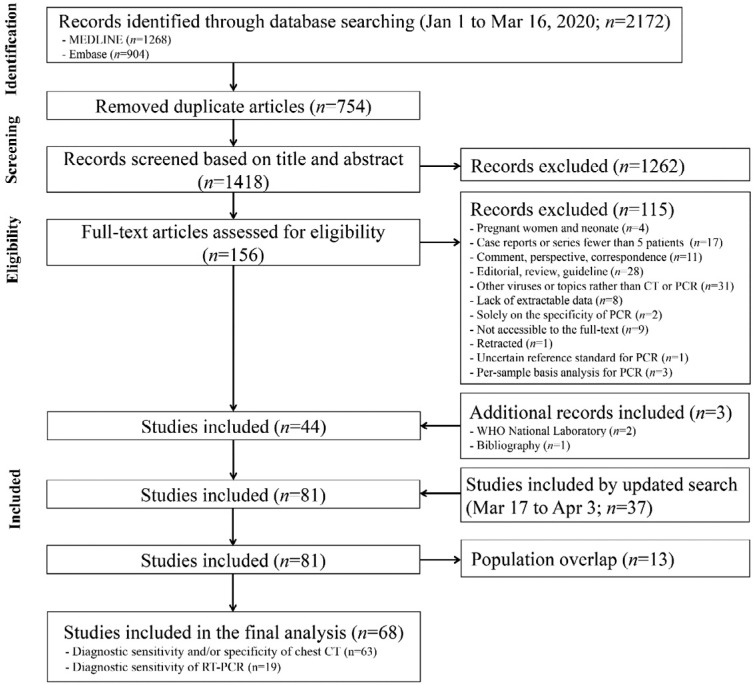
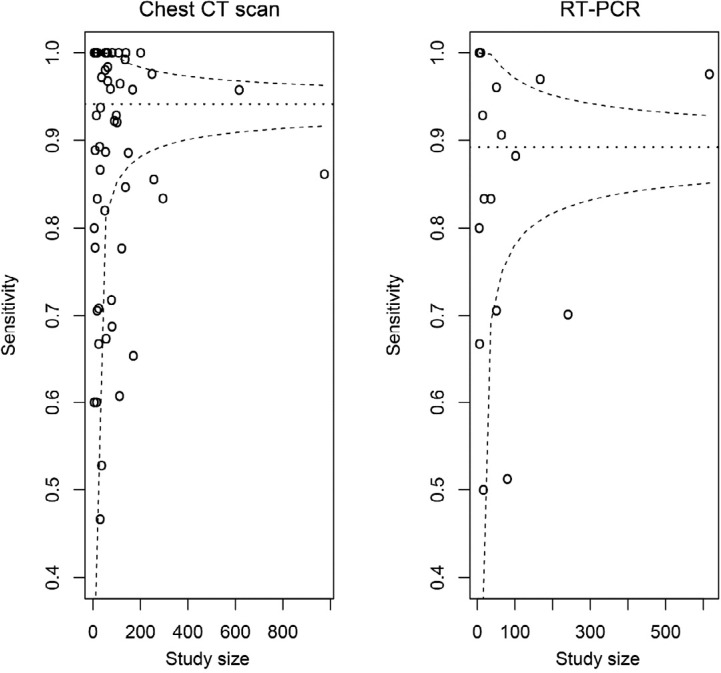
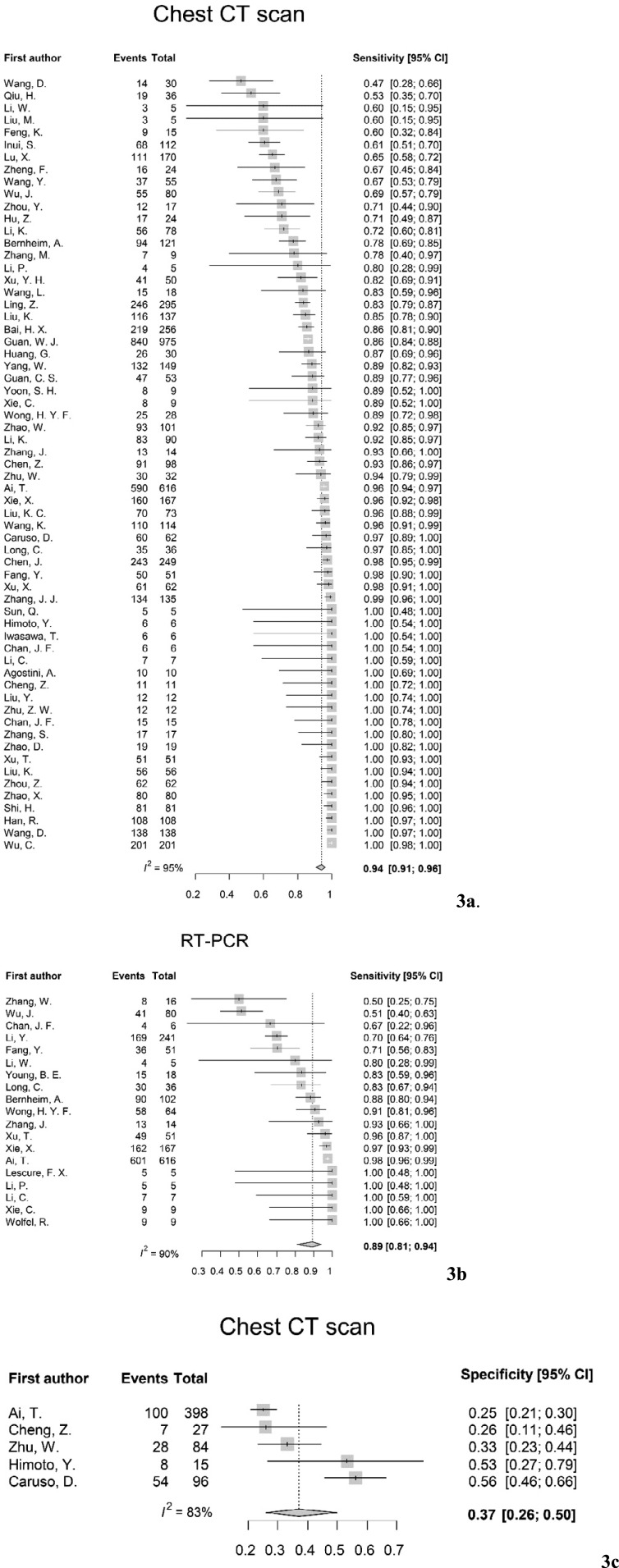
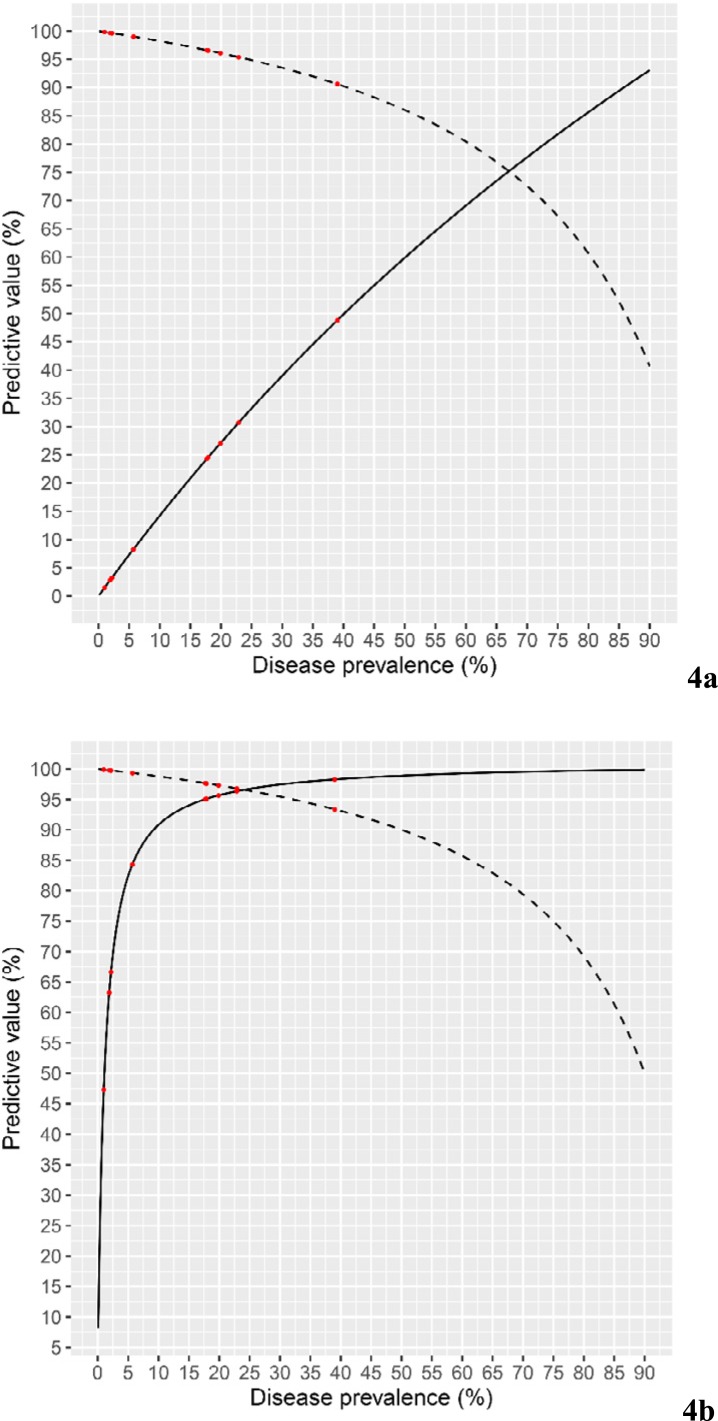
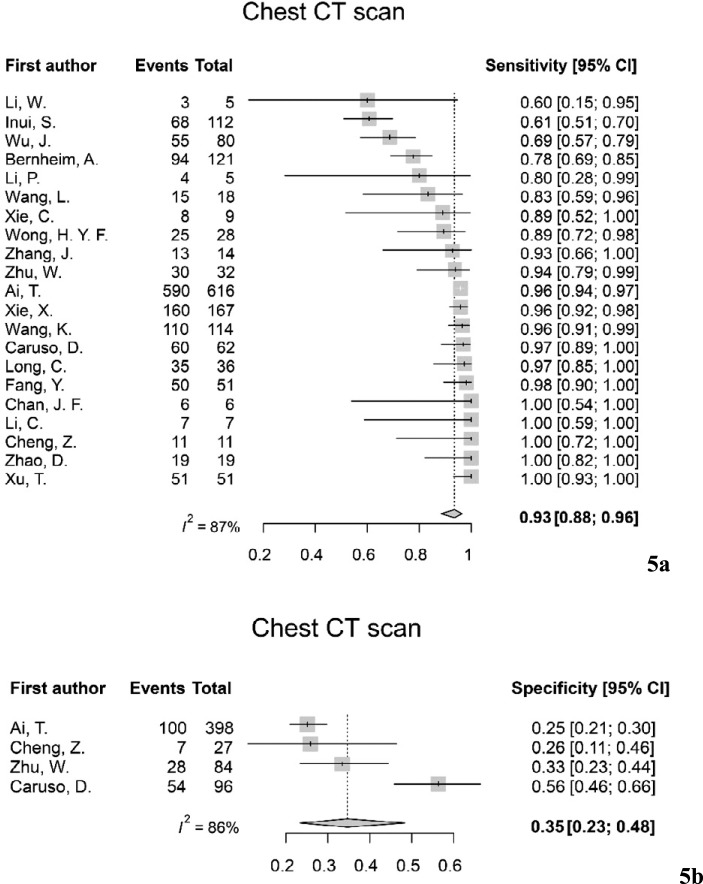
Background Recent studies have suggested that chest CT scans could be used as a primary screening or diagnostic tool for coronavirus disease 2019 (COVID-19) in epidemic areas. Purpose To perform a meta-analysis to evaluate diagnostic performance measures, including predictive values of chest CT and initial reverse transcriptase polymerase chain reaction (RT-PCR). Materials and Methods Medline and Embase were searched from January 1, 2020, to April 3, 2020, for studies on COVID-19 that reported the sensitivity, specificity, or both of CT scans, RT-PCR assays, or both. The pooled sensitivity and specificity were estimated by using random-effects models. The actual prevalence (ie, the proportion of confirmed patients among those tested) in eight countries was obtained from web sources, and the predictive values were calculated. Meta-regression was performed to reveal the effect of potential explanatory factors on the diagnostic performance measures. Results The pooled sensitivity was 94% (95% confidence interval [CI]: 91%, 96%; = 95%) for chest CT and 89% (95% CI: 81%, 94%; = 90%) for RT-PCR. The pooled specificity was 37% (95% CI: 26%, 50%; = 83%) for chest CT. The prevalence of COVID-19 outside China ranged from 1.0% to 22.9%. For chest CT scans, the positive predictive value (PPV) ranged from 1.5% to 30.7%, and the negative predictive value (NPV) ranged from 95.4% to 99.8%. For RT-PCR, the PPV ranged from 47.3% to 96.4%, whereas the NPV ranged from 96.8% to 99.9%. The sensitivity of CT was affected by the distribution of disease severity, the proportion of patients with comorbidities, and the proportion of asymptomatic patients (all < .05). The sensitivity of RT-PCR was negatively associated with the proportion of elderly patients ( = .01). Conclusion Outside of China where there is a low prevalence of coronavirus disease 2019 (range, 1%-22.9%), chest CT screening of patients with suspected disease had low positive predictive value (range, 1.5%-30.7%). © RSNA, 2020
背景 最近的研究表明,在流行地区,胸部 CT 扫描可作为 2019 年冠状病毒病(COVID-19)的主要筛查或诊断工具。目的 进行荟萃分析以评估诊断性能指标,包括胸部 CT 和初始逆转录酶聚合酶链反应(RT-PCR)的预测值。材料与方法 从 2020 年 1 月 1 日至 2020 年 4 月 3 日,在 Medline 和 Embase 上搜索关于 COVID-19 的研究,这些研究报告了 CT 扫描、RT-PCR 检测或两者的敏感性、特异性或两者。使用随机效应模型估计合并敏感性和特异性。从网络资源中获得了八个国家的实际患病率(即,经检测确诊患者的比例),并计算了预测值。进行了元回归分析,以揭示潜在解释因素对诊断性能指标的影响。结果 胸部 CT 的合并敏感性为 94%(95%置信区间[CI]:91%,96%; = 95%),RT-PCR 的敏感性为 89%(95% CI:81%,94%; = 90%)。胸部 CT 的合并特异性为 37%(95% CI:26%,50%; = 83%)。中国以外 COVID-19 的患病率为 1.0%至 22.9%。对于胸部 CT 扫描,阳性预测值(PPV)范围为 1.5%至 30.7%,阴性预测值(NPV)范围为 95.4%至 99.8%。对于 RT-PCR,PPV 范围为 47.3%至 96.4%,NPV 范围为 96.8%至 99.9%。CT 的敏感性受疾病严重程度分布、合并症患者比例和无症状患者比例的影响(均<.05)。RT-PCR 的敏感性与老年患者比例呈负相关( =.01)。结论 在 COVID-19 患病率较低的中国以外地区(范围为 1%-22.9%),疑似疾病患者的胸部 CT 筛查的阳性预测值较低(范围为 1.5%-30.7%)。© RSNA,2020