Zhang Dongyu, Advani Shailesh, Waller Jo, Cupertino Ana-Paula, Hurtado-de-Mendoza Alejandra, Chicaiza Anthony, Rohloff Peter J, Akinyemiju Tomi F, Gharzouzi Eduardo, Huchko Megan J, Barnoya Joaquin, Braithwaite Dejana
Department of Oncology, Georgetown University School of Medicine, Washington, DC.
Social Epidemiology Research Unit, Social Behavioral Research Branch, National Human Genome Research Institute, National Institutes of Health, Bethesda, MD.
JCO Glob Oncol. 2020 Apr;6:617-627. doi: 10.1200/JGO.19.00201.
Cervical cancer screening is not well implemented in many low- and middle-income countries (LMICs). Mobile health (mHealth) refers to utilization of mobile technologies in health promotion and disease management. We aimed to qualitatively synthesize published articles reporting the impact of mHealth on cervical cancer screening-related health behaviors.
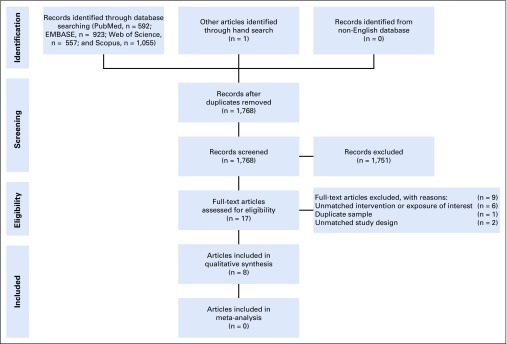
Three reviewers independently reviewed articles with the following criteria: the exposure or intervention of interest was mHealth, including messages or educational information sent via mobile telephone or e-mail; the comparison was people not using mHealth technology to receive screening-related information, and studies comparing multiple different mHealth interventional strategies were also eligible; the primary outcome was cervical cancer screening uptake, and secondary outcomes included awareness, intention, and knowledge of screening; appropriate research designs included randomized controlled trials and quasi-experimental or observational research; and the study was conducted in an LMIC.
Of the 8 selected studies, 5 treated mobile telephone or message reminders as the exposure or intervention, and 3 compared the effects of different messages on screening uptake. The outcomes were diverse, including screening uptake (n = 4); health beliefs regarding the Papanicolaou (Pap) test (n = 1); knowledge of, attitude toward, and adherence to colpocytologic examination (n = 1); interest in receiving messages about Pap test results or appointment (n = 1); and return for Pap test reports (n = 1).
Overall, our systematic review suggests that mobile technologies, particularly telephone reminders or messages, lead to increased Pap test uptake; additional work is needed to unequivocally verify whether mhealth interventions can improve knowledge regarding cervical cancer. Our study will inform mHealth-based interventions for cervical cancer screening promotion in LMICs.
在许多低收入和中等收入国家(LMICs),宫颈癌筛查并未得到很好的实施。移动健康(mHealth)是指在健康促进和疾病管理中利用移动技术。我们旨在对已发表的文章进行定性综合分析,这些文章报告了移动健康对宫颈癌筛查相关健康行为的影响。
三位评审员独立评审文章,评审标准如下:感兴趣的暴露或干预为移动健康,包括通过移动电话或电子邮件发送的信息或教育资讯;对照为未使用移动健康技术获取筛查相关信息的人群,比较多种不同移动健康干预策略的研究也符合要求;主要结局为宫颈癌筛查接受率,次要结局包括筛查的知晓度、意愿和知识;合适的研究设计包括随机对照试验和准实验或观察性研究;研究在低收入和中等收入国家进行。
在入选的8项研究中,5项将移动电话或信息提醒作为暴露或干预,3项比较了不同信息对筛查接受率的影响。结局多种多样,包括筛查接受率(n = 4);对巴氏涂片检查(Pap)的健康信念(n = 1);对阴道细胞学检查的知识、态度和依从性(n = 1);对接收Pap检测结果或预约信息的兴趣(n = 1);以及Pap检测报告的回访(n = 1)。
总体而言,我们的系统评价表明,移动技术,尤其是电话提醒或信息,可提高Pap检测的接受率;需要开展更多工作来明确验证移动健康干预措施是否能提高宫颈癌相关知识。我们的研究将为低收入和中等收入国家基于移动健康的宫颈癌筛查促进干预措施提供参考。