Laura and Isaac Perlmutter Cancer Center, NYU Langone Health, New York, NY, USA.
Center for Genomics and Systems Biology, Department of Biology, New York University, New York, NY, USA.
J Immunother Cancer. 2020 Apr;8(1). doi: 10.1136/jitc-2019-000234.
High C reactive protein (CRP) levels have been reported to be associated with a poor clinical outcome in a number of malignancies and with programmed cell death protein 1 immune checkpoint blockade in patients with advanced cancer. Little is known about the direct effects of CRP on adaptive immunity in cancer. Therefore, we investigated how CRP impacted the function of T cells and dendritic cells (DCs) from patients with melanoma.
The effects of CRP on proliferation, function, gene expression and phenotype of patient T cells and DCs, and expansion of MART-1 antigen-specific T cells were analyzed by multicolor flow cytometry and RNA-seq. Additionally, serum CRP levels at baseline from patients with metastatic melanoma treated on the Checkmate-064 clinical trial were assessed by a Luminex assay.
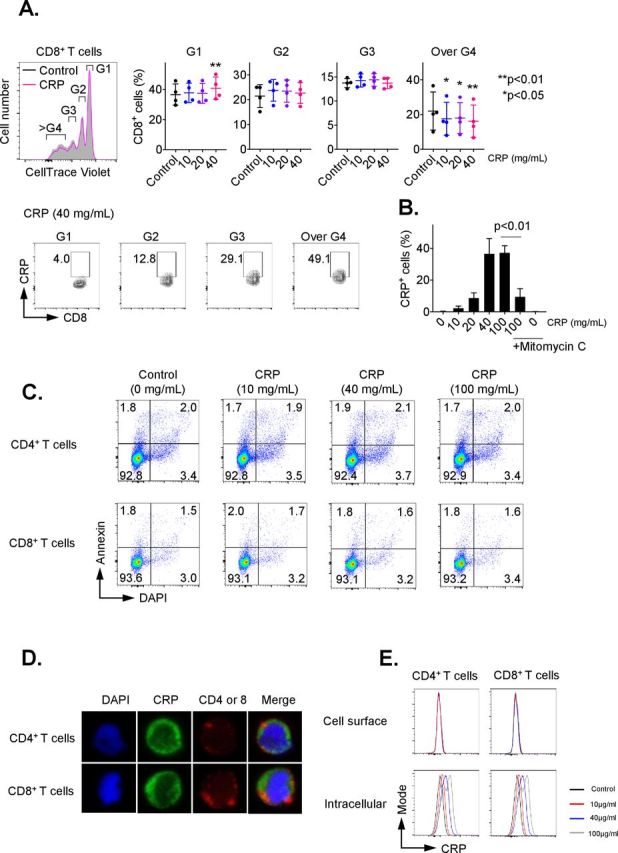
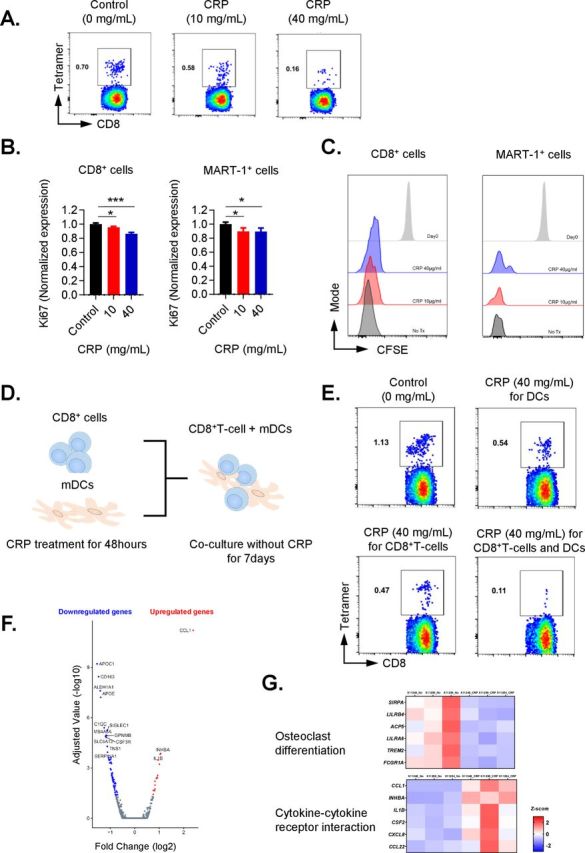
In vitro, CRP inhibited proliferation, activation-associated phenotypes and the effector function of activated CD4+ and CD8+ T cells from patients with melanoma. CRP-treated T cells expressed high levels of interleukin-1β, which is known to enhance CRP production from the liver. CRP also suppressed formation of the immune synapse and inhibited early events in T-cell receptor engagement. In addition, CRP downregulated the expression of costimulatory molecules on mature DCs and suppressed expansion of MART-1-specific CD8+ T cells in a dose-dependent manner by impacting on both T cells and antigen-presenting cells. High-serum CRP levels at baseline were significantly associated with a shorter survival in both nivolumab-treated and ipilimumab-treated patients.
These findings suggest that high levels of CRP induce an immunosuppressive in melanoma and support the blockade of CRP as a therapeutic strategy to enhance immune checkpoint therapies in cancer.
NCT01783938 and NCT02983006.
高 C 反应蛋白(CRP)水平已被报道与多种恶性肿瘤的不良临床结局相关,与晚期癌症患者的程序性死亡蛋白 1 免疫检查点阻断相关。关于 CRP 对癌症适应性免疫的直接影响知之甚少。因此,我们研究了 CRP 如何影响黑色素瘤患者 T 细胞和树突状细胞(DC)的功能。
通过多色流式细胞术和 RNA-seq 分析 CRP 对患者 T 细胞和 DC 增殖、功能、基因表达和表型的影响,以及 MART-1 抗原特异性 T 细胞的扩增。此外,通过 Luminex 测定评估转移性黑色素瘤患者在 Checkmate-064 临床试验中治疗时的基线血清 CRP 水平。
在体外,CRP 抑制了黑色素瘤患者激活的 CD4+和 CD8+T 细胞的增殖、激活相关表型和效应功能。CRP 处理的 T 细胞表达高水平的白细胞介素 1β,已知白细胞介素 1β可增强肝脏中 CRP 的产生。CRP 还抑制免疫突触的形成,并通过影响 T 细胞和抗原呈递细胞来抑制 T 细胞受体结合的早期事件。此外,CRP 以剂量依赖的方式下调成熟 DC 上共刺激分子的表达,并抑制 MART-1 特异性 CD8+T 细胞的扩增。基线时高血清 CRP 水平与 nivolumab 治疗和 ipilimumab 治疗患者的生存时间均显著缩短相关。
这些发现表明,高水平的 CRP 在黑色素瘤中诱导免疫抑制,并支持阻断 CRP 作为一种治疗策略,以增强癌症中的免疫检查点治疗。
NCT01783938 和 NCT02983006。