Department of Anesthesiology and Intensive Therapy, Wroclaw Medical University, Wroclaw 50-556, Poland.
Aging (Albany NY). 2020 Apr 19;12(8):7006-7014. doi: 10.18632/aging.103058.
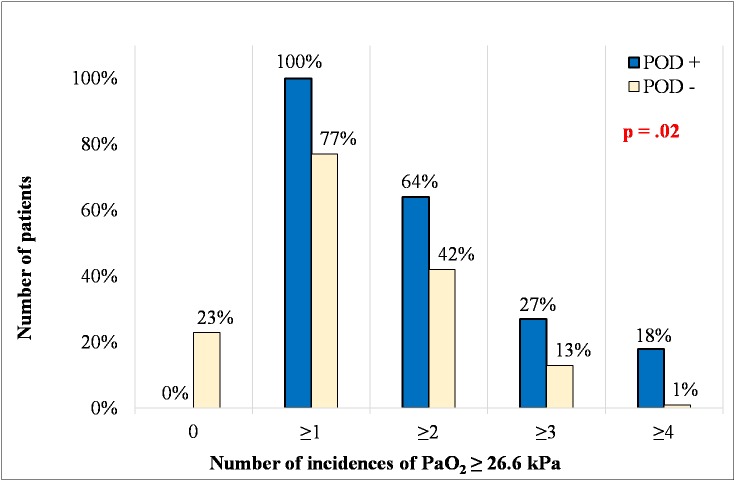
Delirium is a common complication after cardiac surgery. The aim of our study was to determine the impact of hyperoxia episodes occurring during cardiopulmonary bypass (CBP) on the rate of delirium episodes in the postoperative period. 93 patients, aged ≥ 65, who underwent elective cardiac surgery (CBP <90 minutes) were enrolled. The occurrence of delirium episodes was examined every 12 hours for three days after surgery. Eleven patients (11.8%) developed postoperative delirium (POD (+)) and 83 did not (POD (-)). More incidences of severe hyperoxia (PaO2 ≥ 26.6kPa) during CBP were observed in the POD (+) group: 64% had ≥ 2 episodes of hyperoxia, 27% ≥ 3, and 18% ≥ 4, while in the POD (-) group: 42%, 13% and 1%, respectively (P=0.02). Patients in the POD (+) group had a higher maximum PaO during CBP than the POD (-) group (37 ± 5.8 vs 31.6 ± 6.6 kPa; P=0.01) and a higher mean PaO (30.1 ± 4.5 vs 26.1 ± 5.6 kPa; P=0.01). The optimal maximum PaO cut-off point for the occurrence of delirium was 33.2 kPa (AUC 0.72, P=0.001, sensitivity 75%, specificity 38%). We conclude that CBP hyperoxia episodes may be a risk factor associated with the occurrence of postoperative delirium.
谵妄是心脏手术后常见的并发症。我们的研究目的是确定体外循环 (CPB) 过程中发生的高氧血症发作对术后谵妄发作率的影响。纳入了 93 名年龄≥65 岁、接受择期心脏手术(CPB<90 分钟)的患者。术后每 12 小时检查一次谵妄发作情况,持续三天。11 名患者(11.8%)出现术后谵妄(POD (+)),83 名患者未出现(POD (-))。在 POD (+)组中,CPB 期间更频繁地出现严重高氧血症(PaO2≥26.6kPa):64%的患者有≥2 次高氧血症,27%的患者有≥3 次,18%的患者有≥4 次,而在 POD (-)组中,分别为 42%、13%和 1%(P=0.02)。与 POD (-)组相比,POD (+)组患者在 CPB 期间的最大 PaO 更高(37±5.8 与 31.6±6.6kPa;P=0.01),平均 PaO 也更高(30.1±4.5 与 26.1±5.6kPa;P=0.01)。发生谵妄的最佳最大 PaO 截断值为 33.2kPa(AUC 0.72,P=0.001,敏感性 75%,特异性 38%)。我们得出结论,CPB 高氧血症发作可能是与术后谵妄发生相关的危险因素。