Division of Gastroenterology, Department of Internal Medicine, Gachon University Gil Medical Center, Gachon University College of Medicine, 21, Namdong-daero 774 beon-gil, Namdong-gu, Incheon, 21565, Republic of Korea.
Department of Internal Medicine, Jeju National University Hospital, Jeju National University School of Medicine, Jeju, Republic of Korea.
BMC Gastroenterol. 2020 Apr 19;20(1):117. doi: 10.1186/s12876-020-01273-4.
The majority of colonic obstructions result from colorectal cancer. However, malignancies of extra-colonic origin can also disrupt colorectal patency, and the efficacy of self-expanding metal stents (SEMS) insertion as a bridge to surgery in these patients are still in debate. The aim of this study is to evaluate the efficacy of endoscopic stenting as a bridge to surgery (BTS) for extra-colonic malignancy (ECM)-induced colonic obstruction.
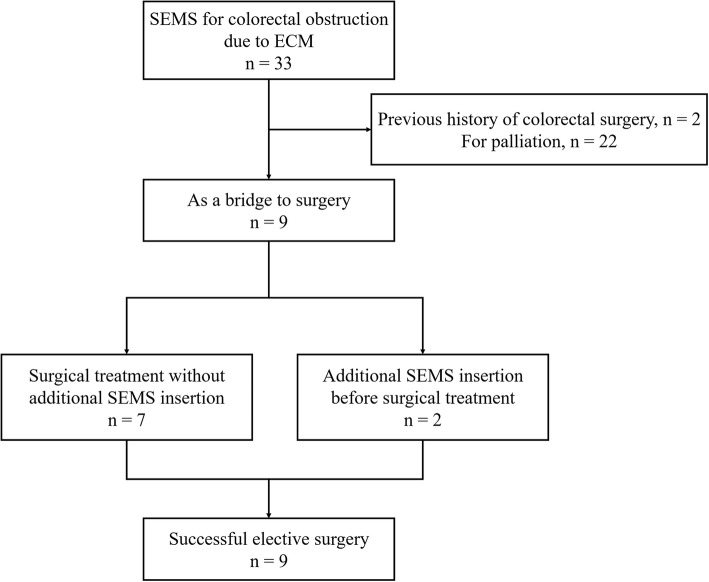
Thirty-three patients with colonic obstruction due to ECM who received self-expanding metal stents (SEMS) insertion at a single academic tertiary medical center between 2004 and 2015 were included. The purpose of SEMS insertion was determined based on whether the patient's medical records indicated any surgical plans before SEMS insertion. Technical success was defined as a patent SEMS covering the entire length of the obstruction. Bridging success was defined as elective surgical procedures after the first SEMS insertion.
Among the 33 patients who underwent SEMS insertion for colorectal obstruction due to ECM, nine underwent SEMS as a BTS. Technical success was achieved in 100% (9/9). Seven patients underwent elective surgery after successful decompression with the first SEMS, and the bridging success rate was 77.8% (7/9). Two patients needed secondary stent insertion before elective surgery. However, none of them required emergent surgery. No major complications occurred, including death related to colorectal endoscopic procedures, perforation, or bleeding.
SEMS insertion as a BTS is a good treatment option to avoid emergent surgery in patients with colonic obstruction caused by extra-colonic malignancy.
大多数结肠梗阻是由结直肠癌引起的。然而,源于结外的恶性肿瘤也可能导致结直肠阻塞,且这些患者采用自膨式金属支架(SEMS)置入作为手术桥接的疗效仍存在争议。本研究旨在评估内镜下支架置入作为结外恶性肿瘤(ECM)所致结肠梗阻手术桥接(BTS)的疗效。
2004 年至 2015 年间,在一家学术性三级医疗中心,33 例因 ECM 导致结肠梗阻的患者接受了 SEMS 置入。SEMS 置入的目的是根据 SEMS 置入前患者的病历是否有任何手术计划来确定。技术成功定义为 SEMS 完全覆盖梗阻段且通畅。桥接成功定义为首次 SEMS 置入后进行的择期手术。
33 例因 ECM 导致结肠梗阻而行 SEMS 置入的患者中,有 9 例将 SEMS 作为 BTS。技术成功率达到 100%(9/9)。首次 SEMS 减压成功后,有 7 例患者进行了择期手术,桥接成功率为 77.8%(7/9)。有 2 例患者需要在择期手术前进行二次支架置入,但均无需紧急手术。无重大并发症发生,包括与结直肠内镜相关的死亡、穿孔或出血。
对于因结外恶性肿瘤引起的结肠梗阻患者,SEMS 置入作为 BTS 是一种避免紧急手术的良好治疗选择。