Clinical Pharmacy and Pharmacology Department, Muhimbili University of Health and Allied Sciences, Dar es Salaam, United Republic of Tanzania.
National Institute for Medical Research, Tanga Centre, Tanga, United Republic of Tanzania.
Malar J. 2020 Apr 19;19(1):160. doi: 10.1186/s12936-020-03234-4.
Malaria in pregnancy increases the risk of deleterious maternal and birth outcomes. The use of ≥ 3 doses of sulfadoxine-pyrimethamine (SP) for intermittent preventive treatment of malaria (IPTp-SP) is recommended for preventing the consequences of malaria during pregnancy. This study assessed the effect of IPTp-SP for prevention of malaria during pregnancy in low transmission settings.
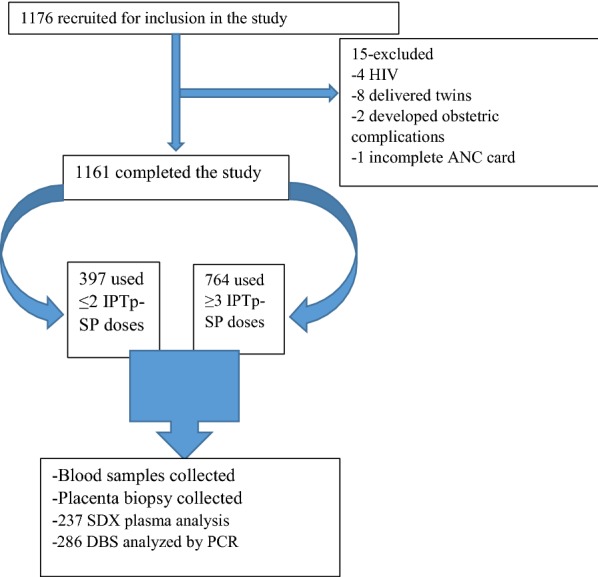
A cross-sectional study that involved consecutively selected 1161 pregnant women was conducted at Mwananyamala regional referral hospital in Dar es Salaam. Assessment of the uptake of IPTp-SP was done by extracting information from antenatal clinic cards. Maternal venous blood, cord blood, placental blood and placental biopsy were collected for assessment of anaemia and malaria. High performance liquid chromatography with ultraviolet detection (HPLC-UV) was used to detect and quantify sulfadoxine (SDX). Dried blood spots (DBS) of placental blood were collected for determination of sub-microscopic malaria using polymerase chain reaction (PCR).
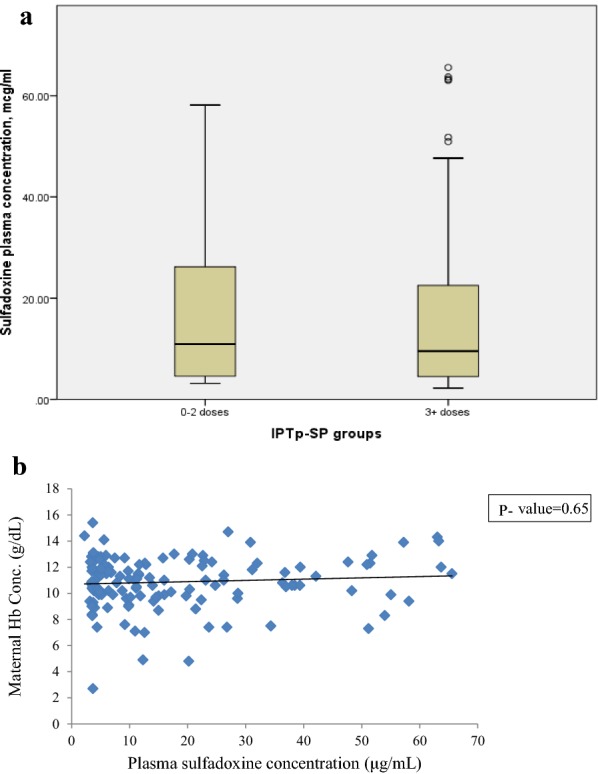
In total, 397 (34.2%) pregnant women reported to have used sub-optimal doses (≤ 2) while 764 (65.8%) used optimal doses (≥ 3) of IPTp-SP at the time of delivery. The prevalence of placental malaria as determined by histology was 3.6%. Submicroscopic placental malaria was detected in 1.4% of the study participants. Women with peripheral malaria had six times risk of maternal anaemia than those who were malaria negative (aOR, 5.83; 95% CI 1.10-30.92; p = 0.04). The geometric mean plasma SDX concentration was 10.76 ± 2.51 μg/mL. Sub-optimal IPTp-SP dose was not associated with placental malaria, premature delivery and fetal anaemia. The use of ≤ 2 doses of IPTp-SP increased the risk of maternal anaemia by 1.36-fold compared to ≥ 3 doses (aOR, 1.36; 95% CI 1.04-1.79; p = 0.02).
The use of < 2 doses of IPTp-SP increased the risk of maternal anaemia. However, sub-optimal doses (≤ 2 doses) were not associated with increased the risk of malaria parasitaemia, fetal anaemia and preterm delivery among pregnant women in low malaria transmission setting. The use of optimal doses (≥ 3 doses) of IPTp-SP and complementary interventions should continue even in areas with low malaria transmission.
妊娠疟疾会增加产妇和围产儿不良结局的风险。推荐使用≥3 剂磺胺多辛-乙胺嘧啶(SP)进行间歇性预防治疗疟疾(IPTp-SP),以预防妊娠期间疟疾的后果。本研究评估了在低传播环境中使用 IPTp-SP 预防妊娠疟疾的效果。
在达累斯萨拉姆的姆万尼亚马拉地区转诊医院进行了一项横断面研究,连续选择了 1161 名孕妇。通过从产前诊所卡片中提取信息来评估 IPTp-SP 的使用率。采集孕妇静脉血、脐血、胎盘血和胎盘组织活检,以评估贫血和疟疾。采用高效液相色谱法结合紫外检测(HPLC-UV)检测和定量磺胺多辛(SDX)。采集胎盘血的干血斑(DBS),采用聚合酶链反应(PCR)检测亚微观疟疾。
共有 397 名(34.2%)孕妇报告使用了不适当剂量(≤2 剂),而 764 名(65.8%)孕妇在分娩时使用了最佳剂量(≥3 剂)的 IPTp-SP。组织学确定的胎盘疟疾患病率为 3.6%。研究参与者中有 1.4%检测到亚微观胎盘疟疾。患有外周疟疾的女性患产妇贫血的风险是疟疾阴性女性的六倍(优势比,5.83;95%CI 1.10-30.92;p=0.04)。血浆 SDX 浓度的几何均数为 10.76±2.51μg/ml。不适当的 IPTp-SP 剂量与胎盘疟疾、早产和胎儿贫血无关。与≥3 剂相比,使用≤2 剂 IPTp-SP 会使产妇贫血的风险增加 1.36 倍(优势比,1.36;95%CI 1.04-1.79;p=0.02)。
使用<2 剂 IPTp-SP 会增加产妇贫血的风险。然而,在低疟疾传播地区,不适当剂量(≤2 剂)与疟疾寄生虫血症、胎儿贫血和早产风险增加无关。即使在疟疾传播率低的地区,也应继续使用最佳剂量(≥3 剂)的 IPTp-SP 和补充干预措施。