
加纳凡蒂夸南区社区居民无症状疟疾的流行病学及患病可能性
Epidemiology and likelihood of asymptomatic malaria among community dwellers in the Fanteakwa south district of Ghana.
作者信息
Aninagyei Enoch, Adedia David, Larbi Gifty, Acheampong Stella Omane, Nyarko Margaret, Abbew George Abeiku, Tuwarlba Isaac, Acheampong Desmond Omane
机构信息
School of Basic and Biomedical Sciences, Department of Biomedical Sciences, University of Health and Allied Sciences, PMB 31 Ho, Volta Region, Ghana.
School of Basic and Biomedical Sciences, Department of Basic, University of Health and Allied Sciences, PMB 31 Ho, Volta Region, Ghana.
出版信息
Parasite Epidemiol Control. 2024 Sep 5;27:e00378. doi: 10.1016/j.parepi.2024.e00378. eCollection 2024 Nov.
BACKGROUND
Data on the asymptomatic burden of malaria in endemic areas is essential for Ghana's malaria elimination efforts. Consequently, the situation of asymptomatic malaria in the Fanteakwa South District (FSD) is determined in this study. The FSD is predominantly forested with more rural than peri-urban communities. Additionally, artisanal mining is prevalent in the district. Despite that the forgoing could promote high incidence of malaria, the burden of asymptomatic malaria and associated factors in the district have never been determined.
METHODS
This community-based cross-sectional study was conducted in four randomly selected communities in the FSD in the Eastern region of Ghana. The participating households were systematically selected, of which one household member was randomly enrolled in the study. With prior consent, 2 mL of whole blood was collected from the participants. Subsequently, the study variables were obtained from the enrolees using a structured questionnaire. The malaria status of the enrolled participants was determined using the CareStart™ malaria rapid diagnostic test kit (mRDT) (USA). The multiple logistic regression model was used to fit the model to predict the groups at risk of infection in the district.
RESULTS
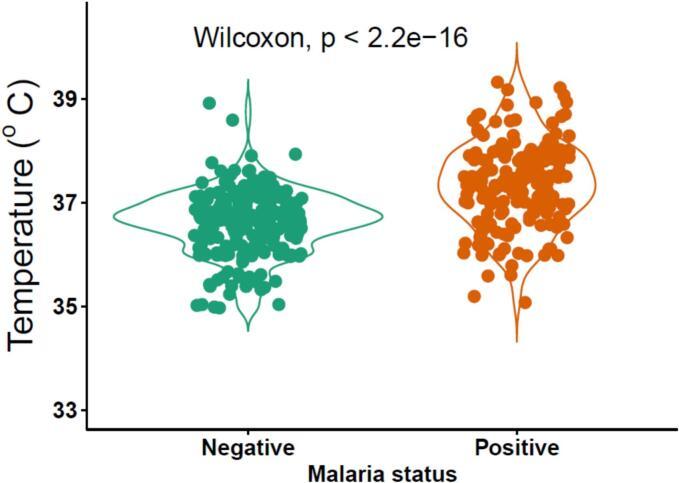
In total, 412 study participants were enrolled. The overall prevalence of asymptomatic malaria in the district was 43.4 % (179/412). The prevalence rate was 36.9 %, 27.7 %, 50 % and 58.8 % (<0.001) respectively for the Dwenase, Bosusu, Nsutam and Osino communities. Living at Bosusu ( = 0.045, AOR = 0.23, 95 % CI: 0.05-0.96), Dwenase ( < 0.001, AOR = 0.12, 95 % CI: 0.04-0.30) and Nsutam (p < 0.001, AOR = 0.19, 95 % CI: 0.08-0.45) were less likely to contract malaria compared to Osino dwellers. Furthermore, pregnant women ( = 0.024, COR = 0.35, 95 % CI: 0.14-0.9) and individuals who do not share mosquito nets with others ( = 0.017, COR = 0.47, 95 % CI: 0.25-0.88) were less likely to contract malaria. Moreover, being an adolescent ( = 0.048, COR = 1.93, 95 % CI: 1.00-3.73), living in mining communities ( = 0.002, COR = 1.97, 95 % CI: 1.27-3.05), being nocturnally active ( = 0.001, AOR = 4.64, 95 % CI: 1.97-11.31), living in a medium quality house ( = 0.031, AOR = 2.31, 95 % CI: 1.09-5.00), schooling in the district ( < 0.001) and body temperature above >37.5 °C (<0.001), were predictors of asymptomatic malaria.
CONCLUSIONS
The burden of asymptomatic malaria is high in the Fanteakwa South district. In this context, the implementation of the 'mass strategy' recommended by the World Health Organization will play a key role in eliminating malaria in the district.
背景
流行地区疟疾无症状负担的数据对于加纳的疟疾消除工作至关重要。因此,本研究确定了南凡蒂阿夸区(FSD)无症状疟疾的情况。FSD主要是森林地区,农村社区多于城郊社区。此外,个体采矿在该地区很普遍。尽管上述情况可能会促使疟疾高发,但该地区无症状疟疾的负担及相关因素从未被确定过。
方法
这项基于社区的横断面研究在加纳东部地区FSD随机选择的四个社区中进行。参与的家庭是系统选取的,其中随机选择一名家庭成员纳入研究。在获得事先同意后,从参与者身上采集2毫升全血。随后,使用结构化问卷从入选者那里获取研究变量。使用CareStart™疟疾快速诊断试剂盒(mRDT)(美国)确定入选参与者的疟疾状况。使用多重逻辑回归模型来拟合模型,以预测该地区有感染风险的人群。
结果
总共招募了412名研究参与者。该地区无症状疟疾的总体患病率为43.4%(179/412)。德瓦内斯、博苏苏、恩苏塔姆和奥西诺社区的患病率分别为36.9%、27.7%、50%和58.8%(<0.001)。与奥西诺居民相比,居住在博苏苏(P = 0.045,调整优势比[AOR]=0.23,95%置信区间[CI]:0.05 - 0.96)、德瓦内斯(P < 0.001,AOR = 0.12,95% CI:0.04 - 0.30)和恩苏塔姆(P < 0.001,AOR = 0.19,95% CI:0.08 - 0.45)感染疟疾的可能性较小。此外,孕妇(P = 0.024,校正优势比[COR]=0.35,95% CI:0.14 - 0.9)和不与他人共用蚊帐的个体(P = 0.017,COR = 0.47,95% CI:0.25 - 0.88)感染疟疾的可能性较小。此外,青少年(P = 0.048,COR = 1.93,95% CI:1.00 - 3.73)、居住在采矿社区(P = 0.002,COR = 1.97,95% CI:1.27 - 3.05)、夜间活动(P = 0.001,AOR = 4.64,95% CI:1.97 - 11.31)、居住在中等质量房屋(P = 0.031,AOR = 2.31,95% CI:1.09 - 5.00)、在该地区上学(P < 0.001)以及体温高于37.5°C(P < 0.001)是无症状疟疾的预测因素。
结论
南凡蒂阿夸区无症状疟疾负担很高。在此背景下,实施世界卫生组织推荐的“大规模策略”将在该地区消除疟疾中发挥关键作用。

 Zotero 插件