Department of Parasitology, Leiden University Medical Centre, L4-Q, PO Box 9600, 2333 ZA Leiden, The Netherlands.
Department of Medical Microbiology, Leiden University Medical Center, 2333 ZA Leiden, The Netherlands.
J Travel Med. 2020 Jul 14;27(4). doi: 10.1093/jtm/taaa055.
Travellers infected with Schistosoma spp. might be pauci- or even asymptomatic on first presentation. Therefore, schistosomiasis may remain undiagnosed in this population. Active infection, as evidenced by the presence of the tissue-dwelling worm, can be demonstrated via the detection of adult worm-derived circulating anodic antigen (CAA) utilising a robust well-described lateral flow-(LF) based test applying background-free up-converting reporter particles (UCP). In this prospective study, we assessed the diagnostic value of serum and urine UCP-LF CAA test in comparison with two Schistosoma-specific serological assays detecting antibodies against adult worm antigen-immuno fluorescence assay (AWA-IFA) and against soluble egg antigen-enzyme-linked immunosorbent assay (SEA-ELISA) antigens in travellers.
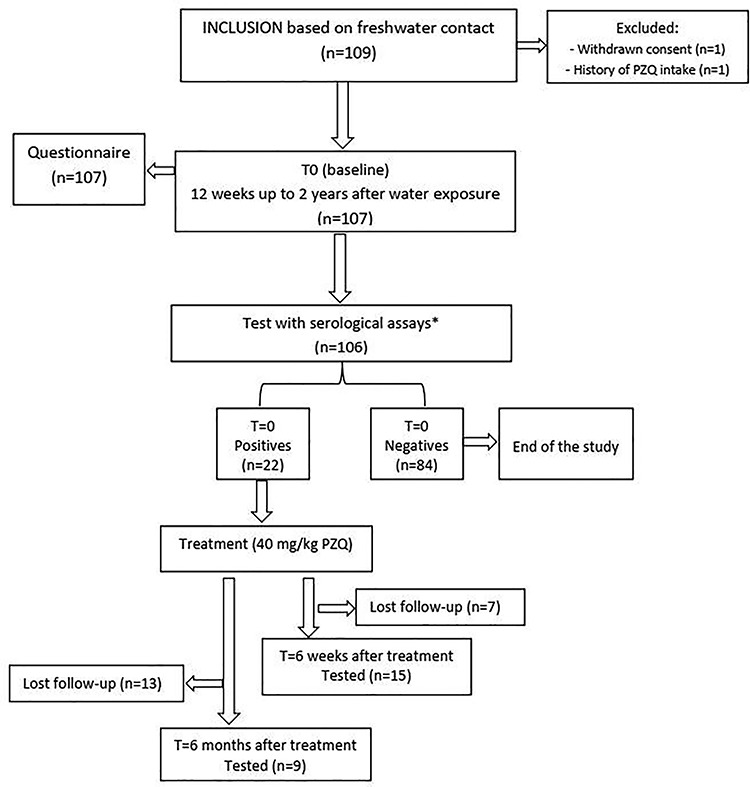
Samples were collected from 106 Dutch travellers who reported freshwater contact in sub-Saharan Africa and who were recruited up to 2 years after return. Subjects were asked to complete a detailed questionnaire on travel history, water contact, signs and symptoms compatible with schistosomiasis.
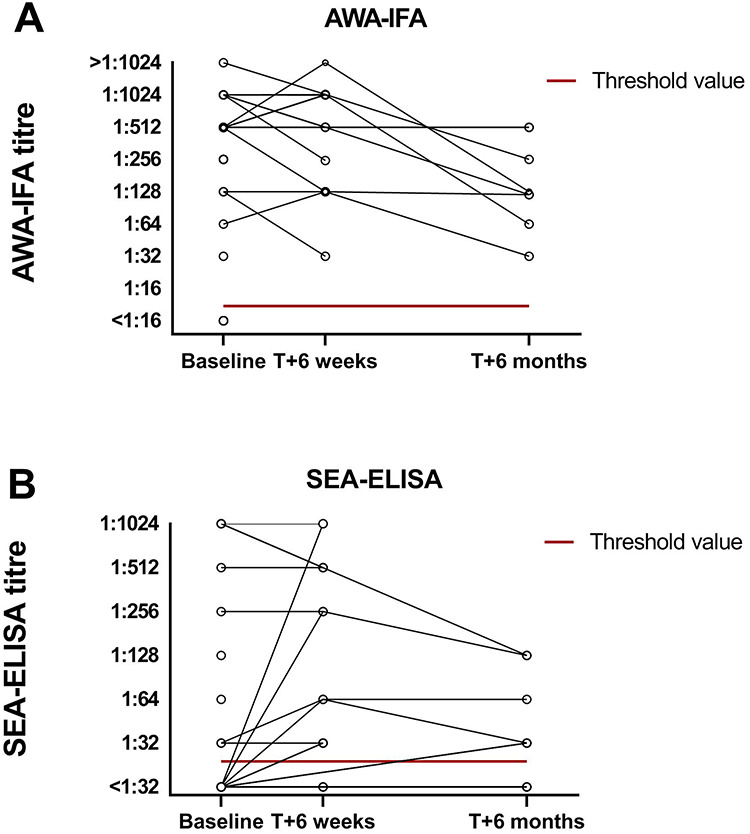
Two travellers were positive by serum CAA and an additional one by urine CAA. A total of 22/106 (21%) samples were antibody positive by AWA-IFA and 9/106 (9%) by SEA-ELISA. At follow-up 6 weeks and 6 months after praziquantel treatment, all seropositives remained antibody positive whereas CAA was cleared. Seropositivity could not be predicted by the type of fresh water-related activity, country visited or symptoms reported.
The low number of UCP-LF CAA positives suggests that in travellers, active infections often do not establish or have very low worm burden. Based on our high seroconversion rates, we conclude that the AWA-IFA assay is the most sensitive test to detect schistosome exposure. Given the lack of predictive symptoms or risk factors, we recommend schistosomiasis screening at least by serology in all travellers with reported freshwater contact in high-endemic areas.
旅行者初次就诊时可能只有轻度感染或甚至无症状。因此,在这一人群中,可能会漏诊血吸虫病。通过使用稳健且描述详尽的侧向流动(LF)基础检测,检测源自成虫的循环阳极抗原(CAA),可以证明存在活动性感染,该检测方法应用无背景的上转换报告颗粒(UCP)。在这项前瞻性研究中,我们评估了血清和尿液 UCP-LF CAA 检测与两种针对成虫抗原的血吸虫病特异性血清学检测方法(检测针对成虫抗原的免疫荧光检测(AWA-IFA)和针对可溶性卵抗原的酶联免疫吸附检测(SEA-ELISA)抗体)的诊断价值,用于旅行者。
采集了 106 名荷兰旅行者的样本,这些旅行者在返回后最多 2 年内报告了在撒哈拉以南非洲地区接触过淡水,并填写了一份详细的旅行史、接触水、与血吸虫病相符的体征和症状问卷。
2 名旅行者的血清 CAA 检测呈阳性,另 1 名旅行者的尿液 CAA 检测呈阳性。共有 22/106(21%)的样本通过 AWA-IFA 呈抗体阳性,9/106(9%)的样本通过 SEA-ELISA 呈抗体阳性。在接受吡喹酮治疗后 6 周和 6 个月的随访中,所有血清阳性者仍保持抗体阳性,而 CAA 则被清除。血清阳性不能通过与淡水相关的活动类型、所访问的国家或报告的症状来预测。
UCP-LF CAA 阳性者数量较少,表明旅行者中,活动性感染通常不会发生或虫负荷非常低。基于我们较高的血清转化率,我们得出结论,AWA-IFA 检测是检测血吸虫暴露最敏感的检测方法。鉴于缺乏预测性症状或风险因素,我们建议在所有报告有淡水接触的旅行者中,至少通过血清学进行血吸虫病筛查。