Universitätsklinikum RWTH Aachen, Pauwelsstrasse 30, 52074, Aachen, Germany.
University of Milano-Bicocca, Monza, Italy.
Ann Hematol. 2020 Jun;99(6):1241-1249. doi: 10.1007/s00277-020-04018-1. Epub 2020 Apr 19.
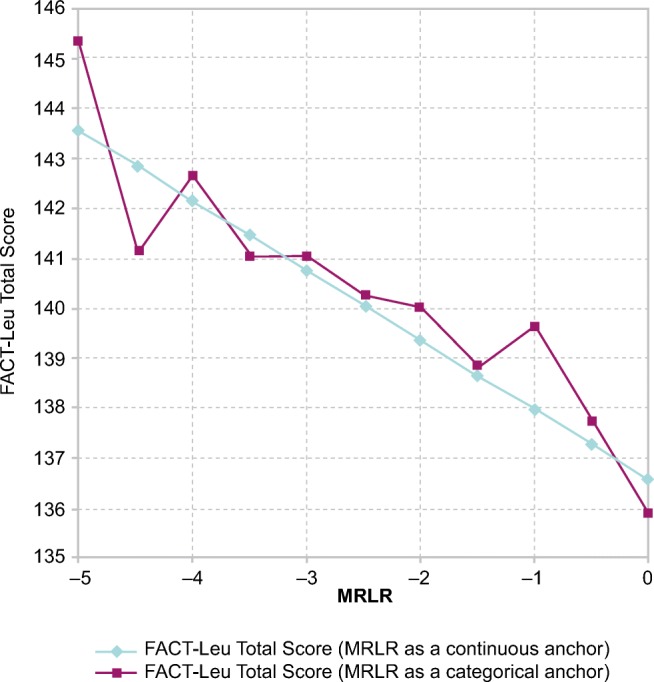
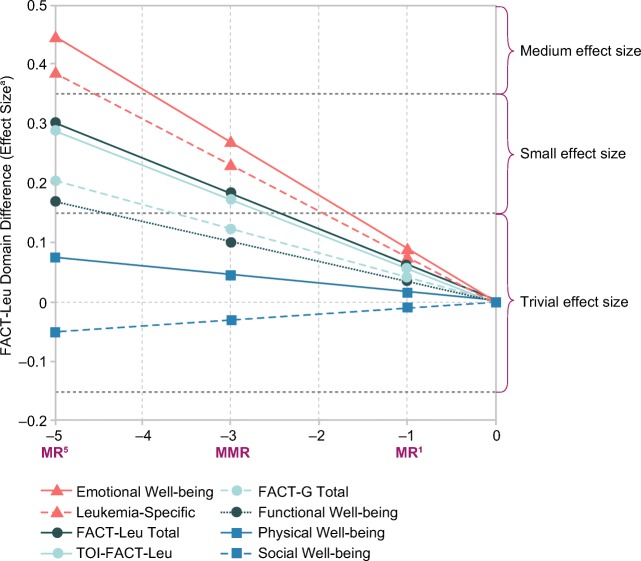
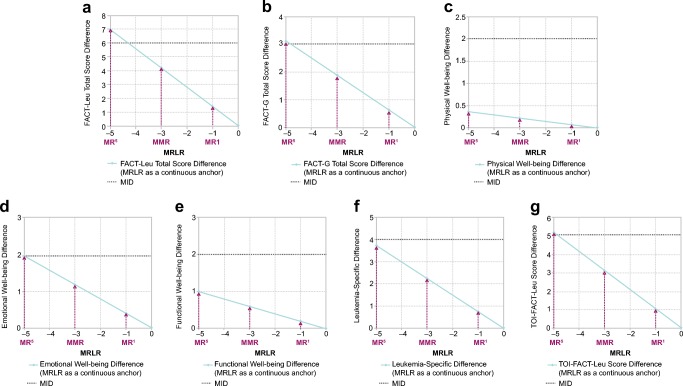
Patients with newly diagnosed chronic phase chronic myeloid leukemia (CP CML) can be effectively treated with tyrosine kinase inhibitors (TKIs) and achieve a lifespan similar to the general population. The success of TKIs, however, requires long-term and sometimes lifelong treatment; thus, patient-assessed health-related quality of life (HRQoL) has become an increasingly important parameter for treatment selection. Bosutinib is a TKI approved for CP CML in newly diagnosed adults and in those resistant or intolerant to prior therapy. In the Bosutinib Trial in First-Line Chronic Myelogenous Leukemia Treatment (BFORE), bosutinib demonstrated a significantly higher major molecular response rate compared with imatinib, with maintenance of HRQoL (measured by the Functional Assessment of Cancer Therapy-Leukemia (FACT-Leu) questionnaire), after 12 months of first-line treatment. We examined relationships between molecular response (MR) and HRQoL. MR values were represented by a log-reduction scale (MRLR; a continuous variable). A repeated-measures longitudinal model was used to estimate the relationships between MRLR as a predictor and each FACT-Leu domain as an outcome. Effect sizes were calculated to determine strength of effects and allow comparisons across domains. The majority of FACT-Leu domains (with the exception of social well-being and physical well-being) demonstrated a significant relationship with MRLR (p < 0.05). Our results showed variable impact of clinical improvement on different dimensions of HRQoL. For patients who achieved MR, emotional well-being and leukemia-specific domains showed the greatest improvement, with medium differences in effect sizes, whereas social well-being and physical well-being had the weakest relationship with MR.
新诊断的慢性期慢性髓性白血病(CP CML)患者可以通过酪氨酸激酶抑制剂(TKIs)有效治疗,并达到与普通人群相似的寿命。然而,TKI 的成功需要长期甚至终身治疗;因此,患者评估的健康相关生活质量(HRQoL)已成为治疗选择的一个越来越重要的参数。博舒替尼是一种用于新诊断的成人 CP CML 和对先前治疗耐药或不耐受的 CP CML 的 TKI。在 Bosutinib 一线治疗初发慢性髓性白血病试验(BFORE)中,与伊马替尼相比,博舒替尼显示出更高的主要分子反应率,并且在一线治疗 12 个月后保持 HRQoL(通过功能性评估癌症治疗 - 白血病(FACT-Leu)问卷测量)。我们研究了分子反应(MR)与 HRQoL 之间的关系。MR 值用对数减少量表(MRLR;连续变量)表示。采用重复测量纵向模型来估计 MRLR 作为预测因子与每个 FACT-Leu 域作为结果之间的关系。计算效应大小以确定效应的强度并允许在不同领域进行比较。大多数 FACT-Leu 域(社会幸福感和身体健康除外)与 MRLR 呈显著相关(p<0.05)。我们的结果表明,临床改善对 HRQoL 的不同维度的影响不同。对于达到 MR 的患者,情绪幸福感和白血病特异性领域显示出最大的改善,效应大小差异中等,而社会幸福感和身体健康与 MR 的关系最弱。