Kokkonen Piia, Slanska Michaela, Dockalova Veronika, Pinto Gaspar P, Sánchez-Carnerero Esther M, Damborsky Jiri, Klán Petr, Prokop Zbynek, Bednar David
Loschmidt Laboratories, Department of Experimental Biology and RECETOX, Faculty of Science, Masaryk University, Brno, Czech Republic.
International Clinical Research Centre, St. Ann's Hospital, Brno, Czech Republic.
Comput Struct Biotechnol J. 2020 Mar 25;18:805-813. doi: 10.1016/j.csbj.2020.03.017. eCollection 2020.
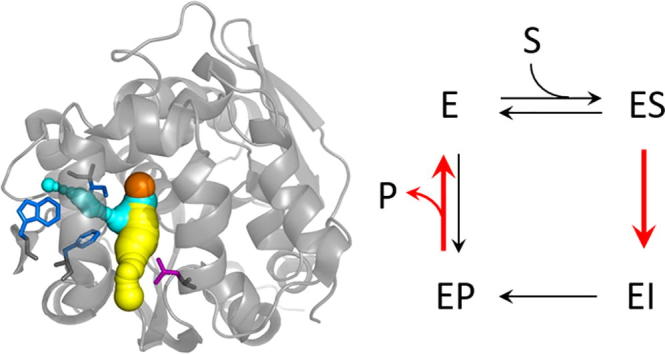
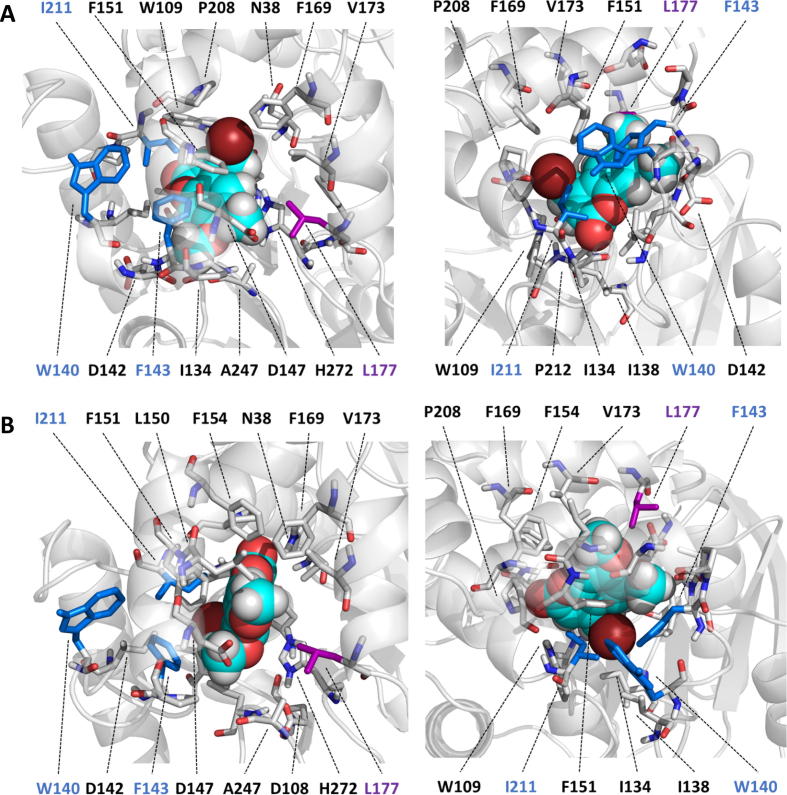
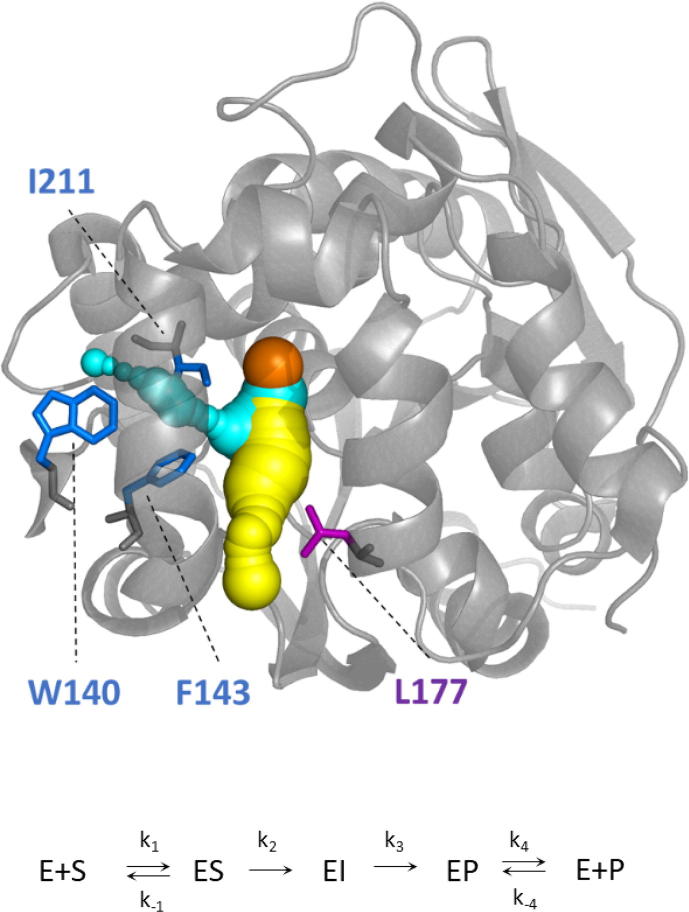
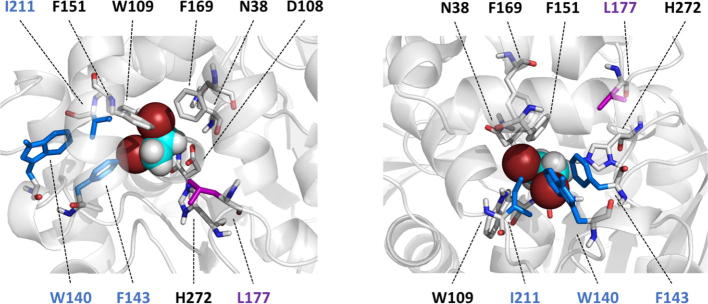
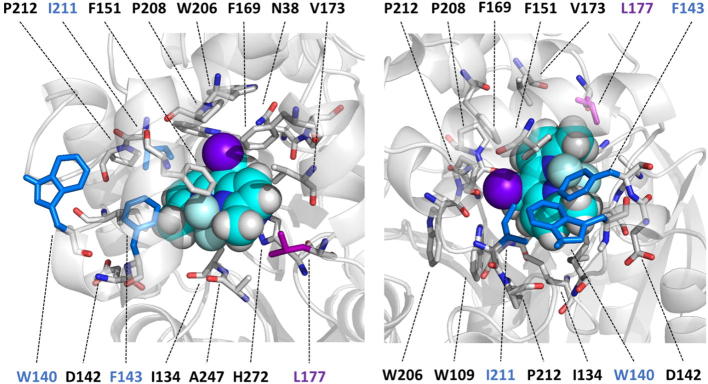
Transport of ligands between bulk solvent and the buried active sites is a critical event in the catalytic cycle of many enzymes. The rational design of transport pathways is far from trivial due to the lack of knowledge about the effect of mutations on ligand transport. The main and an auxiliary tunnel of haloalkane dehalogenase LinB have been previously engineered for improved dehalogenation of 1,2-dibromoethane (DBE). The first chemical step of DBE conversion was enhanced by L177W mutation in the main tunnel, but the rate-limiting product release was slowed down because the mutation blocked the main access tunnel and hindered protein dynamics. Three additional mutations W140A + F143L + I211L opened-up the auxiliary tunnel and enhanced the product release, making this four-point variant the most efficient catalyst with DBE. Here we study the impact of these mutations on the catalysis of bulky aromatic substrates, 4-(bromomethyl)-6,7-dimethoxycoumarin (COU) and 8-chloromethyl-4,4'-difluoro-3,5-dimethyl-4-bora-3a,4a-diaza--indacene (BDP). The rate-limiting step of DBE conversion is the product release, whereas the catalysis of COU and BDP is limited by the chemical step. The catalysis of COU is mainly impaired by the mutation L177W, whereas the conversion of BDP is affected primarily by the mutations W140A + F143L + I211L. The combined computational and kinetic analyses explain the differences in activities between the enzyme-substrate pairs. The effect of tunnel mutations on catalysis depends on the rate-limiting step, the complementarity of the tunnels with the substrates and is clearly specific for each enzyme-substrate pair.
配体在本体溶剂与埋藏的活性位点之间的传输是许多酶催化循环中的关键事件。由于缺乏关于突变对配体传输影响的知识,合理设计传输途径并非易事。卤代烷脱卤酶LinB的主通道和辅助通道先前已进行工程改造,以改善1,2 - 二溴乙烷(DBE)的脱卤作用。主通道中的L177W突变增强了DBE转化的第一步化学反应,但限速产物释放却减慢了,因为该突变阻断了主要的进入通道并阻碍了蛋白质动力学。另外三个突变W140A + F143L + I211L打开了辅助通道并增强了产物释放,使这个四点变体成为催化DBE最有效的催化剂。在此,我们研究这些突变对大分子芳香族底物4 - (溴甲基)-6,7 - 二甲氧基香豆素(COU)和8 - 氯甲基-4,4'-二氟-3,5 - 二甲基-4 - 硼-3a,4a - 二氮杂 - 茚(BDP)催化作用的影响。DBE转化的限速步骤是产物释放,而COU和BDP的催化作用则受化学反应步骤限制。COU的催化作用主要受L177W突变的损害,而BDP的转化主要受W140A + F143L + I211L突变的影响。计算分析和动力学分析相结合解释了酶 - 底物对之间活性的差异。通道突变对催化作用的影响取决于限速步骤、通道与底物的互补性,并且对每个酶 - 底物对都具有明显的特异性。