Zhao Dewei, Zhang Feng, Wang Benjie, Liu Baoyi, Li Lu, Kim Shin-Yoon, Goodman Stuart B, Hernigou Philippe, Cui Quanjun, Lineaweaver William C, Xu Jiake, Drescher Wolf R, Qin Ling
Department of Orthopaedics, Affiliated Zhongshan Hospital of Dalian University, Dalian, PR China.
JMS Burn and Reconstructive Center, Jackson, MS, USA.
J Orthop Translat. 2020 Jan 6;21:100-110. doi: 10.1016/j.jot.2019.12.004. eCollection 2020 Mar.
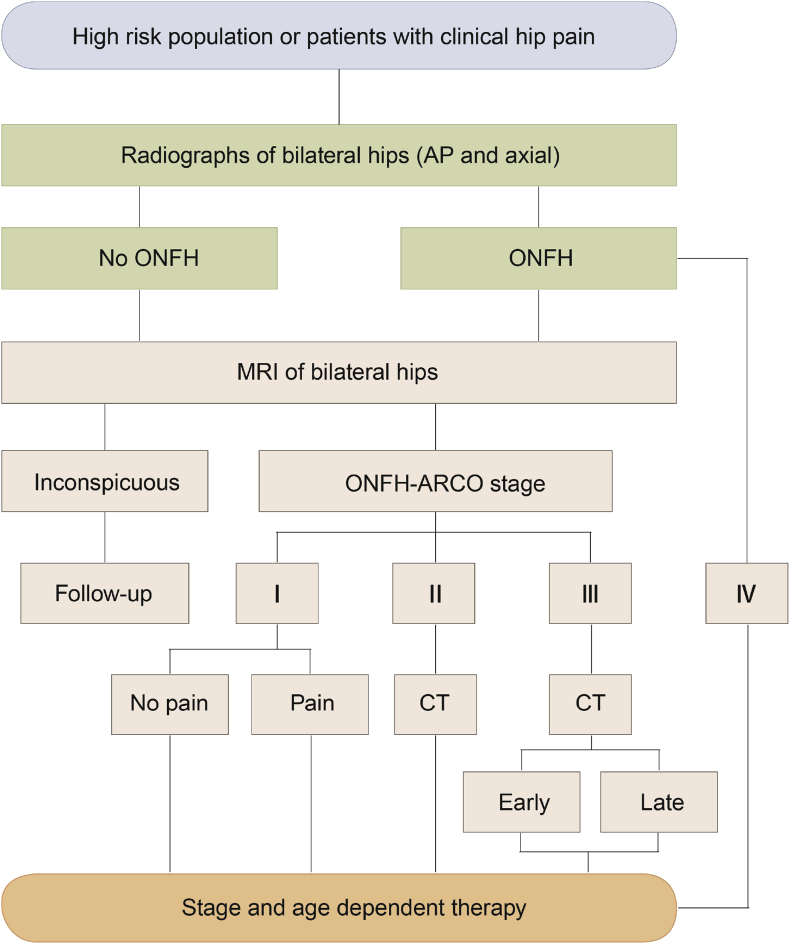
Osteonecrosis of the femoral head (ONFH) is a common and refractory disease in orthopaedic clinics. The number of patients with ONFH is increasing worldwide every year. There are an estimated 8.12 million patients with nontraumatic osteonecrosis in China alone. Treatment of nontraumatic osteonecrosis has always been a clinical challenge for orthopaedic surgeons. To further standardize diagnosis and treatment of ONFH, these guidelines provide not only basic diagnosis, treatment, and evaluation systems for ONFH but also expert advice and standards in many aspects, including epidemiology, aetiology, diagnostic criteria, pathological staging, prevention and treatment options, and postoperative rehabilitation. The aetiological factors of ONFH can currently be divided into two major categories: traumatic and nontraumatic; however, the specific pathological mechanism of ONFH is not completely clear. Currently, the staging system of ONFH formulated by the Association Research Circulation Osseous is widely used in clinical practice. Based on the changes in the intraosseous blood supply at different stages, the corresponding nonsurgical and surgical treatments are recommended, and when there are risk factors for possible ONFH, certain preventive measures to avoid the occurrence of osteonecrosis are recommended. These guidelines provide brief classification criteria and treatment regimen for osteonecrosis. Specification of the aetiology, treatment plan based on comprehensive consideration of the different stages of osteonecrosis, hip function, age, and occupation of the patients are important steps in diagnosis and developing treatment strategies.
New advances in the epidemiology, etiology, pathophysiology, imaging, diagnosis and treatment of ONFH have been renewed in this revision. This guideline can be used for reference by orthopedic professionals and researchers, and for standardized diagnosis and treatment management under the clinical guidance, which is conducive to the prevention, treatment and further research of ONFH, improving the diagnosis and treatment level, making patients' symptoms under good control, and improving their quality of life.
股骨头坏死(ONFH)是骨科临床常见的难治性疾病。全球每年股骨头坏死患者数量都在增加。仅在中国,估计就有812万非创伤性股骨头坏死患者。非创伤性股骨头坏死的治疗一直是骨科医生面临的临床挑战。为进一步规范股骨头坏死的诊断和治疗,本指南不仅提供了股骨头坏死的基本诊断、治疗和评估体系,还在流行病学、病因学、诊断标准、病理分期、防治方案及术后康复等诸多方面提供了专家建议和标准。目前,股骨头坏死的病因可分为两大类:创伤性和非创伤性;然而,股骨头坏死的具体病理机制尚不完全清楚。目前,由骨循环研究协会制定的股骨头坏死分期系统在临床实践中广泛应用。根据不同阶段骨内血供的变化,推荐相应的非手术和手术治疗方法,当存在可能发生股骨头坏死的危险因素时,建议采取一定的预防措施以避免骨坏死的发生。本指南提供了骨坏死的简要分类标准和治疗方案。明确病因、基于对骨坏死不同阶段、髋关节功能、患者年龄及职业的综合考虑制定治疗方案是诊断和制定治疗策略的重要步骤。
本次修订更新了股骨头坏死在流行病学、病因学、病理生理学、影像学、诊断和治疗方面的新进展。本指南可供骨科专业人员和研究人员参考,并在临床指导下进行规范化诊断和治疗管理,有利于股骨头坏死的预防、治疗及进一步研究,提高诊治水平,使患者症状得到良好控制,改善生活质量。