Brasil Luis Josino, Marroni Norma, Schemitt Elizângela, Colares Josieli
Department of Anesthesiology and Pain Management, Universidade Federal de Ciências da Saúde de Porto Alegre (UFCSPA), Porto Alegre, Brazil.
Universidade Federal do Rio Grande do Sul (UFRGS), Porto Alegre, Brazil.
Anesth Pain Med. 2020 Feb 4;10(1):e97372. doi: 10.5812/aapm.97372. eCollection 2020 Feb.
Pulsed radiofrequency (PRF) affects animal and plant tissues; however, the mechanism has not been defined. We hypothesized that the magnetic field produced by PRF exerts its effects by the magnetic sensitivity of transitions between spin states -a spin-correlated radical-pair mechanism (SCRPM)- which, in turn, affects the rates of chemical reactions with participation of paramagnetic species.
This study aimed to evaluate the effects of PRF on redox equilibrium and inflammatory status in a standard model of muscle injury in rats.
Twenty-four animals were subjected to a single impact trauma to the left quadriceps and the groups exposed and not exposed to PRF were compared. On day 7 of the experiment, the animals were killed and the quadriceps muscles were removed for analysis.
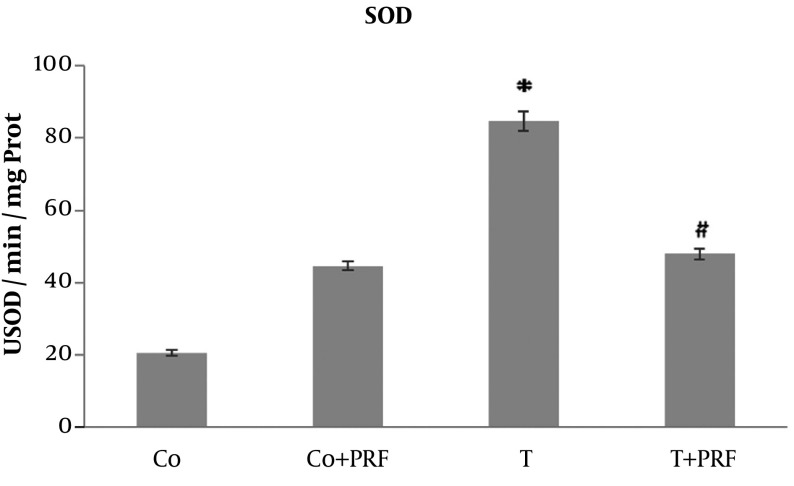
There was a significant increase in the concentration of thiobarbituric acid reactive substances (TBARS) in the muscle of animals from the trauma group (+233%), and this increase was eliminated by PRF administration. Superoxide dismutase (SOD) activity was increased (+411%) by trauma, resulting in significantly higher consumption of catalase (-72%), while PRF administration brought both of these markers back to levels close to those of the control group. Trauma induced considerable production of interleukins TNF-α, IL-1β, and IL-6 (+215%, +262%, and +326% vs. controls, respectively) and these effects were also significantly reduced by PRF administration.
In total, PRF inhibits oxidative stress and restores antioxidant enzymes to control levels and may block production of inflammatory markers in muscles of animals subjected to trauma. By modulating redox equilibrium, PRF treatment might block production of noxious mediators involved in development of trauma-induced injury.
脉冲射频(PRF)会影响动植物组织;然而,其作用机制尚未明确。我们推测,PRF产生的磁场通过自旋态之间跃迁的磁敏感性——一种自旋相关自由基对机制(SCRPM)——发挥作用,进而影响顺磁性物质参与的化学反应速率。
本研究旨在评估PRF对大鼠肌肉损伤标准模型中氧化还原平衡和炎症状态的影响。
对24只动物的左股四头肌进行单次撞击创伤,比较暴露于PRF和未暴露于PRF的两组动物。在实验第7天,处死动物并取出股四头肌进行分析。
创伤组动物肌肉中硫代巴比妥酸反应性物质(TBARS)浓度显著增加(+233%),而PRF给药消除了这种增加。创伤使超氧化物歧化酶(SOD)活性增加(+411%),导致过氧化氢酶消耗显著增加(-72%),而PRF给药使这两种指标均恢复到接近对照组的水平。创伤诱导产生大量白细胞介素TNF-α、IL-1β和IL-6(分别比对照组增加+215%、+262%和+326%),PRF给药也显著降低了这些影响。
总体而言,PRF可抑制氧化应激,使抗氧化酶恢复至对照水平,并可能阻断创伤动物肌肉中炎症标志物的产生。通过调节氧化还原平衡,PRF治疗可能会阻断参与创伤性损伤发展的有害介质的产生。