Ruzsa Zoltan, Januszek Rafał, Óriás Viktor, Chyrchel Michał, Wojtasik-Bakalarz Joanna, Bartuś Jerzy, Arif Saleh, Kleczyński Paweł, Tokarek Tomasz, Nyerges Andras, Stanek Agata, Dudek Dariusz, Bartuś Stanisław
Semmelweis University of Budapest, Cardiac and Vascular Center, Budapest, Hungary.
Bács-Kiskun County Hospital, Invasive Cardiology Department, Teaching Hospital of the Szent-Györgyi Albert Medical University, Kecskemét, Hungary.
Ann Transl Med. 2020 Mar;8(5):206. doi: 10.21037/atm.2020.01.57.
In this trial, our objective was to evaluate the relationship between long-term clinical outcomes in patients with peripheral arterial disease (PAD) treated with retrograde endovascular recanalization (ER) of chronic total occlusions (CTOs) regarding the infra-inguinal lower limb arteries and chronic obstructive pulmonary disease (COPD).
A total of 834 consecutive subjects were enrolled in the study. The mean age was 67.8±10.6 years (62.6% males). COPD was diagnosed in 98 patients (11.7%). The infra-inguinal location included the deep, superficial and common femoral artery, popliteal artery or below the knee arteries. During follow-up, we evaluated major adverse cardiac and cerebrovascular events (MACCE) and major adverse limb events (MALE). MACCE was considered as death, stroke/transient ischemic attack, myocardial infarction, percutaneous coronary intervention or coronary artery bypass grafting operation, while MALE regarded amputation, target lesion re-intervention, target vessel re-intervention and surgical action.
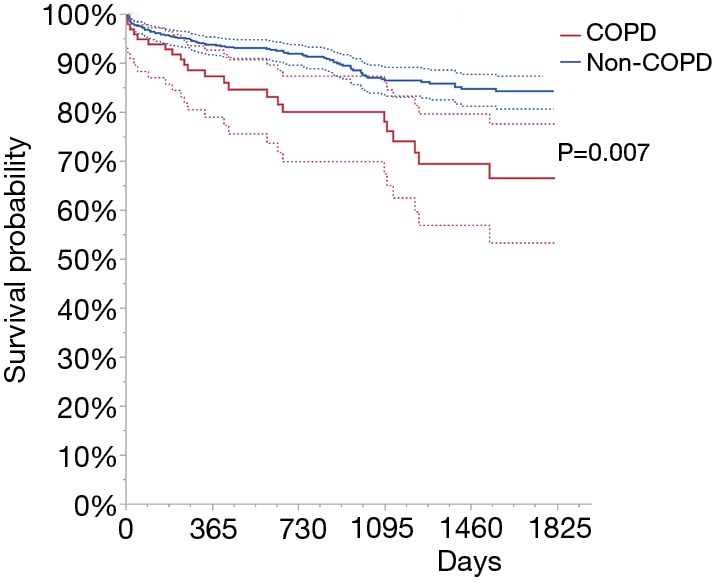
The mean follow-up was 1,144.9±664.3 days and the interquartile range was 1,110.5 (504.5-1,734.7). Data were collected between 2006 and 2016. We noticed significant differences in death rates among the COPD and non-COPD groups. The cumulative number of events (deaths) was 12.2%, 17.3%, 18.4%, 22.4%, 23.5%, 23.5% and 23.5% in the COPD group and 6.1%, 7.5%, 10.5%, 11.3%, 11.4% 11.5% and 11.5% in the non-COPD group after 1, 2, 3, 4, 5, 6 and 7 years of follow-up, and was notably greater for COPD (P=0.0007).
Patients with COPD and PAD treated with the ER and retrograde approach due to CTOs are related to higher mortality than non-COPD patients.
在本试验中,我们的目的是评估因慢性完全闭塞(CTO)而接受逆行血管腔内再通术(ER)治疗的下肢动脉周围动脉疾病(PAD)患者的长期临床结局与慢性阻塞性肺疾病(COPD)之间的关系。
共纳入834例连续受试者。平均年龄为67.8±10.6岁(男性占62.6%)。98例患者(11.7%)被诊断为COPD。下肢动脉部位包括股深动脉、股浅动脉、股总动脉、腘动脉或膝下动脉。在随访期间,我们评估了主要不良心脑血管事件(MACCE)和主要不良肢体事件(MALE)。MACCE被视为死亡、中风/短暂性脑缺血发作、心肌梗死、经皮冠状动脉介入治疗或冠状动脉搭桥手术,而MALE则包括截肢、靶病变再次干预、靶血管再次干预和外科手术。
平均随访时间为1144.9±664.3天,四分位数间距为1110.5(504.5 - 1734.7)。数据收集时间为2006年至2016年。我们注意到COPD组和非COPD组的死亡率存在显著差异。随访1、2、3、4、5、6和7年后,COPD组的累积事件(死亡)发生率分别为12.2%、17.3%、18.4%、22.4%、23.5%、23.5%和23.5%,非COPD组分别为6.1%、7.5%、10.5%、11.3%、11.4%、11.5%和11.5%,COPD组显著更高(P = 0.0007)。
因CTO接受ER和逆行治疗的COPD合并PAD患者的死亡率高于非COPD患者。