Wojtasik-Bakalarz Joanna, Arif Salech, Chyrchel Michał, Rakowski Tomasz, Bartuś Krzysztof, Dudek Dariusz, Bartuś Stanisław
2 Department of Cardiology and Cardiovascular Interventions, University Hospital, Krakow, Poland.
Postepy Kardiol Interwencyjnej. 2017;13(1):47-52. doi: 10.5114/aic.2017.66186. Epub 2017 Mar 10.
Fifty percent of cases of peripheral artery disease are caused by chronic total occlusion (CTO) of the superficial femoral artery (SFA). Ten-fifteen percent of percutaneous SFA recanalization procedures are unsuccessful. In those cases the retrograde technique can increase the success rate of the procedure, but the long-term follow-up of such procedures is still unknown.
To assess the efficacy and clinical outcomes during long-term follow-up after retrograde recanalization of the SFA.
We included patients after at least one unsuccessful percutaneous antegrade recanalization of the SFA. Patients were evaluated for the procedural and clinical follow-up of mean time 13.9 months.
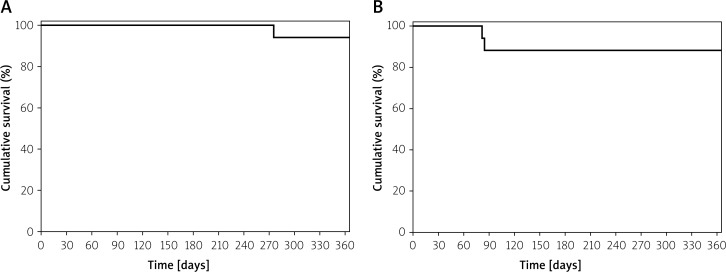
The study included 17 patients (7 females, 10 males) who underwent percutaneous retrograde recanalization of the SFA from June 2011 to June 2015. The mean age of patients was 63 ±7 years. Retrograde puncture of the distal SFA was successful in all cases. A retrograde procedure was performed immediately after antegrade failure in 4 (23.5%) patients and after a previously failed attempt in 13 (76.5%) patients. The procedure was successful in 15 (88.2%) patients, and unsuccessful in 2 (11.8%) patients. Periprocedural complications included 1 peripheral distal embolization (successfully treated with aspiration thrombectomy), 1 bleeding event from the puncture site and 7 puncture site hematomas. During follow-up the all-cause mortality rate was 5.8% (1 patient, non-cardiac death). The primary patency rate at 12 months was 88.2% and secondary patency 100%.
The retrograde SFA puncture seems to be a safe and successful technique for CTO recanalization and is associated with a low rate of perioperative and long-term follow-up complications.
50%的外周动脉疾病病例是由股浅动脉(SFA)慢性完全闭塞(CTO)引起的。10%至15%的经皮SFA再通手术不成功。在这些病例中,逆行技术可提高手术成功率,但此类手术的长期随访情况仍不明确。
评估SFA逆行再通术后长期随访期间的疗效和临床结果。
我们纳入了至少一次经皮顺行SFA再通手术失败后的患者。对患者进行了平均13.9个月的手术及临床随访评估。
该研究纳入了2011年6月至2015年6月期间接受经皮SFA逆行再通手术的17例患者(7例女性,10例男性)。患者的平均年龄为63±7岁。所有病例中SFA远端的逆行穿刺均成功。4例(23.5%)患者在顺行失败后立即进行了逆行手术,13例(76.5%)患者在先前尝试失败后进行了逆行手术。15例(88.2%)患者手术成功,2例(11.8%)患者手术失败。围手术期并发症包括1例外周远端栓塞(通过血栓抽吸术成功治疗)、1例穿刺部位出血事件和7例穿刺部位血肿。随访期间全因死亡率为5.8%(1例患者,非心源性死亡)。12个月时的原发通畅率为88.2%,继发通畅率为100%。
SFA逆行穿刺似乎是一种安全且成功的CTO再通技术,且围手术期和长期随访并发症发生率较低。