International Livestock Research Institute, Ouagadougou, Burkina Faso.
University of Prince Edward Islands, Charlottetown, PE, Canada.
Transbound Emerg Dis. 2020 Nov;67(6):2482-2493. doi: 10.1111/tbed.13587. Epub 2020 May 17.
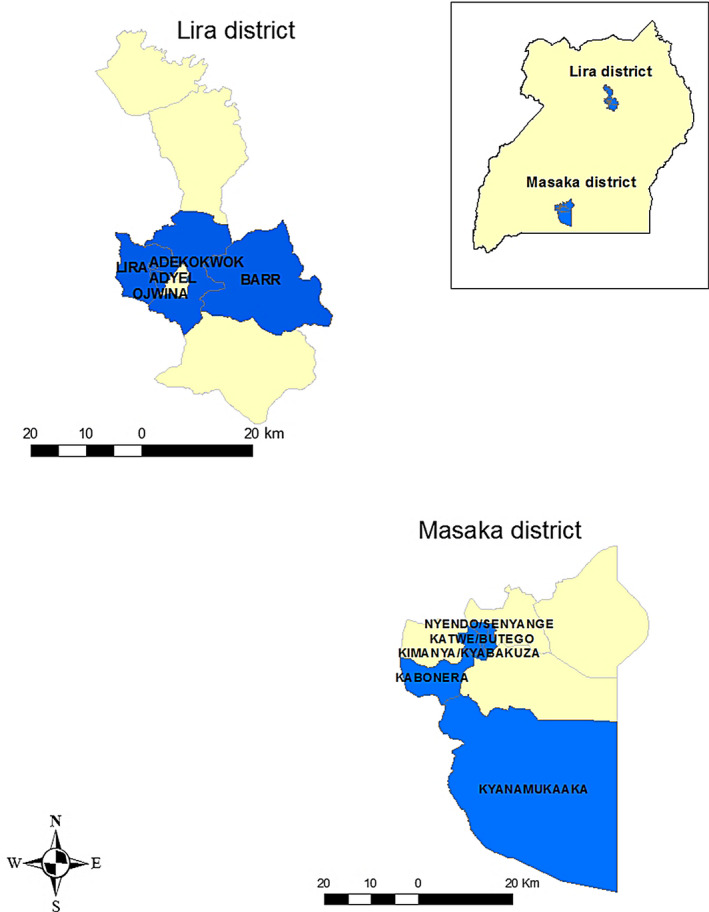
We evaluated the impact of a participatory training of pig farmers on knowledge, attitude and practices (KAP) of biosecurity relating to ASF control in two districts of Uganda using a randomized control trial (RCT). A total of 830 pig farmers from 32 villages were included in the study, with 425 farmers receiving training, while 405 did not. An item response theory model was used to assess the impact of the training on farmer's KAP. Logistic regression models were used to assess the factors that affected knowledge gain and change in attitude and practices after training. Focus group discussions (FGD) were carried out with selected farmers from the treatment group at the end of the intervention, to share their experiences and discuss potential factors that could hinder adoption of biosecurity in their communities. Results of the regression analyses showed that there was a significant effect of biosecurity training (p = .038) on gain in knowledge after 12 months, but there were limited changes in farmer's attitude and practice at 12 and 28 months after training. Pig production domain (peri-urban/urban production), group membership, gender (male) and education of the farmer positively influenced knowledge gain and attitude of farmers towards biosecurity. This paper provides empirical evidence on the impact of training intervention on biosecurity practices for disease prevention or control. In addition, it breaks down the components of the biosecurity practices and documents the specific challenges to its uptake by the farmers. It therefore relaxes the assumption of knowledge constraint as a barrier to uptake. The results clearly show that knowledge is not the binding constraint to uptake of the biosecurity interventions.
我们采用随机对照试验(RCT)评估了在乌干达两个地区对养猪户进行参与式培训对与 ASF 控制相关的生物安全知识、态度和实践(KAP)的影响。共有来自 32 个村庄的 830 名养猪户参与了这项研究,其中 425 名农民接受了培训,而 405 名农民未接受培训。我们使用项目反应理论模型评估了培训对农民 KAP 的影响。我们还使用逻辑回归模型评估了培训后影响知识获取以及态度和实践改变的因素。在干预结束时,我们对来自治疗组的部分农民进行了焦点小组讨论(FGD),以分享他们的经验并讨论可能阻碍其社区采用生物安全措施的潜在因素。回归分析结果表明,生物安全培训对 12 个月后的知识获取有显著影响(p=0.038),但培训后 12 个月和 28 个月时,农民的态度和实践变化有限。养猪生产领域(城乡周边生产)、团体成员身份、性别(男性)和农民教育对知识获取和农民对生物安全的态度产生积极影响。本文提供了关于培训干预对疾病预防或控制生物安全实践影响的经验证据。此外,它还分解了生物安全实践的组成部分,并记录了农民采用生物安全措施的具体挑战。因此,它放宽了知识约束是采用的障碍的假设。结果清楚地表明,知识并不是采用生物安全干预措施的约束性限制。