Ungar Omer J, Santos Felipe, Nadol Joseph B, Horowitz Gilad, Fliss Dan M, Faquin William C, Handzel Ophir
Department of Otolaryngology-Head and Neck Surgery and Maxillofacial Surgery, Tel Aviv Sourasky Medical Center, Sackler School of Medicine, Tel Aviv University, Tel Aviv, Israel.
Department of Otolaryngology, Massachusetts Eye and Ear, Boston, Massachusetts, U.S.A.
Laryngoscope. 2021 Feb;131(2):E590-E597. doi: 10.1002/lary.28676. Epub 2020 Apr 20.
OBJECTIVES/HYPOTHESIS: To describe the histopathology of the invasion patterns of advanced-stage external auditory canal (EAC) squamous cell carcinoma (SCC). Study Design Retrospective cohort study.
Retrospective analysis of medical records of patients diagnosed with EAC SCC available at the Massachusetts Eye and Ear temporal bone (TB) collection. TBs underwent processing for histologic examination. Hematoxylin and eosin-stained slides were examined. Histologic findings were compared to premortem clinical data.
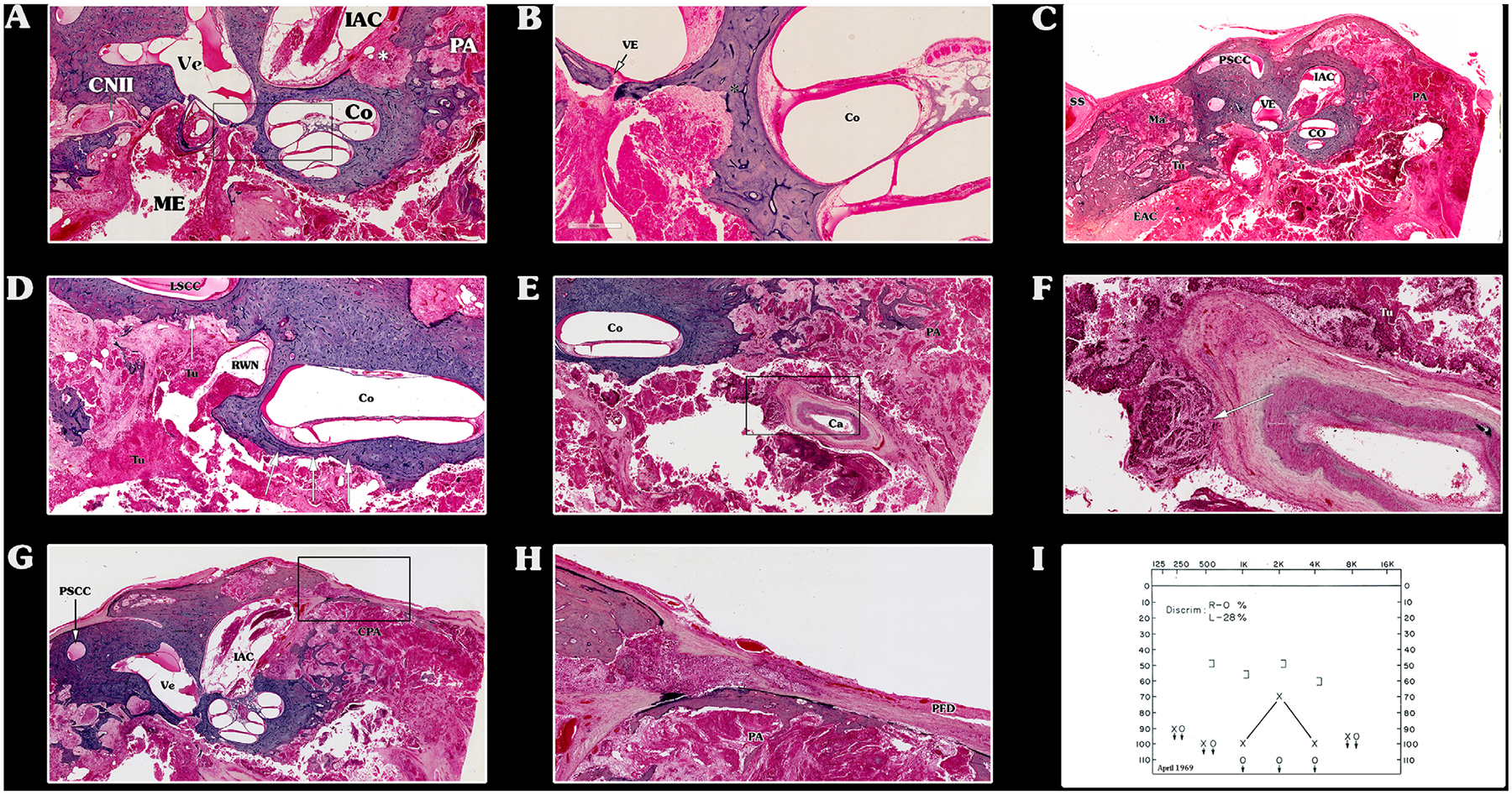
Nine TBs were identified. Male:female ratio was 6:3. The average age of diagnosis and duration of survival was 64 (46-80 years) and 2.3 years (1-50 months), respectively. All presented with T4 disease, most commonly due to petrous apex (PA) invasion and facial nerve (FN) weakness. The mastoid air cells system served as a tumor conduit to the tegmen mastoideum and overlying dura in four patients, posterior fossa dura in one patient, vertical segment of FN in four patients, and middle ear (ME) and lateral semicircular canal in five patients. The tumor did not penetrate the tympanic membrane, oval window membrane (fenestra vestibule), or round window (RW) membrane. Supra- and infralabyrinthine pneumatization patterns allowed direct routes to the PA. Translabyrinthine PA invasion was seen in two patients. The most common locus of otic capsule invasion was the cochlea. One patient had FN paralysis due to compression rather than invasion.
SCC does not tend to extend from the ME to the inner ear through the RW and vestibule-stapedial ligament. Tumors tend to spread along the preexisting TB air-tract routes. Well-aerated TB, may facilitate extension to the PA.
4 Laryngoscope, 131:E590-E597, 2021.
目的/假设:描述晚期外耳道鳞状细胞癌(SCC)侵袭模式的组织病理学特征。研究设计:回顾性队列研究。
对马萨诸塞州眼耳颞骨(TB)库中诊断为外耳道SCC的患者病历进行回顾性分析。颞骨经处理后进行组织学检查。检查苏木精-伊红染色切片。将组织学结果与生前临床数据进行比较。
共识别出9例颞骨。男女比例为6:3。诊断时的平均年龄和生存时间分别为64岁(46 - 80岁)和2.3年(1 - 50个月)。所有患者均表现为T4期疾病,最常见的原因是岩尖(PA)侵犯和面神经(FN)麻痹。乳突气房系统在4例患者中作为肿瘤通道通向乳突盖和硬脑膜,在1例患者中通向颅后窝硬脑膜,在4例患者中通向FN垂直段,在5例患者中通向中耳(ME)和外侧半规管。肿瘤未穿透鼓膜、卵圆窗膜(前庭窗)或圆窗(RW)膜。迷路上下的气化模式为通向PA提供了直接途径。2例患者出现经迷路的PA侵犯。最常见的骨迷路侵犯部位是耳蜗。1例患者因受压而非侵犯导致FN麻痹。
SCC不倾向于通过RW和前庭镫骨韧带从ME延伸至内耳。肿瘤倾向于沿预先存在的颞骨气道途径扩散。气化良好的颞骨可能有助于向PA扩展。
4 《喉镜》,131:E590 - E597,2021年。