Chae Dong-Sik, Kim Da-Ham, Kang Kyung-Yil, Kim Doo-Young, Park Si-Woon, Park Sung-Jun, Kim Jae-Hyung
Department of Orthopedic Surgery.
Department of Physical Medicine and Rehabilitation, Catholic Kwandong University International St Mary's Hospital, Incheon.
Medicine (Baltimore). 2020 Apr;99(16):e19791. doi: 10.1097/MD.0000000000019791.
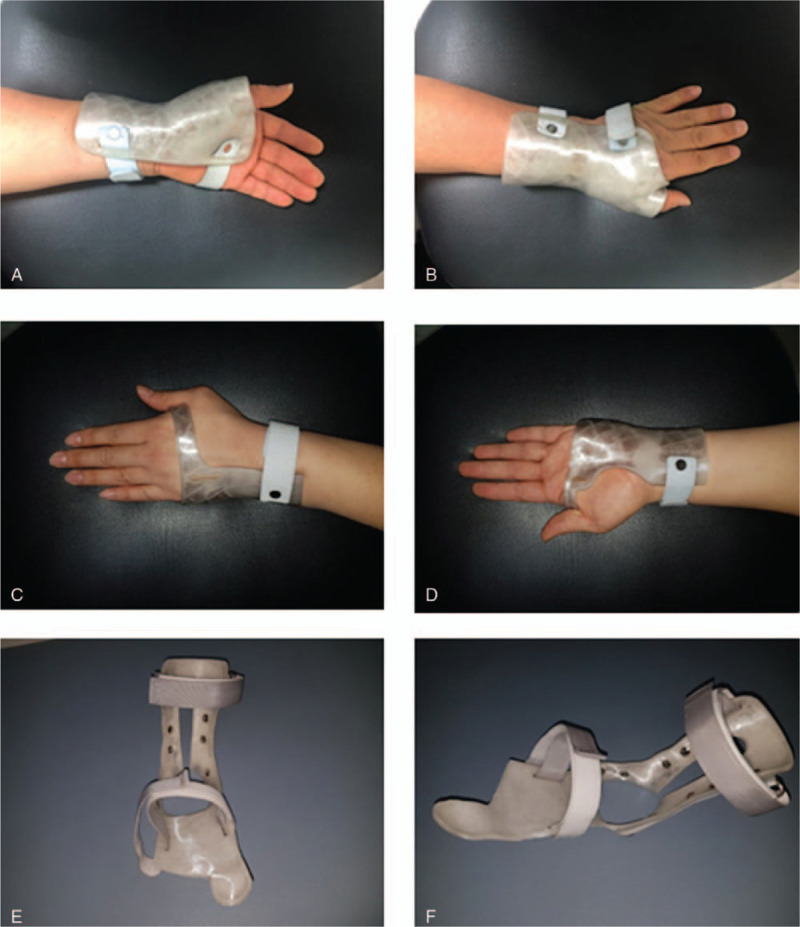
In the medical field, the use of 3-dimensional (3D) printing is increasing explosively and it is especially widespread in the clinical application of fabricating orthosis. Advantages of 3D-printed orthosis compared to conventional ones include its lower cost, easier modification, and faster fabrication. The 3D-printing technique makes it possible for physicians to easily create individual-tailored products. Recently, many kinds of orthosis through 3D printing have been studied and used. The knee orthosis, ankle-foot orthosis, wrist orthosis, hand orthosis, and foot orthotics are examples used in the rehabilitation fields of orthotics. We reported 3 cases of 3D-printed orthoses in patients with peripheral nerve injuries.
In spite of the rapid development of the clinical use of 3D printing, to our knowledge, its application to patients with peripheral nerve injuries has not yet been reported. Two patients suffered from upper limb problems and 1 patient had a foot drop associated with peripheral nerve injury.
Three patients diagnosed with median neuropathy, ulnar neuropathy, and right lower lumbar radiculopathy, respectively, by electromyography.
Herein we present 3 case reports of patients with peripheral nerve injuries whose orthotic needs were fulfilled with the application of 3D-printed wrist orthosis and ankle-foot orthosis.
For hand function evaluation, we assessed the Jebsen-Taylor hand function test. Grasp and pinch powers were assessed by a hand dynamometer before and after orthosis application. For lower limb functional evaluation, we used a 6-minute walking test and modified Emory Functional Ambulation Profile for ambulatory function.
The 3D-printed orthosis could help functional improvement in patients with peripheral nerve injuries.
在医学领域,三维(3D)打印的应用正在迅猛增长,尤其在矫形器制造的临床应用中极为普遍。与传统矫形器相比,3D打印矫形器的优势包括成本更低、更容易修改以及制作速度更快。3D打印技术使医生能够轻松制作个性化定制产品。最近,多种通过3D打印的矫形器已得到研究和应用。膝矫形器、踝足矫形器、腕矫形器、手矫形器和足部矫形器是矫形器康复领域中使用的实例。我们报告了3例使用3D打印矫形器治疗周围神经损伤患者的病例。
尽管3D打印在临床应用中迅速发展,但据我们所知,其在周围神经损伤患者中的应用尚未见报道。2例患者存在上肢问题,1例患者因周围神经损伤出现足下垂。
3例患者分别通过肌电图诊断为正中神经病变、尺神经病变和右下肢腰神经根病。
在此,我们呈现3例周围神经损伤患者的病例报告,这些患者的矫形需求通过应用3D打印的腕矫形器和踝足矫形器得以满足。
对于手部功能评估,我们采用Jebsen-Taylor手部功能测试。在佩戴矫形器前后,使用握力计评估抓握力和捏力。对于下肢功能评估,我们采用6分钟步行测试和改良的埃默里功能步行量表评估步行功能。
3D打印矫形器有助于改善周围神经损伤患者的功能。