Zhan Haifei, Zhang Gang, Bell John M, Tan Vincent B C, Gu Yuantong
School of Mechanical, Medical and Process Engineering, Queensland University of Technology (QUT), Brisbane, QLD, 4001, Australia.
Center for Materials Science, Queensland University of Technology (QLD), Brisbane, QLD, 4001, Australia.
Nat Commun. 2020 Apr 20;11(1):1905. doi: 10.1038/s41467-020-15807-7.
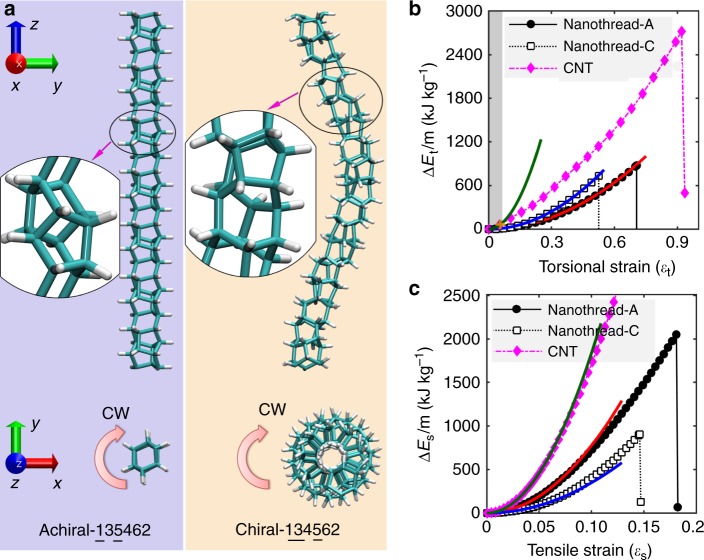
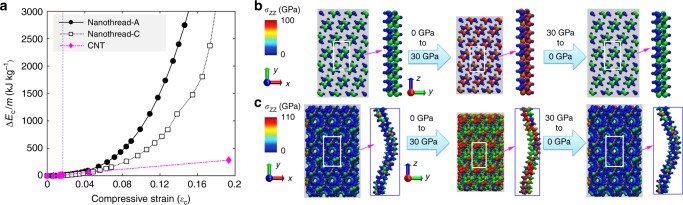
The excellent mechanical properties of carbon nanofibers bring promise for energy-related applications. Through in silico studies and continuum elasticity theory, here we show that the ultra-thin carbon nanothreads-based bundles exhibit a high mechanical energy storage density. Specifically, the gravimetric energy density is found to decrease with the number of filaments, with torsion and tension as the two dominant contributors. Due to the coupled stresses, the nanothread bundle experiences fracture before reaching the elastic limit of any individual deformation mode. Our results show that nanothread bundles have similar mechanical energy storage capacity compared to (10,10) carbon nanotube bundles, but possess their own advantages. For instance, the structure of the nanothread allows us to realize the full mechanical energy storage potential of its bundle structure through pure tension, with a gravimetric energy density of up to 1.76 MJ kg, which makes them appealing alternative building blocks for energy storage devices.
碳纳米纤维优异的机械性能为能源相关应用带来了希望。通过计算机模拟研究和连续介质弹性理论,我们在此表明基于超薄碳纳米线的束状物具有高机械能存储密度。具体而言,发现重量能量密度随细丝数量的增加而降低,扭转和拉伸是两个主要因素。由于耦合应力,纳米线束在达到任何单个变形模式的弹性极限之前就会发生断裂。我们的结果表明,纳米线束与(10,10)碳纳米管束相比具有相似的机械能存储能力,但也有自身优势。例如,纳米线的结构使我们能够通过纯拉伸实现其束状结构的全部机械能存储潜力,重量能量密度高达1.76 MJ/kg,这使其成为储能装置有吸引力的替代构建单元。