Rückerl Florian, Lenz Martin, Betz Timo, Manzi John, Martiel Jean-Louis, Safouane Mahassine, Paterski-Boujemaa Rajaa, Blanchoin Laurent, Sykes Cécile
CNRS, Laboratoire Physico Chimie Curie, Institut Curie, PSL Research University, Paris, France; Sorbonne Universités, UPMC University Paris 06, Paris, France.
CNRS, LPTMS, University Paris-Sud, Orsay, France.
Biophys J. 2017 Sep 5;113(5):1072-1079. doi: 10.1016/j.bpj.2017.07.017.
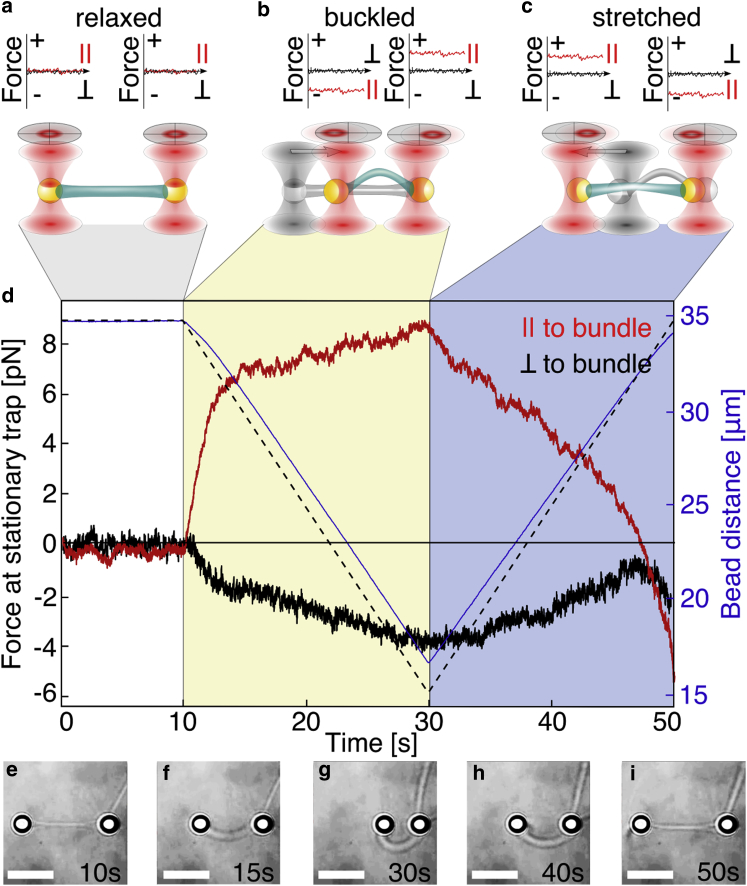
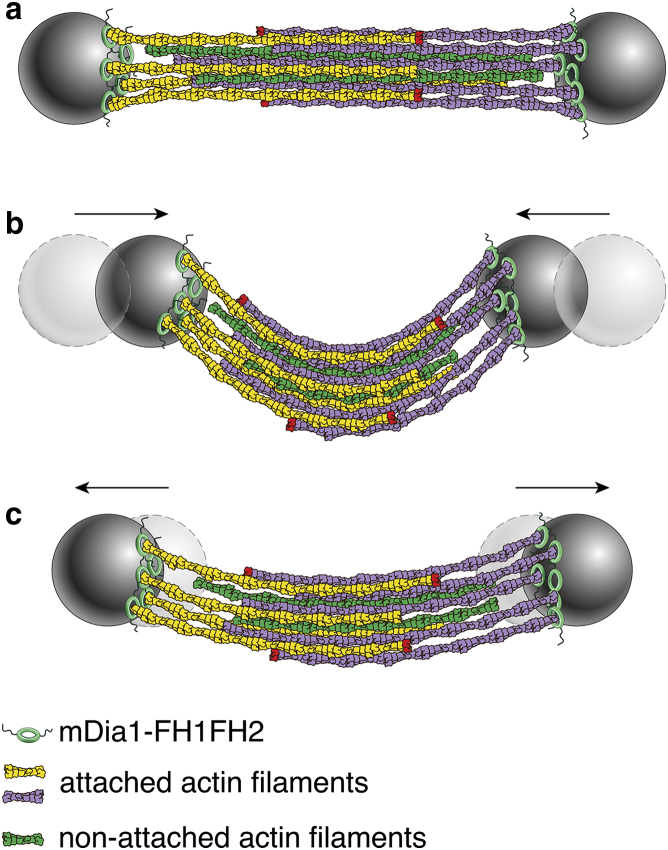
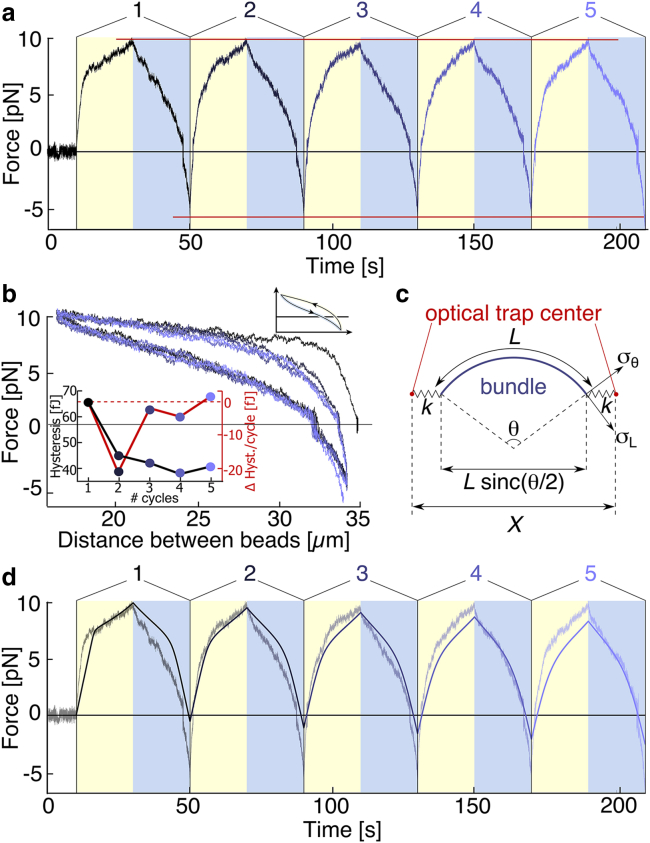
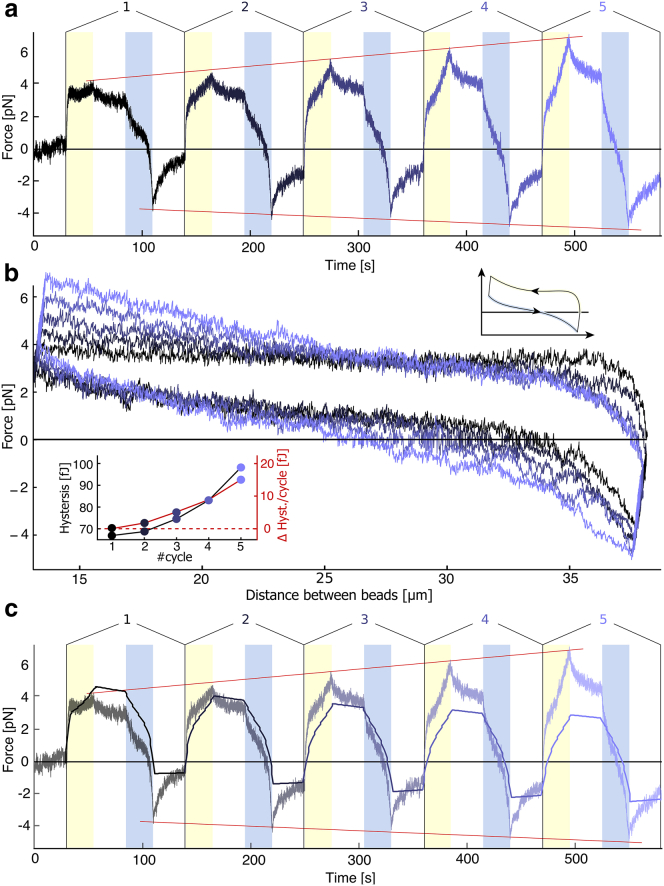
Actin is one of the main components of the architecture of cells. Actin filaments form different polymer networks with versatile mechanical properties that depend on their spatial organization and the presence of cross-linkers. Here, we investigate the mechanical properties of actin bundles in the absence of cross-linkers. Bundles are polymerized from the surface of mDia1-coated latex beads, and deformed by manipulating both ends through attached beads held by optical tweezers, allowing us to record the applied force. Bundle properties are strikingly different from the ones of a homogeneous isotropic beam. Successive compression and extension leads to a decrease in the buckling force that we attribute to the bundle remaining slightly curved after the first deformation. Furthermore, we find that the bundle is solid, and stiff to bending, along the long axis, whereas it has a liquid and viscous behavior in the transverse direction. Interpretation of the force curves using a Maxwell visco-elastic model allows us to extract the bundle mechanical parameters and confirms that the bundle is composed of weakly coupled filaments. At short times, the bundle behaves as an elastic material, whereas at long times, filaments flow in the longitudinal direction, leading to bundle restructuring. Deviations from the model reveal a complex adaptive rheological behavior of bundles. Indeed, when allowed to anneal between phases of compression and extension, the bundle reinforces. Moreover, we find that the characteristic visco-elastic time is inversely proportional to the compression speed. Actin bundles are therefore not simple force transmitters, but instead, complex mechano-transducers that adjust their mechanics to external stimulation. In cells, where actin bundles are mechanical sensors, this property could contribute to their adaptability.
肌动蛋白是细胞结构的主要成分之一。肌动蛋白丝形成具有多种机械性能的不同聚合物网络,这些性能取决于它们的空间组织和交联剂的存在。在这里,我们研究了在没有交联剂的情况下肌动蛋白束的机械性能。肌动蛋白束从涂有mDia1的乳胶珠表面聚合而成,并通过用光学镊子夹住附着的珠子来操纵两端使其变形,从而使我们能够记录施加的力。肌动蛋白束的特性与均匀各向同性梁的特性显著不同。连续的压缩和拉伸导致屈曲力降低,我们将其归因于在第一次变形后束仍保持轻微弯曲。此外,我们发现束在长轴方向上是实心的且抗弯曲,而在横向方向上具有液体和粘性行为。使用麦克斯韦粘弹性模型对力曲线进行解释,使我们能够提取束的机械参数,并证实束由弱耦合的细丝组成。在短时间内,束表现为弹性材料,而在长时间内,细丝在纵向流动,导致束的重组。与模型的偏差揭示了束的复杂适应性流变行为。实际上,当在压缩和拉伸阶段之间进行退火时,束会增强。此外,我们发现特征粘弹性时间与压缩速度成反比。因此,肌动蛋白束不是简单的力传递者,而是复杂的机械传感器,能够根据外部刺激调整其力学性能。在细胞中,肌动蛋白束作为机械传感器,这一特性可能有助于它们的适应性。