Department of Electrical Engineering and Computer Science, University of Michigan, Ann Arbor, MI, USA.
Department of Mathematical Sciences, Indiana University-Purdue University, Indianapolis, IN, USA.
Nat Commun. 2020 Apr 20;11(1):1877. doi: 10.1038/s41467-020-15804-w.
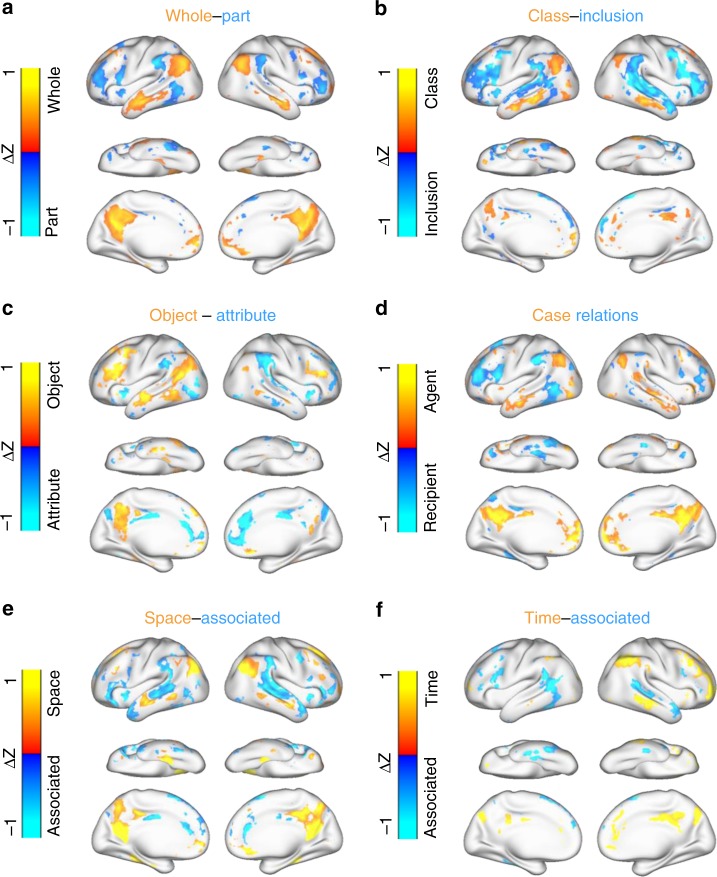
In the brain, the semantic system is thought to store concepts. However, little is known about how it connects different concepts and infers semantic relations. To address this question, we collected hours of functional magnetic resonance imaging data from human subjects listening to natural stories. We developed a predictive model of the voxel-wise response and further applied it to thousands of new words. Our results suggest that both semantic categories and relations are represented by spatially overlapping cortical patterns, instead of anatomically segregated regions. Semantic relations that reflect conceptual progression from concreteness to abstractness are represented by cortical patterns of activation in the default mode network and deactivation in the frontoparietal attention network. We conclude that the human brain uses distributed networks to encode not only concepts but also relationships between concepts. In particular, the default mode network plays a central role in semantic processing for abstraction of concepts.
在大脑中,语义系统被认为存储着概念。然而,关于它如何连接不同的概念和推断语义关系,人们知之甚少。为了解决这个问题,我们从人类受试者那里收集了数小时的功能磁共振成像数据,这些受试者在听自然故事。我们开发了一种基于体素的响应预测模型,并进一步将其应用于数千个新单词。我们的研究结果表明,语义类别和关系都是由空间上重叠的皮质模式来表示的,而不是由解剖上分离的区域来表示。反映从具体到抽象的概念发展的语义关系,是由默认模式网络中的激活模式和额顶叶注意力网络中的失活模式来表示的。我们得出的结论是,人类大脑不仅使用分布式网络来编码概念,还使用分布式网络来编码概念之间的关系。特别是,默认模式网络在概念的抽象处理中起着核心作用。