Department of ultrasound, Qilu Hospital of Shandong University, Jinan, 250012, China.
Sci Rep. 2020 Apr 20;10(1):6657. doi: 10.1038/s41598-020-63653-w.
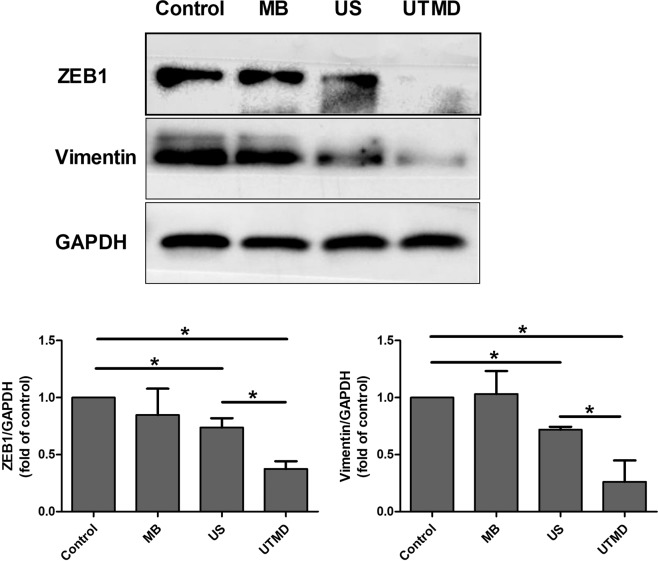
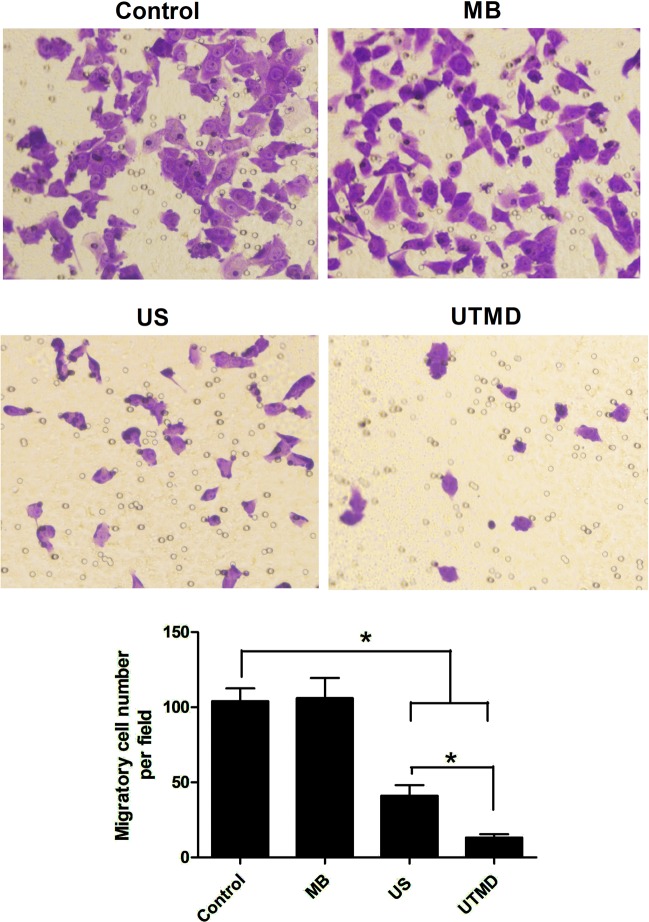
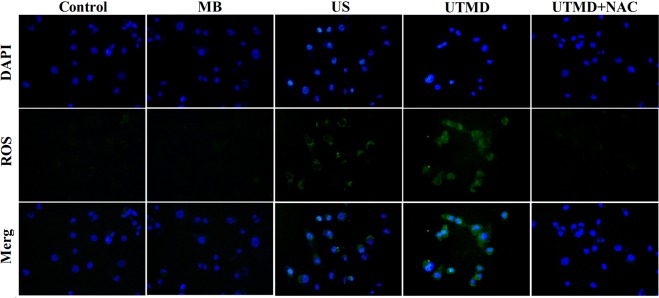
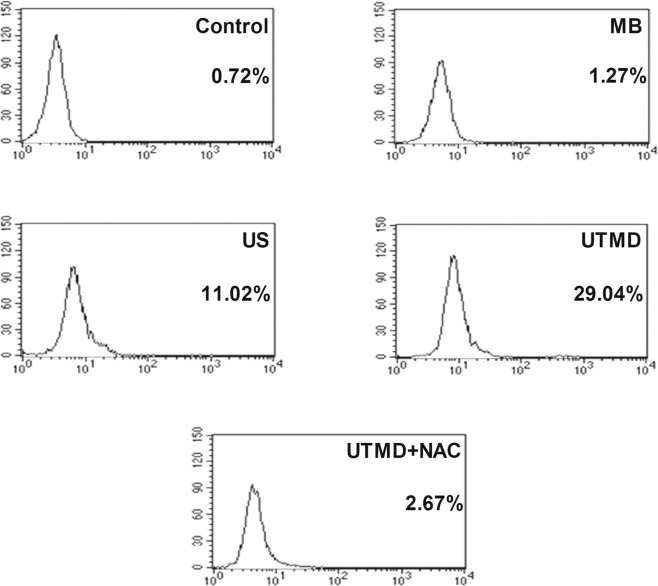
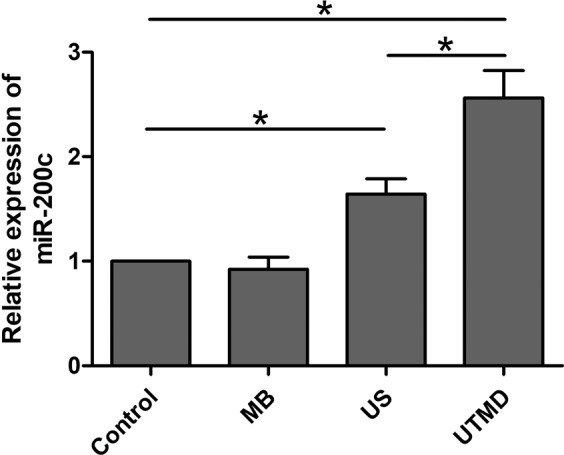
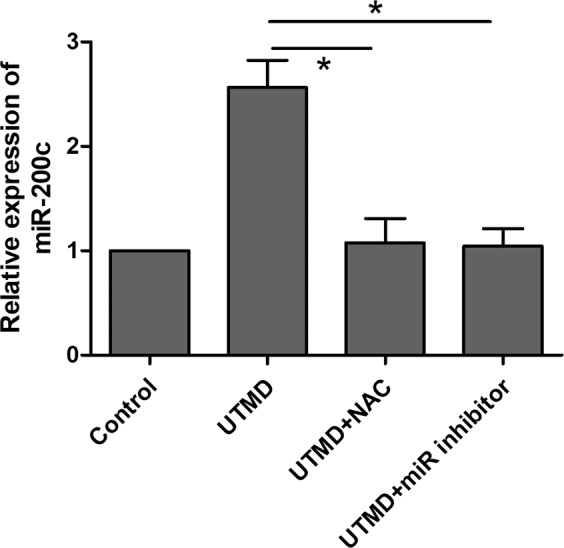
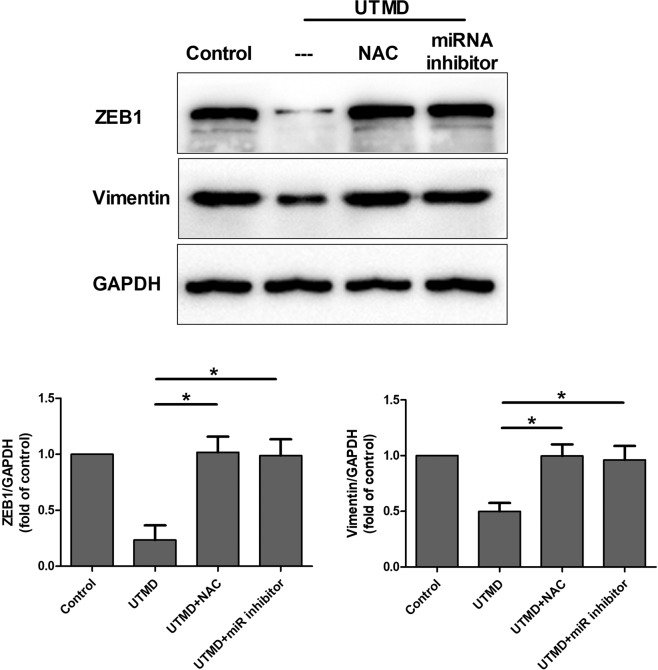
As a potential drug/gene delivery system, the ultrasound-targeted microbubble destruction (UTMD) system can be used as a vehicle as well as increasing the permeability of biological barriers to enhance the effect of tumor treatment. However, the effect of UTMD in the tumor EMT process is unknown. In this study, we aimed to investigate the potential and mechanism of UTMD induced oxidative stress in inhibiting EMT of breast cancer. Human breast MDA231 cells were treated with microbubble (MB), ultrasound (US) and UTMD, respectively. The generation of oxidative stress, the levels of miR-200c, ZEB1 and vimentin, and the numbers of migratory cells were evaluated quantitatively and qualitatively by the measurement of intracellular reactive oxygen species (ROS), qRT-PCR, western blot assay, and transwell assay. Then, to evaluate the role of UTMD-induced oxidative stress and miR-200c in the epithelial-mesenchymal transition (EMT) inhibition, the ROS scavenger N-acetyl-L-cysteine (NAC) and miR-200c inhibitor were used before UTMD treatment. We found that UTMD induced oxidative stress, upregulated the expression of miR-200c, downregulated the expression of ZEB1 and vimentin and suppressed the MDA231 cell migration. The addition of NAC and miR-200c inhibitor had an opposite impact on the expression of miR-200c and ZEB1, thus hindered the effects of UTMD on MDA231 cells EMT. In conclusion, UTMD can inhibit the EMT characteristics of MDA231 cells. The mechanism may be related to the regulation of the miR-200c/ZEB1 axis through the generation of ROS induced by UTMD, which may provide a new strategy to prevent the tumor cells EMT under UTMD treatment.
作为一种潜在的药物/基因递送系统,超声靶向微泡破坏(UTMD)系统既可以作为载体,又可以增加生物屏障的通透性,增强肿瘤治疗效果。然而,UTMD 在肿瘤 EMT 过程中的作用尚不清楚。在这项研究中,我们旨在探讨 UTMD 诱导的氧化应激在抑制乳腺癌 EMT 中的潜力和机制。分别用微泡(MB)、超声(US)和 UTMD 处理人乳腺癌 MDA231 细胞。通过测量细胞内活性氧(ROS)、qRT-PCR、western blot 分析和 Transwell 分析,定量和定性评估氧化应激的产生、miR-200c、ZEB1 和波形蛋白的水平以及迁移细胞的数量。然后,为了评估 UTMD 诱导的氧化应激和 miR-200c 在抑制上皮-间充质转化(EMT)中的作用,在 UTMD 处理前使用 ROS 清除剂 N-乙酰-L-半胱氨酸(NAC)和 miR-200c 抑制剂。我们发现 UTMD 诱导氧化应激,上调 miR-200c 的表达,下调 ZEB1 和波形蛋白的表达,并抑制 MDA231 细胞迁移。添加 NAC 和 miR-200c 抑制剂对 miR-200c 和 ZEB1 的表达有相反的影响,从而阻碍了 UTMD 对 MDA231 细胞 EMT 的影响。总之,UTMD 可以抑制 MDA231 细胞的 EMT 特征。其机制可能与通过 UTMD 诱导的 ROS 生成调节 miR-200c/ZEB1 轴有关,这可能为在 UTMD 治疗下预防肿瘤细胞 EMT 提供新策略。