School of Dentistry, The University of Queensland, Brisbane, QLD 4006, Australia.
School of Dentistry, The University of Adelaide, Adelaide, SA 5000, Australia.
Int J Mol Sci. 2020 Apr 17;21(8):2809. doi: 10.3390/ijms21082809.
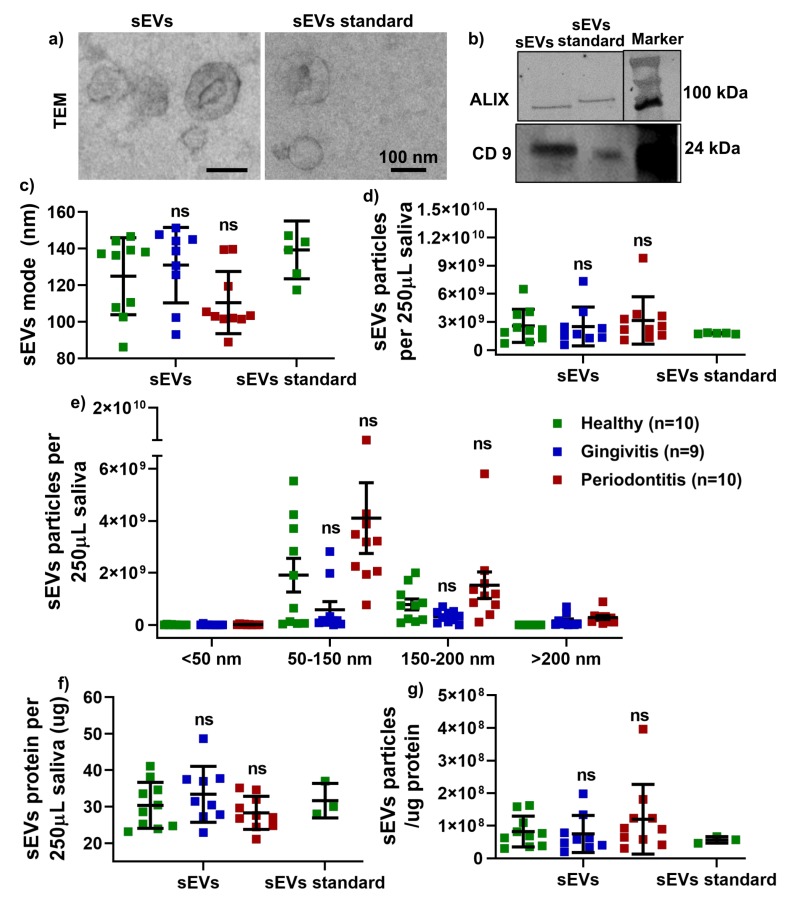
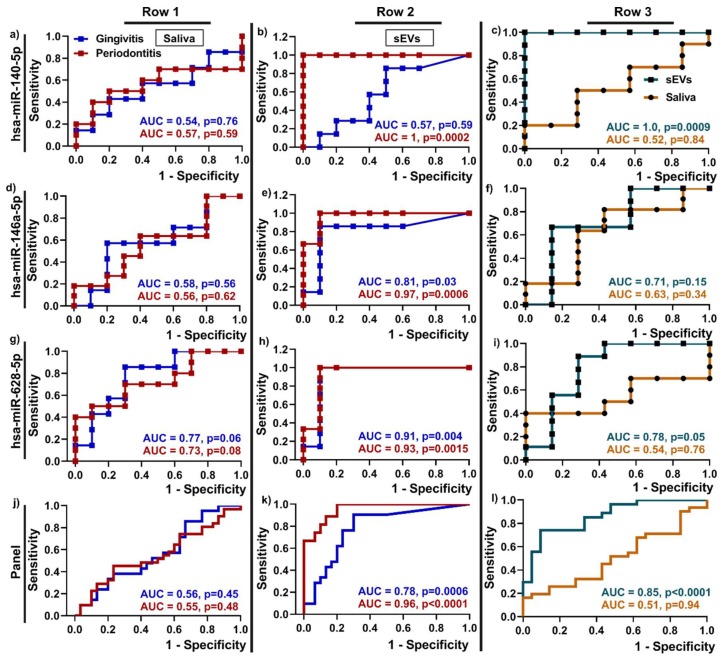
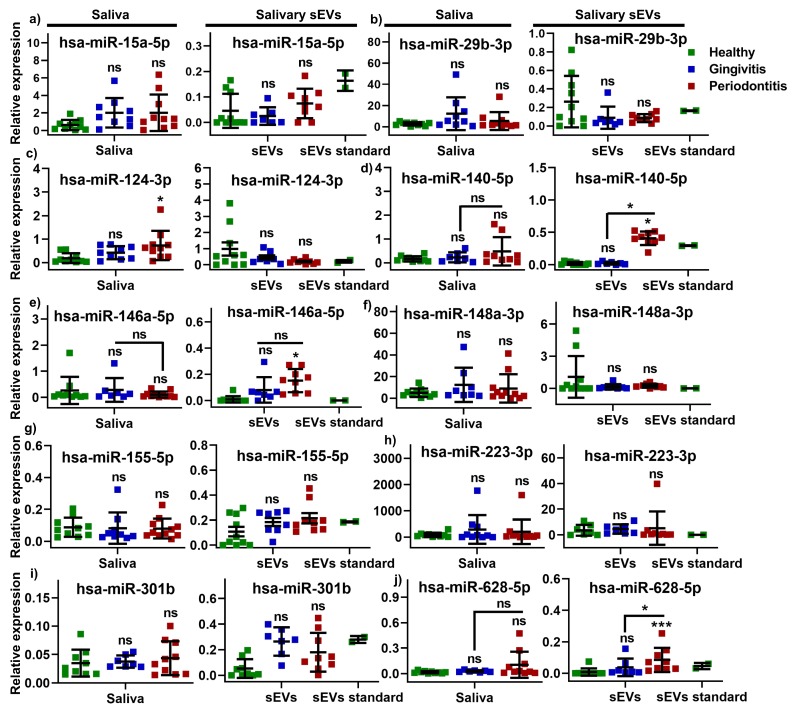
This pilot study aims to investigate whether salivary small extracellular vesicle (sEV)-associated microRNAs could act as potential biomarkers for periodontal disease status. Twenty-nine participants (10 who were healthy, nine with gingivitis, 10 with stage III/IV periodontitis) were recruited and unstimulated whole saliva samples were collected. Salivary sEVs were isolated using the size-exclusion chromatography (SEC) method and characterised by morphology, EV-protein and size distribution using transmission electron microscopy (TEM), Western Blot and Nanoparticle Tracking Analysis (NTA), respectively. Ten mature microRNAs (miRNAs) in salivary sEVs and saliva were evaluated using RT-qPCR. The discriminatory power of miRNAs as biomarkers in gingivitis and periodontitis versus healthy controls was evaluated by Receiver Operating Characteristics (ROC) curves. Salivary sEVs were comparable to sEVs morphology, mode, size distribution and particle concentration in healthy, gingivitis and periodontitis patients. Compared to miRNAs in whole saliva, three significantly increased miRNAs (hsa-miR-140-5p, hsa-miR-146a-5p and hsa-miR-628-5p) were only detected in sEVs in periodontitis when compared to that of healthy controls, with a good discriminatory power (area under the curve (AUC) = 0.96) for periodontitis diagnosis. Our study demonstrated that salivary sEVs are a non-invasive source of miRNAs for periodontitis diagnosis. Three miRNAs that are selectively enriched in sEVs, but not whole saliva, could be potential biomarkers for periodontal disease status.
本初步研究旨在探究唾液小型细胞外囊泡(sEV)相关 microRNAs 是否可作为牙周病状态的潜在生物标志物。招募了 29 名参与者(10 名健康者、9 名牙龈炎患者、10 名牙周炎 III/IV 期患者),并采集了未刺激的全唾液样本。使用尺寸排阻色谱(SEC)法分离唾液 sEV,并通过透射电子显微镜(TEM)、Western Blot 和纳米颗粒跟踪分析(NTA)分别对 EV-蛋白和大小分布进行形态、特征分析。使用 RT-qPCR 评估了唾液 sEV 和唾液中的 10 种成熟 microRNAs(miRNAs)。通过受试者工作特征(ROC)曲线评估了 miRNAs 作为牙龈炎和牙周炎与健康对照之间生物标志物的区分能力。与健康、牙龈炎和牙周炎患者的 sEV 形态、模式、大小分布和颗粒浓度相比,唾液 sEV 具有可比性。与全唾液中的 miRNAs 相比,仅在牙周炎患者的 sEV 中检测到三种显著增加的 miRNAs(hsa-miR-140-5p、hsa-miR-146a-5p 和 hsa-miR-628-5p),与健康对照组相比,其对牙周炎的诊断具有良好的区分能力(曲线下面积(AUC)=0.96)。本研究表明,唾液 sEV 是牙周炎诊断的一种非侵入性 miRNA 来源。三种选择性富集在 sEV 中、而不在全唾液中富集的 miRNAs 可能是牙周病状态的潜在生物标志物。