Seol Aeran, Shim Yoo Jin, Kim Sung Woo, Kim Seul Ki, Lee Jung Ryeol, Jee Byung Chul, Suh Chang Suk, Kim Seok Hyun
Department of Obstetrics and Gynecology, Seoul National University Hospital, Seoul, Korea.
Department of Obstetrics and Gynecology, Seoul National University Bundang Hospital, Seongnam, Korea.
Clin Exp Reprod Med. 2020 Jun;47(2):147-152. doi: 10.5653/cerm.2019.03132. Epub 2020 Apr 22.
The purpose of this study was to determine the effect of vaginal progesterone for luteal phase support (LPS) on the clinical pregnancy rate (CPR) in natural frozen embryo transfer (FET) cycles via a meta-analysis.
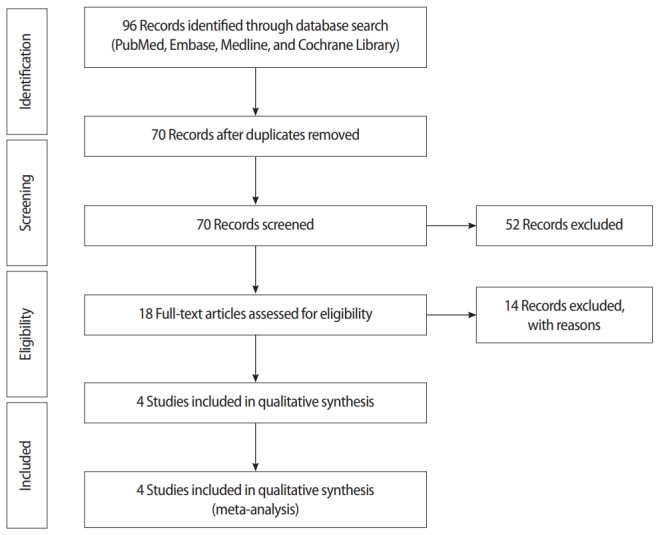
We performed a meta-analysis of randomized controlled trials (RCTs) and retrospective studies that met our selection criteria. Four online databases (PubMed, Embase, Medline, and the Cochrane Library) were searched between January 2017 and May 2017. Studies were selected according to predefined inclusion criteria and meta-analyzed using R software version 2.14.2. The main outcome measure was CPR.
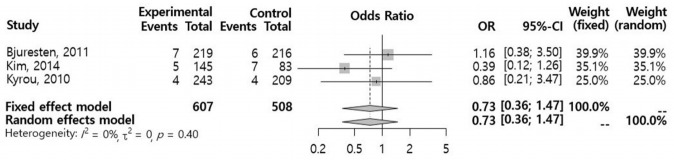
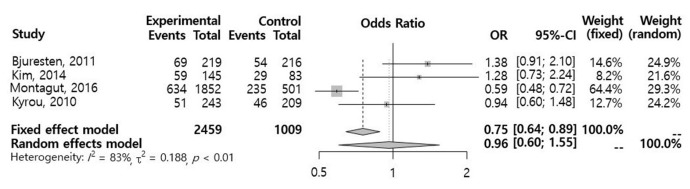
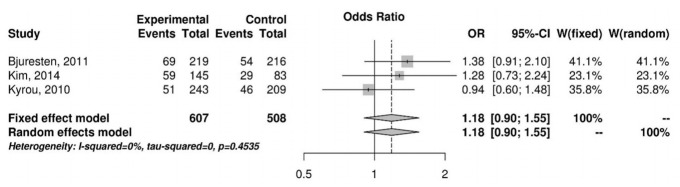
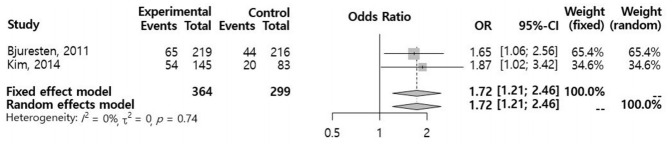
A total of 18 studies were reviewed and assessed for eligibility. One RCT (n=435) and three retrospective studies (n=3,033) met the selection criteria. In a meta-analysis of the selected studies, we found no significant difference in the CPR (odds ratio [OR], 0.96; 95% confidence interval [CI], 0.60-1.55) between the vaginal progesterone and control groups. An analysis of the two retrospective cohort studies that reported the live birth rate (LBR) following FET showed a significantly higher LBR in the vaginal progesterone group (OR, 1.72; 95% CI, 1.21-2.46). A subgroup meta-analysis of FET conducted 5 days after injection of human chorionic gonadotropin showed no significant differences between the two groups with regard to the CPR (OR, 1.18; 95% CI, 0.90-1.55) or miscarriage rate (OR, 0.73; 95% CI, 0.36-1.47).
The results of this meta-analysis of the currently available literature suggest that LPS with vaginal progesterone in natural FET cycles does not improve the CPR.
本研究旨在通过荟萃分析确定阴道用黄体酮进行黄体期支持(LPS)对自然周期冷冻胚胎移植(FET)周期临床妊娠率(CPR)的影响。
我们对符合选择标准的随机对照试验(RCT)和回顾性研究进行了荟萃分析。在2017年1月至2017年5月期间检索了四个在线数据库(PubMed、Embase、Medline和Cochrane图书馆)。根据预先定义的纳入标准选择研究,并使用R软件2.14.2版进行荟萃分析。主要结局指标为CPR。
共审查和评估了18项研究的 eligibility。一项RCT(n = 435)和三项回顾性研究(n = 3,033)符合选择标准。在对所选研究的荟萃分析中,我们发现阴道用黄体酮组和对照组之间的CPR无显著差异(优势比[OR],0.96;95%置信区间[CI],0.60 - 1.55)。对两项报告FET后活产率(LBR)的回顾性队列研究的分析显示,阴道用黄体酮组的LBR显著更高(OR,1.72;95% CI,1.21 - 2.46)。对注射人绒毛膜促性腺激素5天后进行的FET的亚组荟萃分析显示,两组在CPR(OR,1.18;95% CI,0.90 - 1.55)或流产率(OR,0.73;95% CI,0.36 - 1.47)方面无显著差异。
对现有文献的这项荟萃分析结果表明,自然FET周期中使用阴道用黄体酮进行LPS并不能提高CPR。