Li Hai-Tao, Liu Yajun, Liu Hongde, Sun Xiao
State Key Laboratory of Bioelectronics, School of Biological Science and Medical Engineering, Southeast University, Nanjing, China.
The Second Affiliated Hospital of Zhengzhou University, Zhengzhou, China.
Front Genet. 2020 Apr 7;11:230. doi: 10.3389/fgene.2020.00230. eCollection 2020.
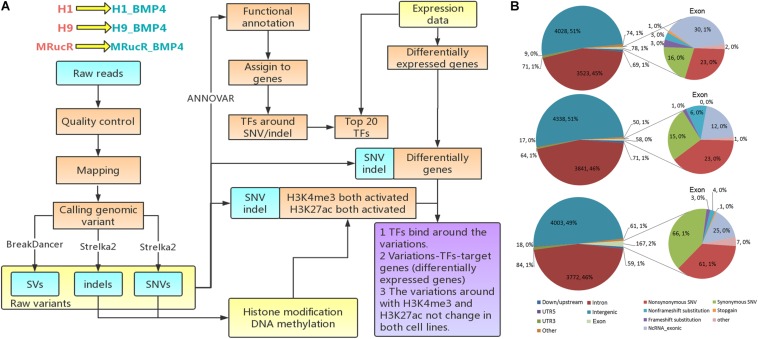
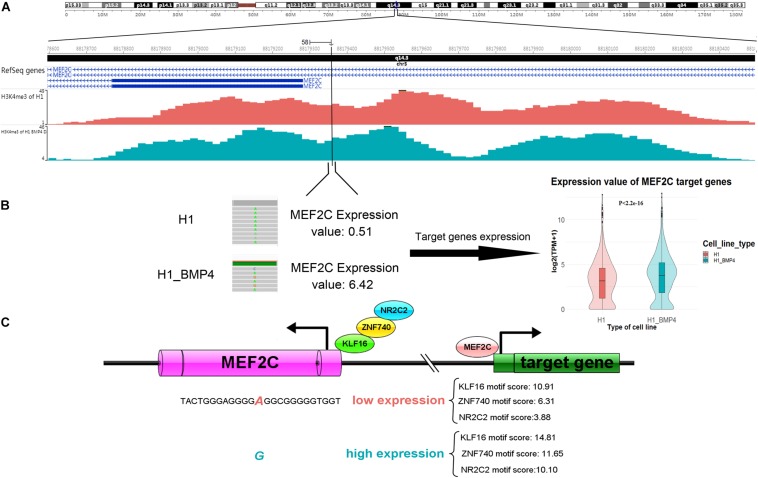
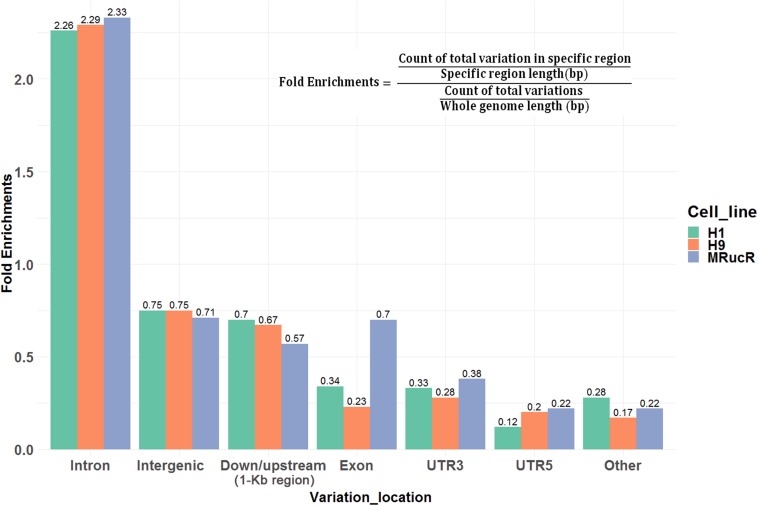
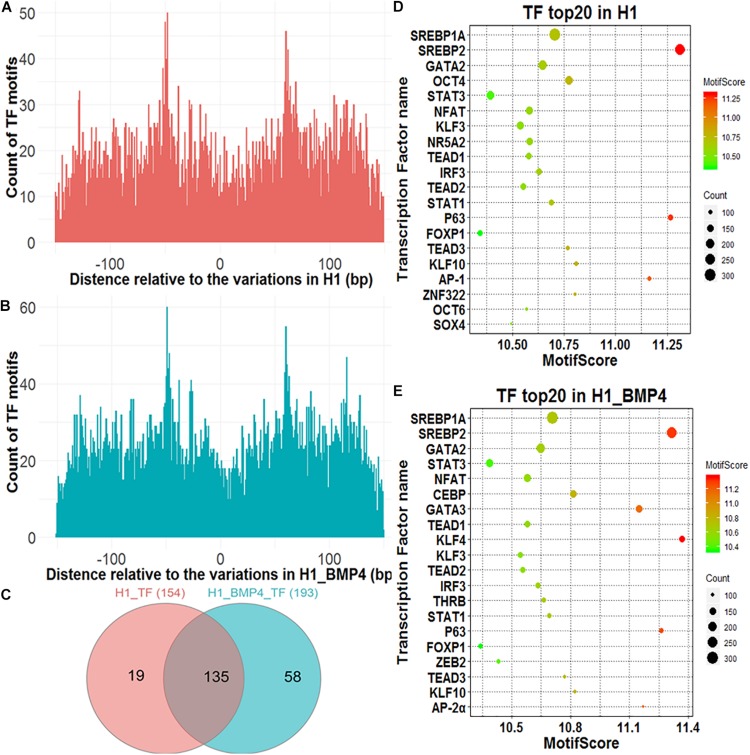
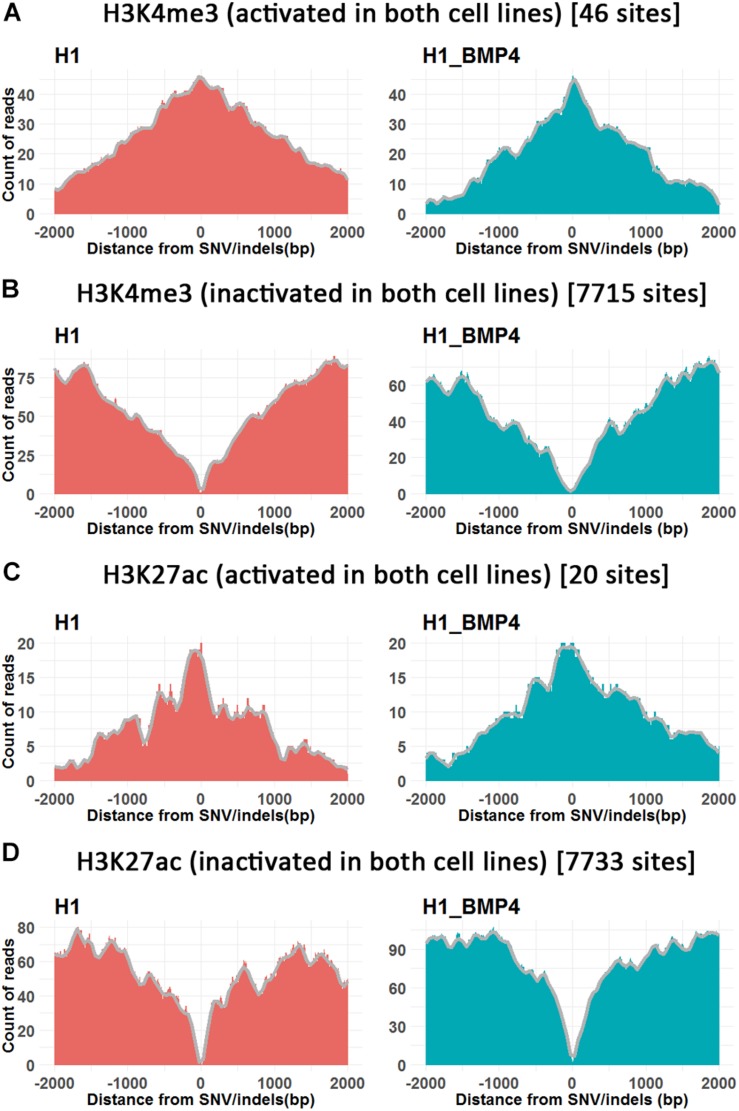
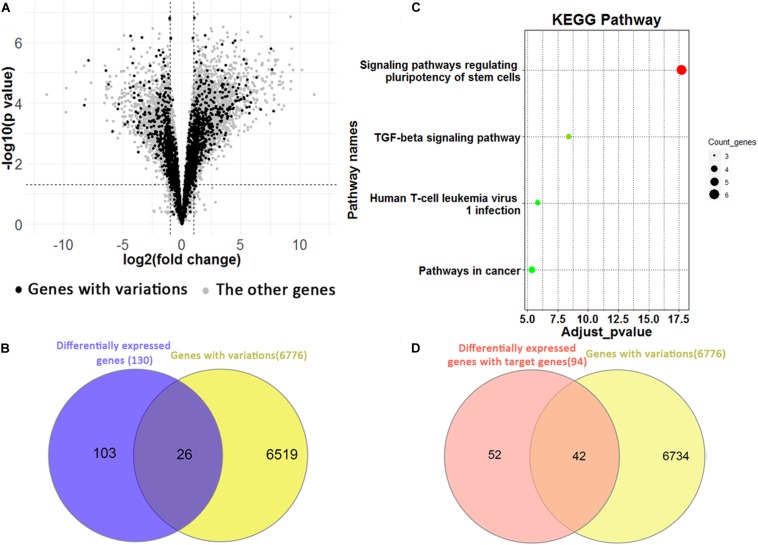
The role of genomic variation in differentiation is currently not well understood. Here, the genomic variations were determined with the whole-genome sequencing for three pairs of pluripotent stem cell lines and their corresponding BMP4-induced trophoblast cell lines. We identified ∼3,500 single nucleotide variations and ∼4,500 indels by comparing the genome sequenced data between the stem cell lines and the matched BMP4-induced trophoblast cell lines and annotated them by integrating the epigenomic and transcriptomic datasets. Relatively, introns enrich more variations. We found ∼45% (42 genes) of the differentially expressed genes in trophoblasts that associate genomic variations. Six variations, located at transcription factor binding sites where H3K4me3 and H3K27ac are enriched in both H1 and H1_BMP4, were identified. The epigenetic status around the genomic variations in H1 was similar to that in H1_BMP4. This means that the variation-associated gene's expression change can not be attributed to epigenetic alteration. The genes associated with the six variations were upregulated in differentiation. We inferred that during the differentiation, an increased in the expression level of the MEF2C gene is due to a genomic variation in chromosomes 5: 88179358 A > G, which is at a binding site of TFs KLF16, NR2C2, and ZNF740 to MEF2C. Allele G shows a higher affinity to the TFs in the induced cells. The increased expression of MEF2C leads to an increased expression of TF MEF2C's target genes, subsequently affecting the differentiation. Although genomic variation should not be a dominant factor in differentiation, we believe that genomic variation could indeed play a role in the differentiation from stem cells into trophoblast.
目前,基因组变异在分化过程中的作用尚未得到充分理解。在此,我们通过对三对多能干细胞系及其相应的BMP4诱导滋养层细胞系进行全基因组测序来确定基因组变异。通过比较干细胞系和匹配的BMP4诱导滋养层细胞系之间的基因组测序数据,我们鉴定出约3500个单核苷酸变异和约4500个插入缺失,并通过整合表观基因组和转录组数据集对它们进行注释。相对而言,内含子富集了更多变异。我们发现滋养层细胞中约45%(42个基因)的差异表达基因与基因组变异相关。我们鉴定出六个位于转录因子结合位点的变异,在H1和H1_BMP4中H3K4me3和H3K27ac均富集于此。H1中基因组变异周围的表观遗传状态与H1_BMP4中的相似。这意味着与变异相关的基因表达变化不能归因于表观遗传改变。与这六个变异相关的基因在分化过程中上调。我们推断,在分化过程中,MEF2C基因表达水平的增加是由于5号染色体上的基因组变异88179358 A > G,该变异位于TFs KLF16、NR2C2和ZNF740与MEF2C的结合位点。等位基因G在诱导细胞中对TFs显示出更高的亲和力。MEF2C表达的增加导致TF MEF2C靶基因表达的增加,随后影响分化。尽管基因组变异不应是分化中的主导因素,但我们认为基因组变异确实可能在从干细胞向滋养层的分化中发挥作用。