Laboratory of Anatomy II, Department of Veterinary Medicine, School of Veterinary Medicine, Azabu University, Kanagawa 252-5201, Japan.
Laboratory of Veterinary Pathology, Department of Veterinary Medicine, School of Veterinary Medicine, Azabu University, Kanagawa 252-5201, Japan.
J Vet Med Sci. 2020 Jun 30;82(6):827-835. doi: 10.1292/jvms.19-0551. Epub 2020 Apr 21.
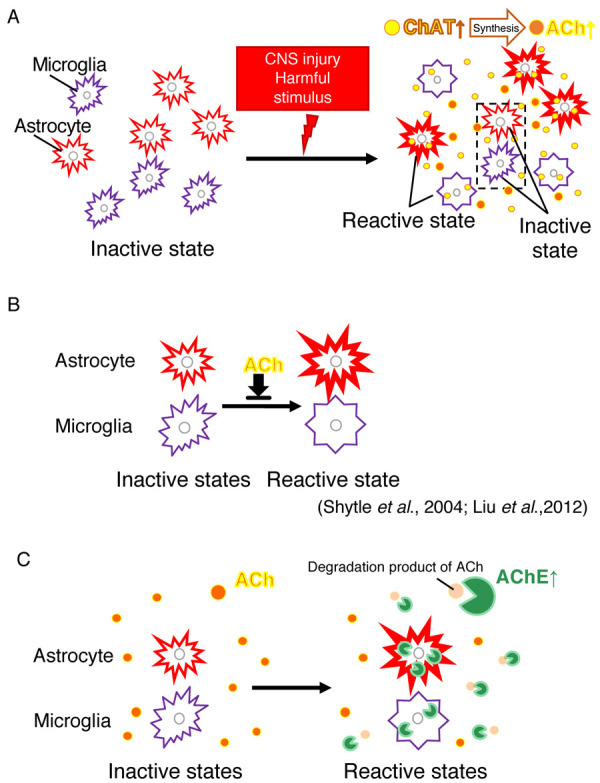
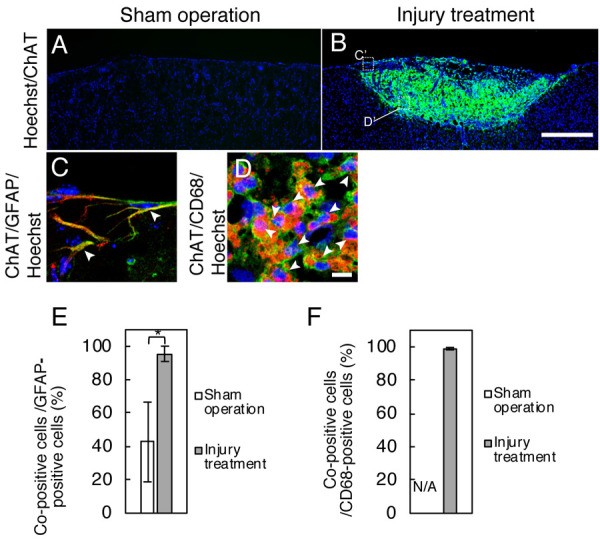
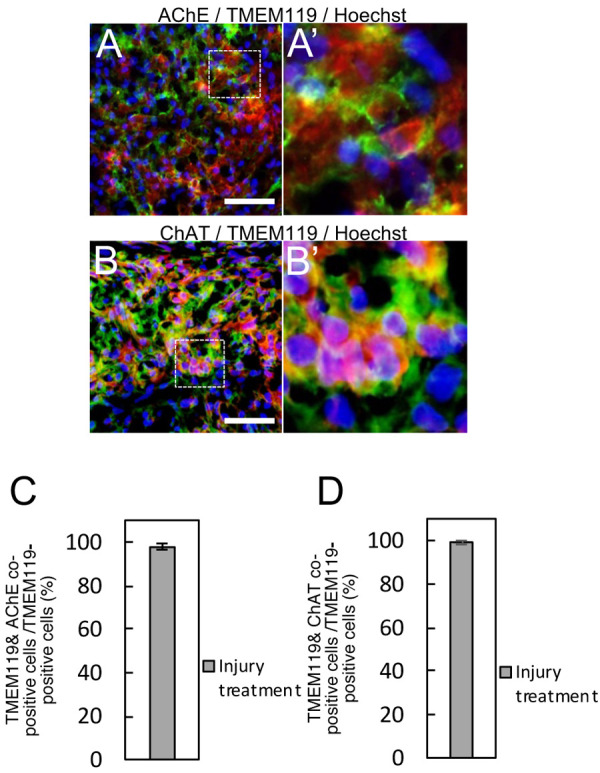
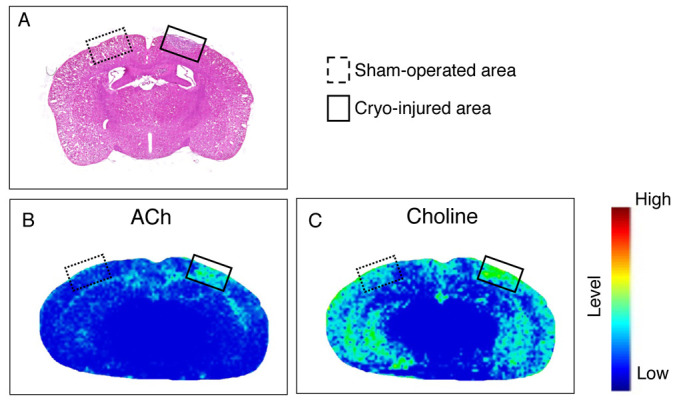
The regulation of glial cells, especially astrocytes and microglia, is important to prevent the exacerbation of a brain injury because over-reactive glial cells promote neuronal death. Acetylcholine (ACh), a neurotransmitter synthesized and hydrolyzed by choline acetyltransferase (ChAT) and acetylcholinesterase (AChE), respectively, in the central nervous system, has the potential to regulate glial cells' states, i.e., non-reactive and reactive states. However, the expression levels of these ACh-related enzymes in areas containing reactive glial cells are unclear. Herein we immunohistochemically investigated the distributions of AChE and ChAT with reactive glial cells in the cryo-injured brain of mice as a traumatic brain injury model. Immunohistochemistry revealed AChE- and ChAT-immunopositive signals in injured areas at 7 days post-injury. The signals were observed in and around glial fibrillary acidic protein (GFAP)- or CD68-immunopositive cells, and the numbers of cells doubly positive for GFAP/AChE, GFAP/ChAT, CD68/AChE, and CD68/ChAT were significantly increased in injured areas compared to sham-operated areas. Enzyme histochemistry for AChE showed intensely positive signals in injured areas. These results suggest that reactive astrocytes and microglia express and secrete AChE and ChAT in brain-injury areas. These glial cells may adjust the ACh concentration around themselves through the regulation of the expression of ACh-related enzymes in order to control their reactive states.
胶质细胞(尤其是星形胶质细胞和小胶质细胞)的调节对于防止脑损伤的恶化非常重要,因为过度活跃的胶质细胞会促进神经元死亡。乙酰胆碱(ACh)是一种在中枢神经系统中由胆碱乙酰转移酶(ChAT)和乙酰胆碱酯酶(AChE)分别合成和水解的神经递质,它有可能调节胶质细胞的状态,即非反应性和反应性状态。然而,在含有反应性胶质细胞的区域中,这些与 ACh 相关的酶的表达水平尚不清楚。在此,我们使用冷冻损伤的小鼠脑作为创伤性脑损伤模型,通过免疫组织化学方法研究了反应性胶质细胞中 AChE 和 ChAT 的分布。免疫组织化学显示,损伤后 7 天损伤区域存在 AChE 和 ChAT 免疫阳性信号。这些信号在 GFAP 或 CD68 免疫阳性细胞的内部和周围观察到,并且 GFAP/AChE、GFAP/ChAT、CD68/AChE 和 CD68/ChAT 双阳性细胞的数量在损伤区域明显高于假手术区域。AChE 的酶组织化学显示损伤区域存在强烈的阳性信号。这些结果表明,反应性星形胶质细胞和小胶质细胞在脑损伤区域表达和分泌 AChE 和 ChAT。这些胶质细胞可能通过调节与 ACh 相关的酶的表达来调整其周围的 ACh 浓度,从而控制其反应状态。