Wappenschmidt Barbara, Hauke Jan, Faust Ulrike, Niederacher Dieter, Wiesmüller Lisa, Schmidt Gunnar, Groß Evi, Gehrig Andrea, Sutter Christian, Ramser Juliane, Rump Andreas, Arnold Norbert, Meindl Alfons
Zentrum familiärer Brust- und Eierstockkrebs, Universitätsklinikum Köln, Köln, Germany.
Institut für Medizinische Genetik und Angewandte Genomik, Universität Tübingen, Tübingen, Germany.
Geburtshilfe Frauenheilkd. 2020 Apr;80(4):410-429. doi: 10.1055/a-1110-0909. Epub 2020 Apr 21.
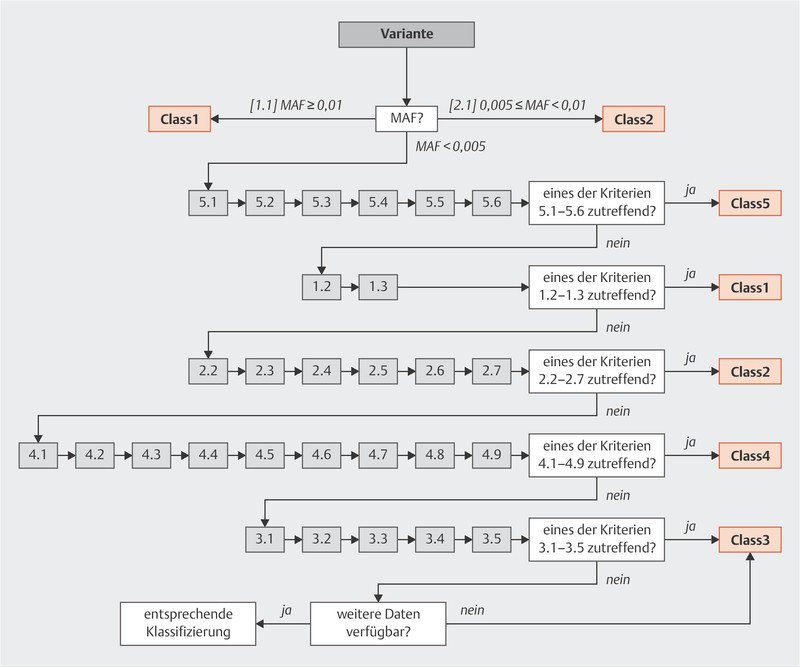
More than ten years ago, the German Consortium for Hereditary Breast and Ovarian Cancer (GC-HBOC) set up a panel of experts (VUS Task Force) which was tasked with reviewing the classifications of genetic variants reported by individual centres of the GC-HBOC to the central database in Leipzig and reclassifying them, where necessary, based on the most recent data. When it evaluates variants, the VUS Task Force must arrive at a consensus. The resulting classifications are recorded in a central database where they serve as a basis for ensuring the consistent evaluation of previously known and newly identified variants in the different centres of the GC-HBOC. The standardised VUS evaluation by the VUS Task Force is a key element of the recall system which has also been set up by the GC-HBOC. The system will be used to pass on information to families monitored and managed by GC-HBOC centres in the event that previously classified variants are reclassified based on new information. The evaluation algorithm of the VUS Task Force was compiled using internationally established assessment methods (IARC, ACMG, ENIGMA) and is presented here together with the underlying evaluation criteria used to arrive at the classification decision using a flow chart. In addition, the characteristics and special features of specific individual risk genes associated with breast and/or ovarian cancer are discussed in separate subsections. The URLs of relevant databases have also been included together with extensive literature references to provide additional information and cover the scope and dynamism of the current state of knowledge on the evaluation of genetic variants. In future, if criteria are updated based on new information, the update will be published on the website of the GC-HBOC ( https://www.konsortium-familiaerer-brustkrebs.de/ ).
十多年前,德国遗传性乳腺癌和卵巢癌联盟(GC-HBOC)设立了一个专家小组(VUS特别工作组),其任务是审查GC-HBOC各中心向莱比锡中央数据库报告的基因变异分类,并在必要时根据最新数据对其重新分类。VUS特别工作组在评估变异时必须达成共识。最终的分类记录在一个中央数据库中,作为确保GC-HBOC不同中心对先前已知和新发现的变异进行一致评估的基础。VUS特别工作组的标准化VUS评估是GC-HBOC建立的召回系统的关键要素。如果根据新信息对先前分类的变异进行重新分类,该系统将用于向由GC-HBOC中心监测和管理的家庭传递信息。VUS特别工作组的评估算法是使用国际公认的评估方法(IARC、ACMG、ENIGMA)编制的,并在此与用于通过流程图做出分类决定的基础评估标准一起呈现。此外,在单独的小节中讨论了与乳腺癌和/或卵巢癌相关的特定个体风险基因的特征和特点。还包括了相关数据库的网址以及大量文献参考,以提供更多信息,并涵盖基因变异评估当前知识状态的范围和动态性。未来,如果根据新信息更新标准,更新内容将在GC-HBOC的网站(https://www.konsortium-familiaerer-brustkrebs.de/)上发布。