Chin Voon Kin, Yong Voon Chen, Chong Pei Pei, Amin Nordin Syafinaz, Basir Rusliza, Abdullah Maha
School of Biosciences, Faculty of Health and Medical Sciences, Taylor's University Lakeside Campus, 47500 Subang Jaya, Malaysia.
Department of Medical Microbiology and Parasitology, Faculty of Medicine and Health Sciences, Universiti Putra Malaysia, 43400 Serdang, Selangor, Malaysia.
Mediators Inflamm. 2020 Apr 4;2020:9560684. doi: 10.1155/2020/9560684. eCollection 2020.
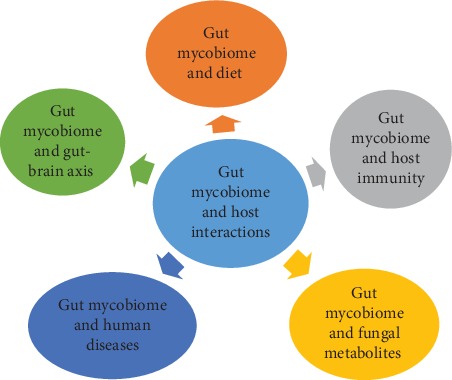
Human gut is home to a diverse and complex microbial ecosystem encompassing bacteria, viruses, parasites, fungi, and other microorganisms that have an undisputable role in maintaining good health for the host. Studies on the interplay between microbiota in the gut and various human diseases remain the key focus among many researchers. Nevertheless, advances in sequencing technologies and computational biology have helped us to identify a diversity of fungal community that reside in the gut known as the mycobiome. Although studies on gut mycobiome are still in its infancy, numerous sources have reported its potential role in host homeostasis and disease development. Nonetheless, the actual mechanism of its involvement remains largely unknown and underexplored. Thus, in this review, we attempt to discuss the recent advances in gut mycobiome research from multiple perspectives. This includes understanding the composition of fungal communities in the gut and the involvement of gut mycobiome in host immunity and gut-brain axis. Further, we also discuss on multibiome interactions in the gut with emphasis on fungi-bacteria interaction and the influence of diet in shaping gut mycobiome composition. This review also highlights the relation between fungal metabolites and gut mycobiota in human homeostasis and the role of gut mycobiome in various human diseases. This multiperspective review on gut mycobiome could perhaps shed new light for future studies in the mycobiome research area.
人类肠道是一个多样而复杂的微生物生态系统的家园,其中包括细菌、病毒、寄生虫、真菌和其他微生物,它们在维持宿主的健康方面发挥着无可争议的作用。肠道微生物群与各种人类疾病之间相互作用的研究仍然是许多研究人员的关键关注点。尽管如此,测序技术和计算生物学的进步帮助我们识别出了存在于肠道中的多种真菌群落,即真菌微生物组。虽然对肠道真菌微生物组的研究仍处于起步阶段,但众多研究已报道了其在宿主内稳态和疾病发展中的潜在作用。然而,其实际参与机制在很大程度上仍不为人知且未得到充分探索。因此,在本综述中,我们试图从多个角度探讨肠道真菌微生物组研究的最新进展。这包括了解肠道真菌群落的组成,以及肠道真菌微生物组在宿主免疫和肠脑轴中的作用。此外,我们还讨论了肠道中的多微生物组相互作用,重点是真菌与细菌的相互作用以及饮食对塑造肠道真菌微生物组组成的影响。本综述还强调了真菌代谢产物与肠道真菌微生物群在人类内稳态中的关系,以及肠道真菌微生物组在各种人类疾病中的作用。这篇关于肠道真菌微生物组的多视角综述或许能为真菌微生物组研究领域的未来研究提供新的思路。