Yin Min, Chen Aiping, Zhao Fei, Ji Xuechao, Li Chuan, Wang Guangning
1Medical College of Qingdao University, Qingdao, Shandong Province China.
2Department of Gynecology, The Affiliated Hospital of Qingdao University, Qingdao, Shandong Province China.
Infect Agent Cancer. 2020 Apr 15;15:23. doi: 10.1186/s13027-020-00289-5. eCollection 2020.
The cause of epithelial ovarian cancer (EOC) is not elucidated. Viral infection may induce chronic inflammatory infection and play a role in the pathogenesis of cancers. Some viruses are considered to be oncomodulatory, modulating cellular pathways such as cell proliferation, tumor progression, vascular disease development, and immune evasion. Human cytomegalovirus (HCMV) has been detected in several types of cancers including ovarian cancer. However, the role of HCMV in ovarian carcinogenesis remains controversial.
To investigate the potential role of HCMV infection in EOC, we evaluated the prevalence of HCMV proteins in EOC tissue and its impacts on patients' survival.
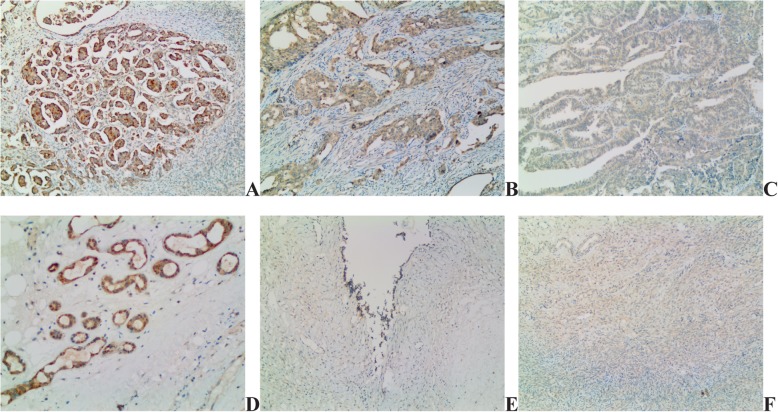
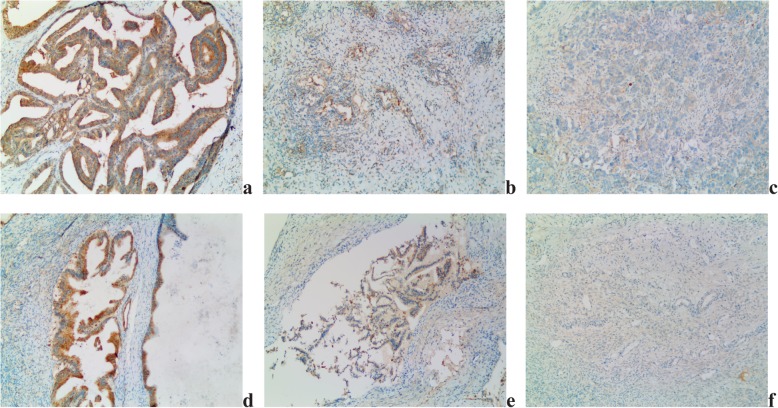
Formalin-fixed paraffin-embedded tissues from 66 patients with EOC and 30 patients with benign ovarian cystadenoma were studied. Specimens were analyzed for expression of HCMV immediate early protein (IE) and HCMV tegument protein (pp65) by immunohistochemistry.
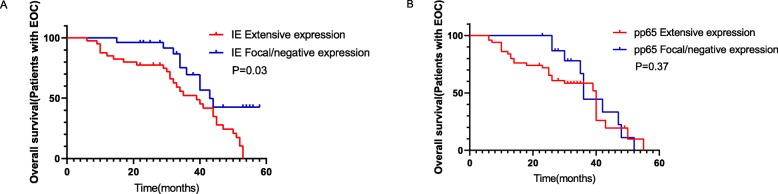
HCMV-IE protein expression was detected in 82% of EOC and 36% of benign tumors; pp65 was detected in 97% of EOC and 63% of benign tumors. Extensive HCMV-IE protein expression was associated with higher stage of EOC. Reactivation of latent HCMV within the tumor at interval debulking surgery may be induced by neoadjuvant chemotherapy before surgery. Extensive HCMV-IE expression was associated with shorter median overall survival than focal or negative expression (39 versus 41 months, = 0.03). Multivariate analysis indicated that HCMV-IE expression was an independent prognostic factor for overall survival ( = 0.034).
This study demonstrate a high prevalence of HCMV proteins in tissue sections from patients with EOC. HCMV infection can be potential risk factor for EOC development. Extensive HCMV-IE expression indicated a poor prognosis. The relationship between HCMV and clinical outcomes highlight the need for further researches on the oncomodulatory role of HCMV in ovarian cancer.
上皮性卵巢癌(EOC)的病因尚未阐明。病毒感染可能引发慢性炎症感染,并在癌症发病机制中起作用。一些病毒被认为具有肿瘤调节作用,可调节细胞增殖、肿瘤进展、血管疾病发展和免疫逃逸等细胞途径。人类巨细胞病毒(HCMV)已在包括卵巢癌在内的多种癌症中被检测到。然而,HCMV在卵巢癌发生中的作用仍存在争议。
为了研究HCMV感染在EOC中的潜在作用,我们评估了EOC组织中HCMV蛋白的患病率及其对患者生存的影响。
对66例EOC患者和30例良性卵巢囊腺瘤患者的福尔马林固定石蜡包埋组织进行研究。通过免疫组织化学分析标本中HCMV立即早期蛋白(IE)和HCMV被膜蛋白(pp65)的表达。
82%的EOC和36%的良性肿瘤中检测到HCMV-IE蛋白表达;97%的EOC和63%的良性肿瘤中检测到pp65。广泛的HCMV-IE蛋白表达与EOC的更高分期相关。术前新辅助化疗可能诱导肿瘤内潜伏HCMV在间隔减瘤手术时重新激活。广泛的HCMV-IE表达与中位总生存期短于局灶性或阴性表达相关(39个月对41个月,P = 0.03)。多变量分析表明,HCMV-IE表达是总生存期的独立预后因素(P = 0.034)。
本研究表明EOC患者组织切片中HCMV蛋白的患病率很高。HCMV感染可能是EOC发生的潜在危险因素。广泛的HCMV-IE表达表明预后不良。HCMV与临床结果之间的关系凸显了对HCMV在卵巢癌中的肿瘤调节作用进行进一步研究的必要性。