Tam Shing Yau, Wu Vincent W C, Law Helen K W
Department of Health Technology and Informatics, Faculty of Health and Social Sciences, The Hong Kong Polytechnic University, Kowloon, Hong Kong.
Front Oncol. 2020 Apr 8;10:486. doi: 10.3389/fonc.2020.00486. eCollection 2020.
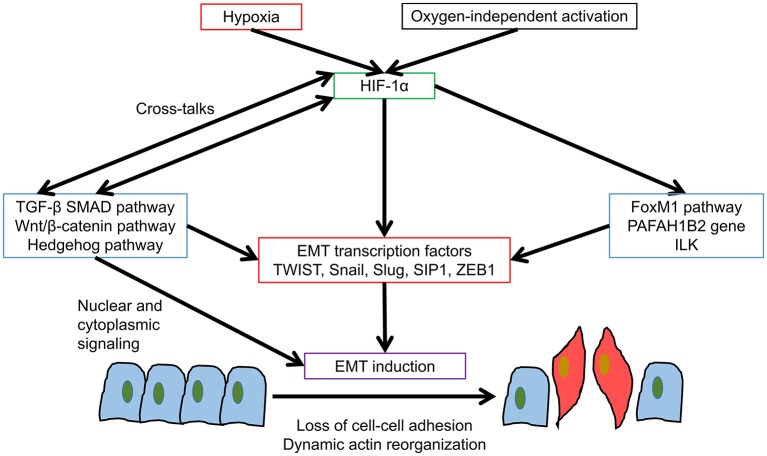
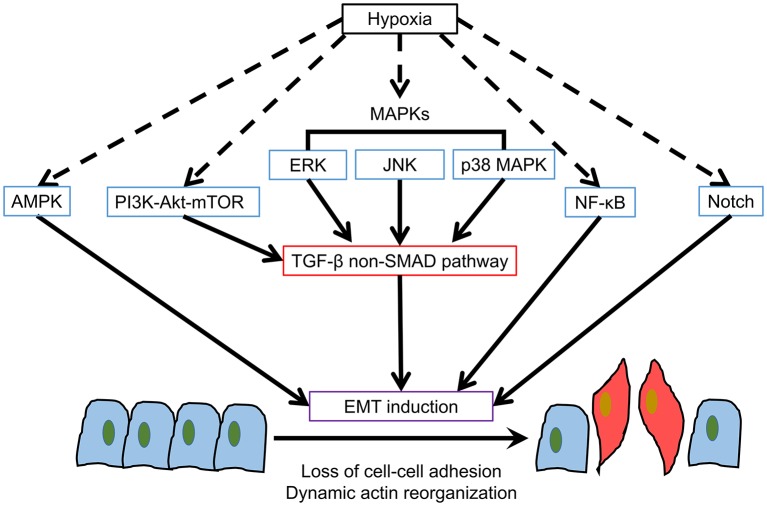
Metastasis is the main cause of cancer-related mortality. Although the actual process of metastasis remains largely elusive, epithelial-mesenchymal transition (EMT) has been considered as a major event in metastasis. Besides, hypoxia is common in solid cancers and has been considered as an important factor for adverse treatment outcomes including metastasis. Since EMT and hypoxia potentially share several signaling pathways, many recent studies focused on investigate the issue of hypoxia-induced EMT. Among all potential mediators of hypoxia-induced EMT, hypoxia-inducible factor-1α (HIF-1α) has been studied extensively. Moreover, there are other potential mediators that may also contribute to the process. This review aims to summarize the recent reports on hypoxia-induced EMT by HIF-1α or other potential mediators and provide insights for further investigations on this issue. Ultimately, better understanding of hypoxia-induced EMT may allow us to develop anti-metastatic strategies and improve treatment outcomes.
转移是癌症相关死亡的主要原因。尽管转移的实际过程在很大程度上仍不清楚,但上皮-间质转化(EMT)被认为是转移中的一个主要事件。此外,缺氧在实体癌中很常见,并被认为是包括转移在内的不良治疗结果的一个重要因素。由于EMT和缺氧可能共享几个信号通路,最近许多研究集中于调查缺氧诱导的EMT问题。在缺氧诱导的EMT的所有潜在介质中,缺氧诱导因子-1α(HIF-1α)已被广泛研究。此外,还有其他潜在介质也可能促成这一过程。本综述旨在总结最近关于HIF-1α或其他潜在介质诱导缺氧EMT的报道,并为该问题的进一步研究提供见解。最终,更好地理解缺氧诱导的EMT可能使我们能够制定抗转移策略并改善治疗结果。