Rackaityte Elze, Halkias Joanna
Biomedical Sciences Graduate Program, University of California, San Francisco, San Francisco, CA, United States.
Division of Neonatology, Department of Pediatrics, University of California, San Francisco, San Francisco, CA, United States.
Front Immunol. 2020 Apr 9;11:588. doi: 10.3389/fimmu.2020.00588. eCollection 2020.
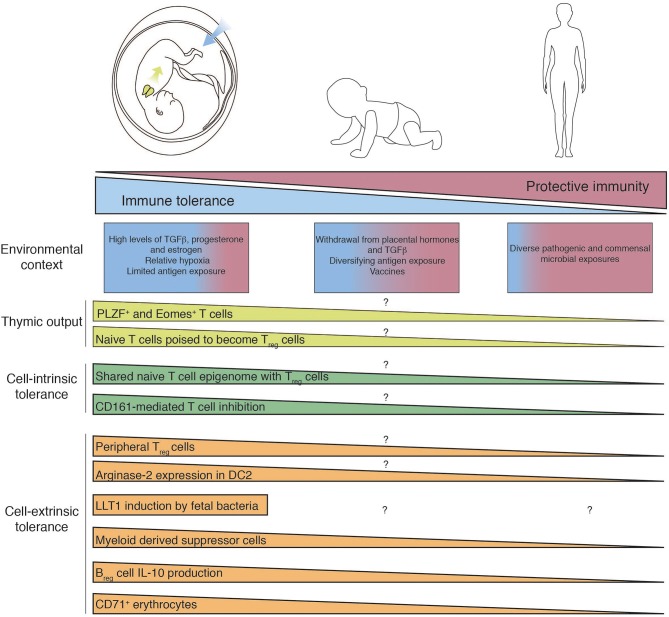
The developing human fetus generates both tolerogenic and protective immune responses in response to the unique requirements of gestation. Thus, a successful human pregnancy depends on a fine balance between two opposing immunological forces: the semi-allogeneic fetus learns to tolerate both self- and maternal- antigens and, in parallel, develops protective immunity in preparation for birth. This critical window of immune development bridges prenatal immune tolerance with the need for postnatal environmental protection, resulting in a vulnerable neonatal period with heightened risk of infection. The fetal immune system is highly specialized to mediate this transition and thus serves a different function from that of the adult. Adaptive immune memory is already evident in the fetal intestine. Fetal T cells with pro-inflammatory potential are born in a tolerogenic environment and are tightly controlled by both cell-intrinsic and -extrinsic mechanisms, suggesting that compartmentalization and specialization, rather than immaturity, define the fetal immune system. Dysregulation of fetal tolerance generates an inflammatory response with deleterious effects to the pregnancy. This review aims to discuss the recent advances in our understanding of the cellular and molecular composition of fetal adaptive immunity and the mechanisms that govern T cell development and function. We also discuss the tolerance promoting environment that impacts fetal immunity and the consequences of its breakdown. A greater understanding of fetal mechanisms of immune activation and regulation has the potential to uncover novel paradigms of immune balance which may be leveraged to develop therapies for transplantation, autoimmune disease, and birth-associated inflammatory pathologies.
发育中的人类胎儿会根据妊娠的独特需求产生耐受性和保护性免疫反应。因此,成功的人类妊娠取决于两种相反免疫力量之间的精细平衡:半同种异体胎儿学会耐受自身和母体抗原,同时发展保护性免疫以准备出生。这个关键的免疫发育窗口将产前免疫耐受与产后环境保护的需求联系起来,导致新生儿期易受感染,感染风险增加。胎儿免疫系统高度特化以介导这种转变,因此其功能与成人不同。适应性免疫记忆在胎儿肠道中已经很明显。具有促炎潜力的胎儿T细胞在耐受性环境中产生,并受到细胞内在和外在机制的严格控制,这表明分区化和特化而非不成熟定义了胎儿免疫系统。胎儿耐受性的失调会产生对妊娠有害的炎症反应。本综述旨在讨论我们对胎儿适应性免疫的细胞和分子组成以及控制T细胞发育和功能的机制的最新认识进展。我们还将讨论影响胎儿免疫的耐受性促进环境及其破坏的后果。对胎儿免疫激活和调节机制的更深入理解有可能揭示免疫平衡的新范式,这些范式可用于开发移植、自身免疫性疾病和与出生相关的炎症性疾病的治疗方法。