Atre Tanmaya, Reid Gregor S D
Michael Cuccione Childhood Cancer Research Program, BC Children's Hospital Research Institute, Vancouver, BC, Canada.
Department of Pediatrics, University of British Columbia, Vancouver, BC, Canada.
Front Immunol. 2025 May 28;16:1531145. doi: 10.3389/fimmu.2025.1531145. eCollection 2025.
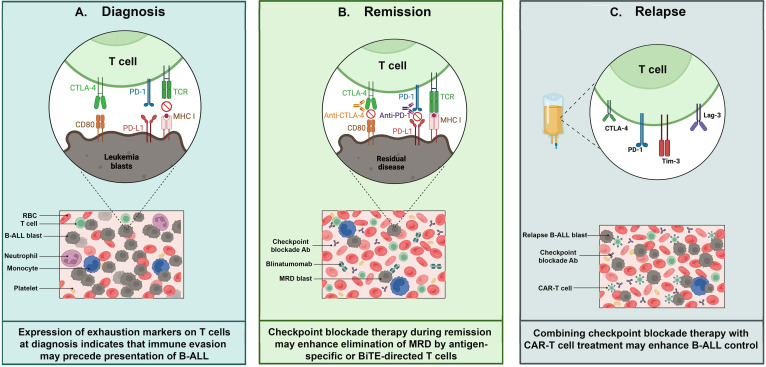
B-cell acute lymphoblastic leukemia (B-ALL) is the most common pediatric malignancy, accounting for 20-25% of all new cancer diagnoses in North American children each year. The leukemia arises, most commonly after a latency of 3-5 years, from a preleukemic B cell precursor population generated . Despite the generally low immunogenicity of B-ALL cells, emerging evidence implicates T cell exhaustion - a state marked by sustained expression of inhibitory receptors and progressive functional decline - as a contributor to disease progression. Expression of inhibitory receptors is frequently detected on T cells from children with B-ALL at diagnosis and during therapy. As T cell exhaustion presents an actionable target for enhancing protective immune activity, in this review we summarize evidence from both clinical and pre-clinical settings for T cell exhaustion during pediatric B-ALL progression and discuss the opportunities and challenges to incorporating immune checkpoint blockade into pediatric B-ALL therapy regimens.
B细胞急性淋巴细胞白血病(B-ALL)是最常见的儿童恶性肿瘤,每年占北美儿童所有新癌症诊断病例的20%-25%。这种白血病最常见于3-5年的潜伏期后,源自产生的白血病前期B细胞前体群体。尽管B-ALL细胞的免疫原性通常较低,但新出现的证据表明,T细胞耗竭——一种以抑制性受体持续表达和功能逐渐衰退为特征的状态——是疾病进展的一个因素。在诊断和治疗期间,经常在B-ALL患儿的T细胞上检测到抑制性受体的表达。由于T细胞耗竭为增强保护性免疫活性提供了一个可操作的靶点,在本综述中,我们总结了临床和临床前研究中关于儿童B-ALL进展过程中T细胞耗竭的证据,并讨论了将免疫检查点阻断纳入儿童B-ALL治疗方案的机遇和挑战。