Key Laboratory of Utilization and Conservation for Tropical Marine Bioresources of Ministry of Education, Hainan Tropical Ocean University, Sanya, China.
Key Laboratory of Tropical Marine Fishery Resources Protection and Utilization of Hainan Province, Hainan Tropical Ocean University, Sanya China.
PLoS One. 2020 Apr 24;15(4):e0232162. doi: 10.1371/journal.pone.0232162. eCollection 2020.
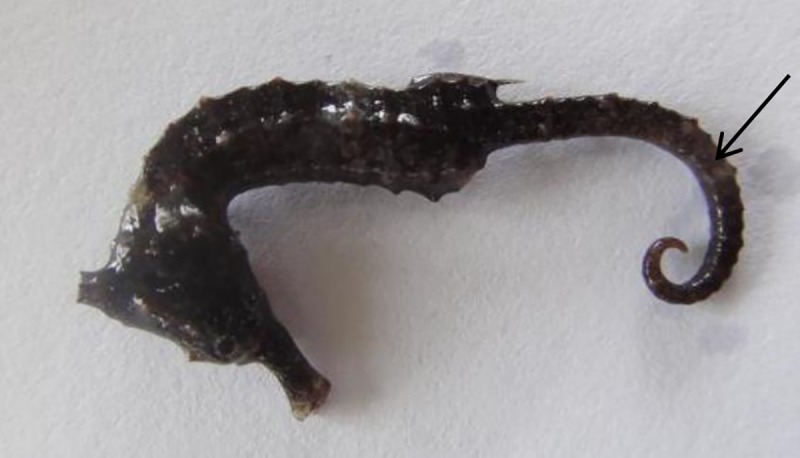
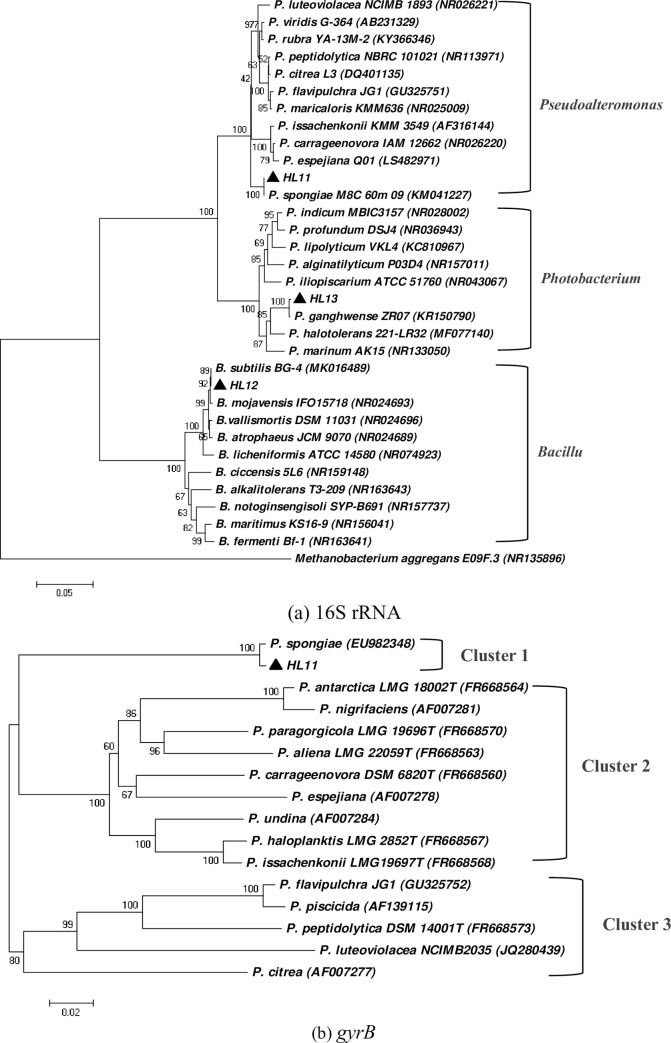
Tail rot disease is associated with major economic losses in the seahorse aquaculture in China. This study aimed to isolate and identify the pathogen causing tail rot disease in seahorses. Three culturable intestinal bacteria strains were isolated from Hippocampus kuda specimens with tail rot disease. Strain HL11, HL12, and HL13 were identified as Pseudoalteromonas spongiae, Bacillus subtilis and Photobacterium ganghwense based on its morphological characteristics, physiological and biochemical properties, through 16S rRNA and gyrB sequencing, respectively. Challenge experiments using these strains on healthy H. kuda and bacterial re-isolation from challenged diseased seahorses showed that the bacteria strain named HL11 induced identical pathological symptoms, indicating that it is the causative pathogen of the disease. Antibiotic-resistance tests against of 32 antibiotics revealed that HL11 was highly sensitive to 13 kinds, while exhibited intermediate susceptibility to 6, and resistance to 13 kinds. Antibacterial tests of the bioactive agents showed that HL11 was susceptible to five kinds, including tea polyphenols, lactic acid, gallic acid, allicin, and polylysine; however, it was not susceptible to the other 13 kinds of bioactive agents. The results demonstrate the potential of using bioactive agents to replace antibiotics to generate an environmentally friendly mode of culturing seahorses.
尾腐病是中国海马养殖中导致重大经济损失的主要疾病。本研究旨在分离和鉴定导致海马尾腐病的病原体。从患有尾腐病的海马标本中分离出三株可培养肠道细菌菌株。根据其形态特征、生理生化特性,通过 16S rRNA 和 gyrB 测序,菌株 HL11、HL12 和 HL13 分别被鉴定为海绵假交替单胞菌、枯草芽孢杆菌和江氏气单胞菌。用这些菌株对健康的 H. kuda 进行攻毒实验,并从攻毒患病海马中重新分离细菌,结果表明,命名为 HL11 的细菌菌株引起了相同的病理症状,表明其是该病的病原体。对 32 种抗生素的药敏试验表明,HL11 对 13 种抗生素高度敏感,对 6 种抗生素中度敏感,对 13 种抗生素耐药。生物活性物质的抑菌试验表明,HL11 对 5 种生物活性物质敏感,包括茶多酚、乳酸、没食子酸、大蒜素和聚赖氨酸;然而,它对其他 13 种生物活性物质不敏感。结果表明,使用生物活性物质替代抗生素来产生一种环保的海马养殖模式具有潜力。