Amsalem Zohar, Arif Tasleem, Shteinfer-Kuzmine Anna, Chalifa-Caspi Vered, Shoshan-Barmatz Varda
Department of Life Sciences, Ben-Gurion University of the Negev, Beer-Sheva 84105, Israel.
National Institute for Biotechnology in the Negev, Ben-Gurion University of the Negev, Beer-Sheva 84105, Israel.
Cancers (Basel). 2020 Apr 22;12(4):1031. doi: 10.3390/cancers12041031.
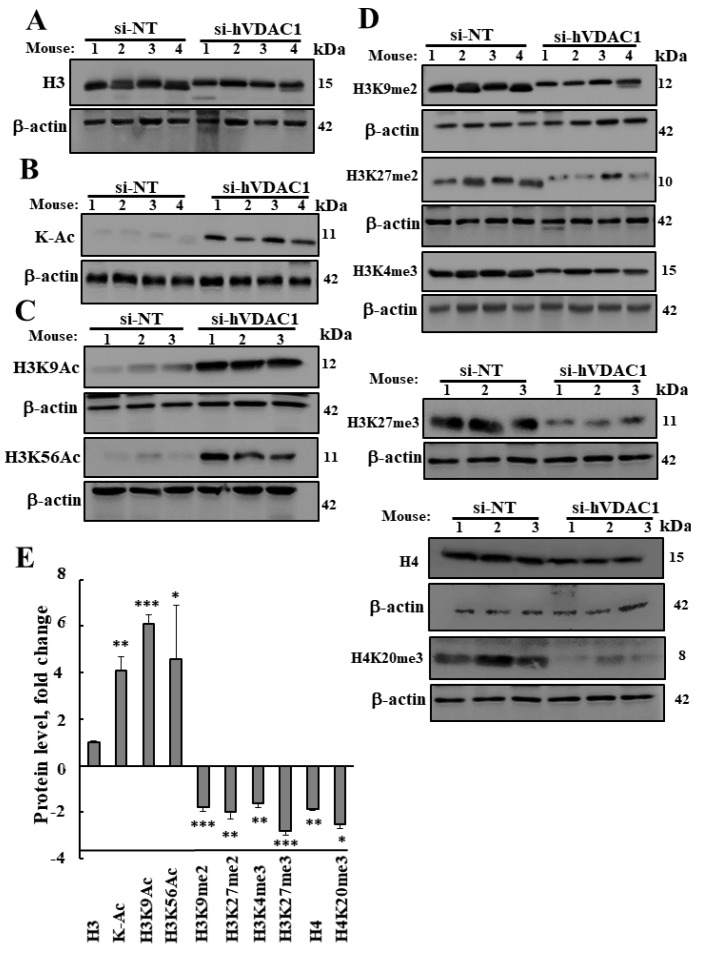
Carcinogenesis is a complicated process that involves the deregulation of epigenetics, resulting in cellular transformational events, such as proliferation, differentiation, and metastasis. Most chromatin-modifying enzymes utilize metabolites as co-factors or substrates and thus are directly dependent on such metabolites as acetyl-coenzyme A, S-adenosylmethionine, and NAD+. Here, we show that using specific siRNA to deplete a tumor of VDAC1 not only led to reprograming of the cancer cell metabolism but also altered several epigenetic-related enzymes and factors. VDAC1, in the outer mitochondrial membrane, controls metabolic cross-talk between the mitochondria and the rest of the cell, thus regulating the metabolic and energetic functions of mitochondria, and has been implicated in apoptotic-relevant events. We previously demonstrated that silencing VDAC1 expression in glioblastoma (GBM) U-87MG cell-derived tumors, resulted in reprogramed metabolism leading to inhibited tumor growth, angiogenesis, epithelial-mesenchymal transition and invasiveness, and elimination of cancer stem cells, while promoting the differentiation of residual tumor cells into neuronal-like cells. These VDAC1 depletion-mediated effects involved alterations in transcription factors regulating signaling pathways associated with cancer hallmarks. As the epigenome is sensitive to cellular metabolism, this study was designed to assess whether depleting VDAC1 affects the metabolism-epigenetics axis. Using DNA microarrays, q-PCR, and specific antibodies, we analyzed the effects of si-VDAC1 treatment of U-87MG-derived tumors on histone modifications and epigenetic-related enzyme expression levels, as well as the methylation and acetylation state, to uncover any alterations in epigenetic properties. Our results demonstrate that metabolic rewiring of GBM via VDAC1 depletion affects epigenetic modifications, and strongly support the presence of an interplay between metabolism and epigenetics.
癌症发生是一个复杂的过程,涉及表观遗传学失调,导致细胞转化事件,如增殖、分化和转移。大多数染色质修饰酶利用代谢物作为辅助因子或底物,因此直接依赖于诸如乙酰辅酶A、S-腺苷甲硫氨酸和NAD+等代谢物。在这里,我们表明,使用特异性小干扰RNA(siRNA)耗尽肿瘤中的电压依赖性阴离子通道1(VDAC1)不仅导致癌细胞代谢重编程,还改变了几种表观遗传相关酶和因子。位于线粒体外膜的VDAC1控制线粒体与细胞其他部分之间的代谢串扰,从而调节线粒体的代谢和能量功能,并与凋亡相关事件有关。我们之前证明,在胶质母细胞瘤(GBM)U-87MG细胞衍生的肿瘤中沉默VDAC1表达会导致代谢重编程,从而抑制肿瘤生长、血管生成、上皮-间质转化和侵袭,并消除癌症干细胞,同时促进残留肿瘤细胞分化为神经元样细胞。这些VDAC1缺失介导的效应涉及调节与癌症特征相关信号通路的转录因子的改变。由于表观基因组对细胞代谢敏感,本研究旨在评估耗尽VDAC1是否会影响代谢-表观遗传学轴。我们使用DNA微阵列、定量聚合酶链反应(q-PCR)和特异性抗体,分析了用si-VDAC1处理U-87MG衍生肿瘤对组蛋白修饰和表观遗传相关酶表达水平以及甲基化和乙酰化状态的影响,以揭示表观遗传特性的任何改变。我们的结果表明,通过耗尽VDAC1对GBM进行代谢重塑会影响表观遗传修饰,并有力地支持了代谢与表观遗传学之间存在相互作用。