Institute for Marine and Antarctic Studies, University of Tasmania, Hobart, Australia.
ARC Centre of Excellence for Climate System Science, Hobart, Australia.
Nat Commun. 2020 Apr 24;11(1):2008. doi: 10.1038/s41467-020-15754-3.
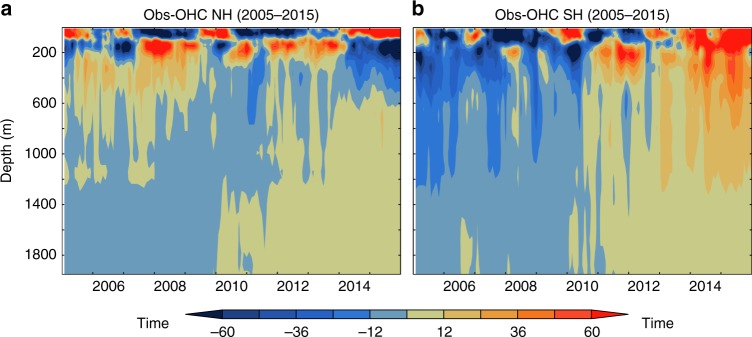
Recent research shows that 90% of the net global ocean heat gain during 2005-2015 was confined to the southern hemisphere with little corresponding heat gain in the northern hemisphere ocean. We propose that this heating pattern of the ocean is driven by anthropogenic climate change and an asymmetric climate variation between the two hemispheres. This asymmetric variation is found in the pre-industrial control simulations from 11 climate models. While both layers (0-700 m and 700-2000 m) experience steady anthropogenic warming, the 0-700 m layer experiences large internal variability, which primarily drives the observed hemispheric asymmetry of global ocean heat gain in 0-2000 m layer. We infer that the rate of global ocean warming is consistent with the climate simulations for this period. However, the observed hemispheric asymmetry in heat gain can be explained by the Earth's internal climate variability without invoking alternate hypotheses, such as asymmetric aerosol loading.
最近的研究表明,在 2005 年至 2015 年期间,全球海洋净热量的 90%都集中在南半球,而北半球海洋的相应热量增加很少。我们提出,海洋的这种加热模式是由人为气候变化和两个半球之间的非对称气候变化驱动的。这种非对称变化在 11 个气候模型的工业化前控制模拟中都有发现。虽然两层(0-700 米和 700-2000 米)都经历着稳定的人为变暖,但 0-700 米层经历着较大的内部变率,这主要导致了观测到的全球海洋在 0-2000 米层中热量的半球非对称性。我们推断,在这一时期,全球海洋变暖的速度与气候模拟是一致的。然而,观测到的热量获取的半球非对称性可以用地球内部气候变率来解释,而无需援引替代假设,如非对称气溶胶负荷。