Department of Neuroradiology, Heidelberg University Hospital, Heidelberg, Germany.
Amyloidosis Center Heidelberg, Heidelberg University Hospital, Heidelberg, Germany.
Ann Clin Transl Neurol. 2020 May;7(5):799-807. doi: 10.1002/acn3.51049. Epub 2020 Apr 25.
To quantify peripheral nerve lesions in symptomatic and asymptomatic hereditary transthyretin amyloidosis with polyneuropathy (ATTRv-PNP) by analyzing the magnetization transfer ratio (MTR) of the sciatic nerve, and to test its potential as a novel biomarker for macromolecular changes.
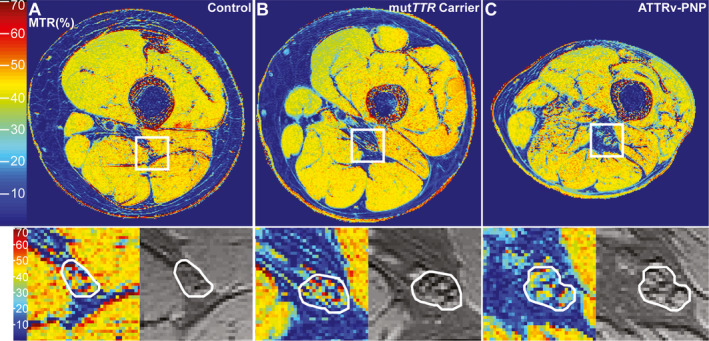
Twenty-five patients with symptomatic ATTRv-PNP, 30 asymptomatic carriers of the mutant transthyretin gene (mutTTR), and 20 age-/sex-matched healthy controls prospectively underwent magnetization transfer contrast imaging at 3 Tesla. Two axial three-dimensional gradient echo sequences with and without an off-resonance saturation rapid frequency pulse were conducted at the right distal thigh. Sciatic nerve regions of interest were manually drawn on 10 consecutive axial slices in the images without off-resonance saturation, and then transferred to the corresponding slices that were generated by the sequence with the off-resonance saturation pulse. Subsequently, the MTR and cross-sectional area (CSA) of the sciatic nerve were evaluated. Detailed neurologic and electrophysiologic examinations were conducted in all ATTRv-PNP patients and mutTTR-carriers.
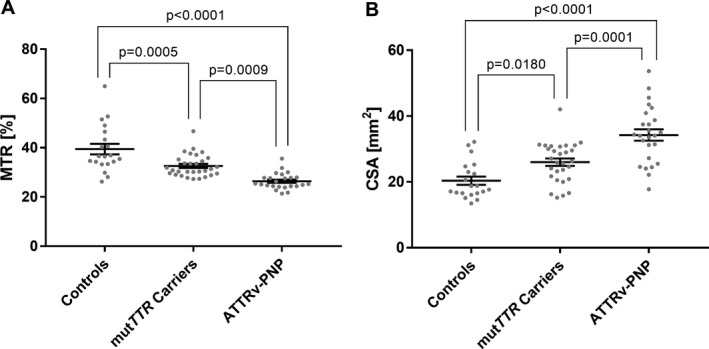
Sciatic nerve MTR and CSA reliably differentiated between ATTRv-PNP, mutTTR-carriers, and controls. MTR was lower in ATTRv-PNP (26.4 ± 0.7; P < 0.0001) and in mutTTR-carriers (32.6 ± 0.8; P = 0.0005) versus controls (39.4 ± 2.1), and was also lower in ATTRv-PNP versus mutTTR-carriers (P = 0.0009). MTR correlated negatively with the NIS-LL and positively with CMAPs and SNAPs. CSA was higher in ATTRv-PNP (34.3 ± 1.7 mm ) versus mutTTR-carriers (26.0 ± 1.1 mm ; P = 0.0005) and versus controls (20.4 ± 1.2 mm ; P < 0.0001). CSA was also higher in mutTTR-carriers versus controls.
MTR is a novel imaging marker that can quantify macromolecular changes in ATTRv-PNP and differentiate between symptomatic ATTRv-PNP and asymptomatic mutTTR-carriers and correlates with electrophysiology.
通过分析坐骨神经的磁化传递率(MTR),定量检测有症状和无症状遗传性转甲状腺素蛋白淀粉样变多发性神经病(ATTRv-PNP)患者的周围神经病变,并测试其作为一种新的用于检测大分子变化的生物标志物的潜力。
25 名有症状的 ATTRv-PNP 患者、30 名携带突变转甲状腺素蛋白基因(mutTTR)的无症状携带者和 20 名年龄和性别匹配的健康对照者前瞻性地在 3T 磁共振扫描仪上进行磁共振转移对比成像。在右侧大腿的两个轴向三维梯度回波序列中进行了带有和不带离频饱和快速频率脉冲的序列扫描。在无离频饱和的图像上手动绘制 10 个连续轴向切片的坐骨神经感兴趣区(ROI),然后将其转移到带有离频饱和脉冲的序列生成的相应切片上。随后,评估坐骨神经的 MTR 和横截面积(CSA)。所有 ATTRv-PNP 患者和 mutTTR 携带者均进行了详细的神经和电生理检查。
坐骨神经 MTR 和 CSA 可靠地区分了 ATTRv-PNP、mutTTR 携带者和对照组。ATTRv-PNP(26.4 ± 0.7;P < 0.0001)和 mutTTR 携带者(32.6 ± 0.8;P = 0.0005)的 MTR 低于对照组(39.4 ± 2.1),ATTRv-PNP 的 MTR 也低于 mutTTR 携带者(P = 0.0009)。MTR 与 NIS-LL 呈负相关,与 CMAPs 和 SNAPs 呈正相关。与 mutTTR 携带者(26.0 ± 1.1 mm;P = 0.0005)和对照组(20.4 ± 1.2 mm;P < 0.0001)相比,ATTRv-PNP 的 CSA 更高。与对照组相比,mutTTR 携带者的 CSA 也更高。
MTR 是一种新的成像标志物,可定量检测 ATTRv-PNP 中的大分子变化,并区分有症状的 ATTRv-PNP 和无症状的 mutTTR 携带者,与电生理学相关。