Department of Medicine, University of British Columbia, Vancouver, BC, Canada; Centre for Heart Lung Innovation, St. Paul's Hospital, Vancouver, BC, Canada.
Sunnybrook Health Sciences Centre, Department of Medicine, University of Toronto, Toronto, ON, Canada.
Chest. 2020 Sep;158(3):1069-1078. doi: 10.1016/j.chest.2020.04.019. Epub 2020 Apr 22.
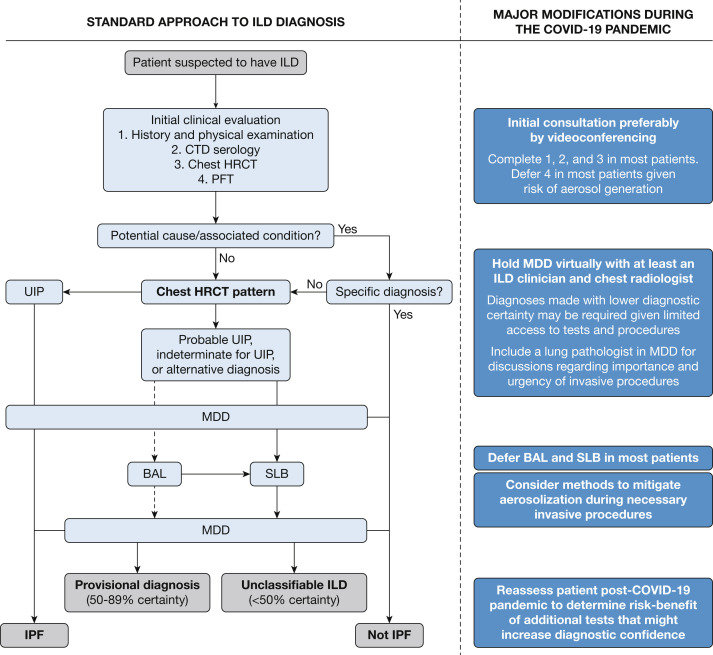
The coronavirus disease 2019 (COVID-19) pandemic, caused by severe acute respiratory syndrome coronavirus 2, has affected virtually all aspects of patient care. Health-care systems around the world are trying simultaneously to treat patients with COVID-19, prepare for its long-term impacts, and treat patients with other acute and chronic diseases. There are multiple ways that the COVID-19 pandemic will directly affect patients with fibrotic interstitial lung disease (ILD), particularly given their common risk factors for poor outcomes. Major issues for patients with ILD will include restricted access to key components of the diagnostic process, new uncertainties in the use of common ILD pharmacotherapies, limited ability to monitor both disease severity and the presence of medication adverse effects, and significantly curtailed research activities. The purpose of this review is to summarize how COVID-19 has impacted key components of the diagnosis and management of fibrotic ILD as well as to provide strategies to mitigate these challenges. We further review major obstacles for researchers and identify priority areas for future ILD research related to COVID-19. Our goals are to provide practical considerations to support the care of patients with ILD during the COVID-19 pandemic and to provide a road map for clinicians caring for these patients during future infectious disease outbreaks.
新型冠状病毒病 2019(COVID-19)大流行是由严重急性呼吸系统综合征冠状病毒 2 引起的,几乎影响到患者护理的各个方面。世界各地的医疗保健系统正试图同时治疗 COVID-19 患者,为其长期影响做准备,并治疗患有其他急性和慢性疾病的患者。COVID-19 大流行将通过多种方式直接影响肺纤维化间质性肺病(ILD)患者,尤其是鉴于他们常见的不良预后风险因素。ILD 患者的主要问题包括难以获得诊断过程的关键部分,ILD 常用药物治疗方法的应用存在新的不确定性,监测疾病严重程度和药物不良反应的能力有限,以及研究活动大大减少。本综述的目的是总结 COVID-19 如何影响肺纤维化 ILD 的诊断和管理的关键部分,并提供减轻这些挑战的策略。我们进一步审查了研究人员的主要障碍,并确定了与 COVID-19 相关的未来 ILD 研究的优先领域。我们的目标是为 COVID-19 大流行期间照顾 ILD 患者提供实用考虑因素,并为照顾这些患者的临床医生在未来传染病爆发期间提供路线图。