IrsiCaixa AIDS Research Institute, Badalona, Spain.
Fight AIDS Foundation (FLS), Infectious Disease Service, Germans Trias i Pujol University Hospital, Badalona, Spain.
J Antimicrob Chemother. 2020 Aug 1;75(8):2258-2263. doi: 10.1093/jac/dkaa139.
Initiation of combination antiretroviral therapy (cART) soon after HIV-1 infection limits the establishment of viral reservoirs. Thus, early treated individuals are preferred candidates to evaluate novel viral remission strategies. However, their cART-dependent HIV-1 DNA decay dynamics are still poorly defined. This can hamper the design and interpretation of results from clinical trials intended to further reduce viral reservoirs.
To clarify the duration of cART needed for the HIV-1 reservoir to be stabilized in early treated individuals.
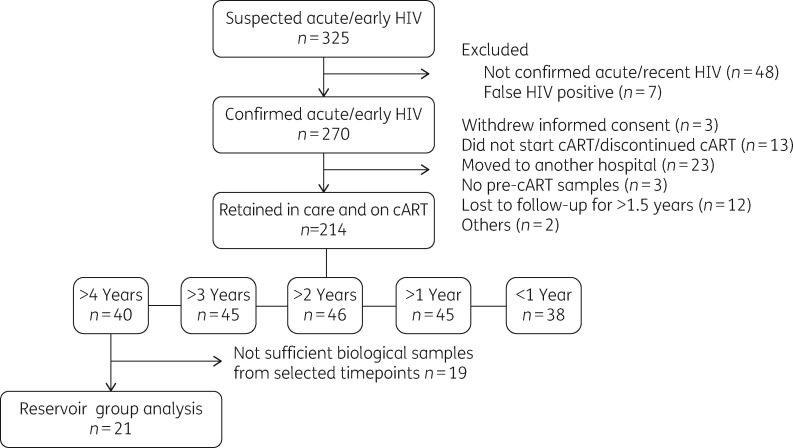
We characterized the longitudinal decline of total HIV-1 DNA levels by droplet digital PCR in 21 individuals initiating cART within 6 months after estimated HIV-1 acquisition. Measurements were taken at cART initiation, after 6 months and annually until Year 4. Correlations between virological and clinical parameters were statistically analysed. Statistical modelling was performed applying a mixed-effects model.
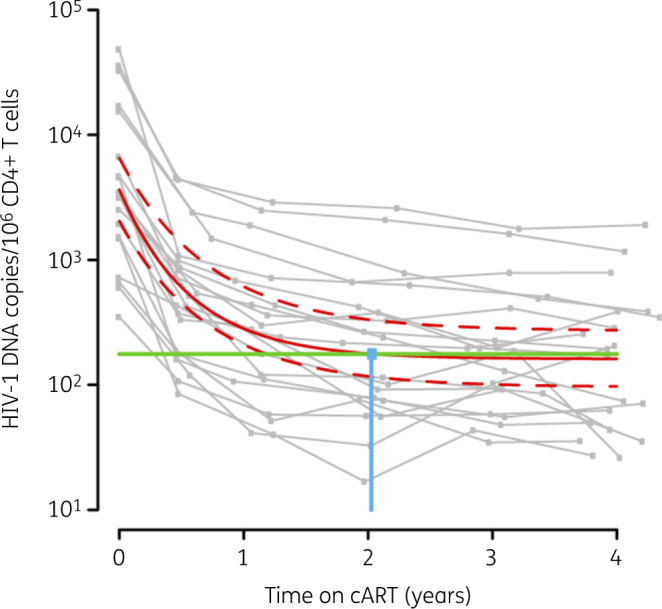
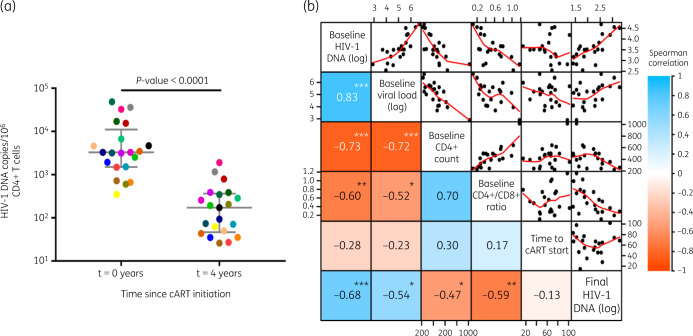
Total HIV-1 DNA experienced a median overall decrease of 1.43 log10 units (IQR = 1.17-1.69) throughout the 4 years of follow-up. Baseline levels for total HIV-1 DNA, viral load, absolute CD4+ T cell count and CD4+/CD8+ ratio correlate with final HIV-1 DNA measurements (R2 = 0.68, P < 0.001; R2 = 0.54, P = 0.012; R2 = -0.47, P = 0.031; and R2 = -0.59, P = 0.0046, respectively). Statistical modelling shows that after 2 years on cART the viral reservoir had reached a set point.
A waiting period of 2 years on cART should be considered when designing interventions aiming to impact latent HIV-1 reservoir levels and viral rebound kinetics after cART discontinuation, in order to facilitate interpretation of results and enhance the chance of viral control.
在 HIV-1 感染后不久启动联合抗逆转录病毒治疗(cART)可限制病毒库的建立。因此,早期治疗的个体是评估新型病毒缓解策略的首选候选者。然而,他们依赖 cART 的 HIV-1 DNA 衰减动力学仍未得到充分定义。这可能会阻碍旨在进一步减少病毒库的临床试验的设计和解释。
阐明在早期治疗的个体中,cART 需要多长时间才能稳定 HIV-1 库。
我们通过液滴数字 PCR 对 21 名在估计 HIV-1 获得后 6 个月内开始 cART 的个体进行了纵向研究,以描述总 HIV-1 DNA 水平的下降。在 cART 开始时、6 个月后和每年进行测量,直到第 4 年。对病毒学和临床参数之间的相关性进行了统计学分析。应用混合效应模型进行统计建模。
在 4 年的随访中,总 HIV-1 DNA 中位数总体下降了 1.43log10 单位(IQR=1.17-1.69)。总 HIV-1 DNA、病毒载量、绝对 CD4+T 细胞计数和 CD4+/CD8+比值的基线水平与最终 HIV-1 DNA 测量值相关(R2=0.68,P<0.001;R2=0.54,P=0.012;R2=-0.47,P=0.031;和 R2=-0.59,P=0.0046,分别)。统计模型显示,在接受 cART 治疗 2 年后,病毒库已达到稳定点。
在设计旨在影响潜伏 HIV-1 库水平和 cART 停药后病毒反弹动力学的干预措施时,应考虑在 cART 上等待 2 年,以便于解释结果并提高病毒控制的机会。